• Write for Us
  • Advertise
  • Tools
  • About
  • Contact
Cryptech Today
  • News
    • Market Watch
    • Policy & Regulation
    • Geopolitics & Economy
    • Security & Risks
  • Blockchain & Web3
  • Finance & Fintech
    • Cryptocurrency
    • Fintech & Digital Finance
  • Voices
    • Events & Interviews
    • People & Companies
No Result
View All Result
tokenomist ai
Cryptech Today
  • News
    • Market Watch
    • Policy & Regulation
    • Geopolitics & Economy
    • Security & Risks
  • Blockchain & Web3
  • Finance & Fintech
    • Cryptocurrency
    • Fintech & Digital Finance
  • Voices
    • Events & Interviews
    • People & Companies
No Result
View All Result
Cryptech Today
No Result
View All Result
Home Market Watch Central Bank Digital Currency (CBDC)

China bans all crypto: What it really means for the global market

A Familiar Shockwave with Global Consequences

Pranav Joshi by Pranav Joshi
June 11, 2025
in Central Bank Digital Currency (CBDC), Cryptocurrency, Geopolitics & Economy, Policy & Regulation
0
China Bans All Crypto (Again?): What It Really Means for the Global Market
78
SHARES
1.3k
VIEWS
Share on FacebookShare on Twitter

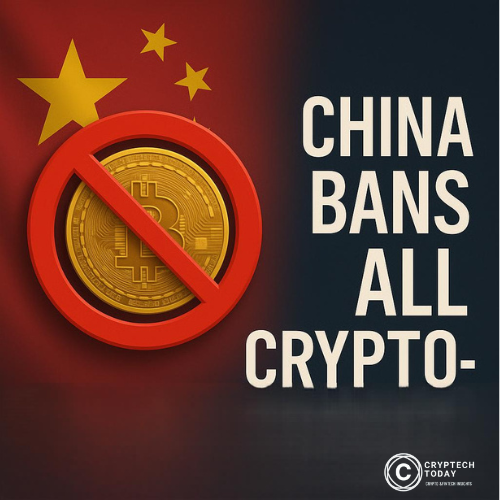
China bans all crypto: The country has reportedly announced a blanket ban on all cryptocurrency-related operations. From trading and mining to even holding crypto assets, every aspect of digital currency usage appears to have been outlawed within its borders. The news hit global markets fast, sending shockwaves across exchanges and triggering waves of uncertainty.

Table of Contents

Toggle
  • You might also like
  • Uzbekistan Crypto Regulation: NAPP License Guide
  • Argentina Crypto License VASP Guide 2026
  • UK FCA Crypto Regulation: 2026-2027 Rules Guide
  • China bans all crypto: Did China really impose a wide ban?
  • Why is China so hostile to crypto?
  • When China leaves, others step in
  • How the market reacted — And why it matters
  • So, should Chinese crypto owners be worried?

You might also like

Uzbekistan Crypto Regulation: NAPP License Guide

Argentina Crypto License VASP Guide 2026

UK FCA Crypto Regulation: 2026-2027 Rules Guide

In a matter of hours, Bitcoin’s price plunged from $111,000 to $104,000. Ethereum lost nearly 7% of its value. Major crypto exchanges were flooded with withdrawal requests. As investors rushed for safety, demand for stablecoins like USDT surged. While the reaction was intense, it wasn’t entirely unexpected. China’s relationship with crypto has always been rocky, with repeated crackdowns over the past decade.

But this time, the ban feels different — not just in its scope, but in what it reveals about the global shift in digital finance.

China bans all crypto: Did China really impose a wide ban?

According to early media reports, Chinese authorities have taken the most aggressive step yet by banning every form of crypto engagement. This includes mining operations, digital token trading, holding coins in private wallets, and using both domestic and foreign crypto exchanges. There are even suggestions that Chinese citizens who hold crypto overseas could be subject to investigation.

However, there’s a significant catch. These reports cite sources ranging from social media to Binance Square (a user-driven platform, not an official Binance source). However, China’s primary regulatory authorities have not issued any official statements. These official authorities include the People’s Bank of China, the Cyberspace Administration of China, and the State Administration of Foreign Exchange. The lack of official documentation raises issues about the narrative’s veracity and aim.

This has led many analysts to wonder if this is truly a new ban or simply a resurgence of older policies amplified by media and market sentiment.

Why is China so hostile to crypto?

The Chinese government officially claims that the crackdown is aimed at reducing financial crime, preventing capital flight, and maintaining economic order — concerns cited in earlier bans as well. But beneath these explanations lies a deeper motive: the rise of the digital yuan.

China has led the way among global economies in establishing a Central Bank Digital Currency (CBDC). Its Digital Yuan is fully state-controlled, traceable, and programmable. Decentralized cryptocurrencies like Bitcoin and Ethereum stand in direct contrast to this model. As such, crypto poses not just a technical threat — but a philosophical one. China doesn’t want a parallel financial system; it wants total monetary sovereignty.

So, this latest clampdown may have less to do with protecting citizens and more with eliminating rivals to the state-controlled Digital Yuan.

When China leaves, others step in

Interestingly, China’s retreat from the crypto space often creates opportunities for other nations, especially those looking to attract capital, innovation, or infrastructure investment.

This isn’t just a theory — we’ve seen it happen.

Back in 2021, when China banned Bitcoin mining, many miners moved their operations abroad. One surprising destination was Iran, where cheap electricity and a looser regulatory framework allowed miners to flourish. According to a report by Elliptic and Cambridge Centre for Alternative Finance, Iran accounted for nearly 5% of global Bitcoin mining activity at one point.

And now, as China targets crypto ownership, new contenders are emerging. Pakistan is among the most significant.

Pakistan, which was once extremely distrustful of cryptocurrencies, is now showing a shift. The country’s Securities and Exchange Commission has been working on a regulatory framework to recognise and oversee crypto assets. In 2024 and early 2025, Pakistani officials hinted at reforms aimed at embracing digital finance as a tool for economic inclusion and tech innovation.

This suggests a growing trend: where one country bans, another builds.

How the market reacted — And why it matters

The market reaction to China’s decision was swift and dramatic. Prices plunged, investors panicked, and exchanges reported a flurry of activity. However, this was not the first instance, and it is unlikely to be the last.

Crypto veterans recognise this as a familiar pattern. Historically, such news is often followed by a period of recovery and, in many cases, strong rallies. When retail investors panic, institutional buyers often see an opportunity. This phenomenon — sometimes referred to as “buying the fear” — has played out time and again, especially in reaction to regulatory uncertainty.

More importantly, it shows the resilience of decentralised systems. While national bans may cause short-term disruption, they rarely stop innovation or adoption in the long run.

So, should Chinese crypto owners be worried?

If one is in China, holding crypto may now come with serious legal consequences. But for the global community, this moment is less about fear and more about perspective.

Cryptocurrency was designed to be borderless, censorship-resistant, and decentralised. Every time a government tries to suppress it, it only reinforces why it matters in the first place. And as long as crypto can migrate — whether to Iran for mining or Pakistan for innovation — it will continue to evolve.

The important thing for investors is not to react to rumours, but to understand the deeper currents. Markets overreact in the short term but correct themselves over time. The best course of action is to remain grounded and educated.


 

Tags: BitcoinBitcoin miningChina cryptocurrencyCyberspace Administration of ChinaDigital YuanEthereumIranPakistanPeople's Bank of ChinaState Administration of Foreign ExchangeUSDT
Share31Tweet20
Pranav Joshi

Pranav Joshi

A blockchain book author and crypto expert, dedicated to making cryptocurrency simple for everyone — byte by byte.

Recommended For You

Uzbekistan Crypto Regulation: NAPP License Guide

by Aarav Prakash
August 30, 2026
0
Concept illustration showing Uzbekistan crypto regulation, NAPP licensing tiers, and solar mining infrastructure

While Western regulators fight in courtrooms, Uzbekistan quietly built Central Asia's most structured crypto regime. With dedicated licenses for retail crypto shops, solar-only mining mandates, and a 2035...

Read moreDetails

Argentina Crypto License VASP Guide 2026

by Aarav Prakash
August 30, 2026
0
Concept illustration showing Argentina crypto licensing and VASP regulation under the CNV framework

While most nations debate crypto theory, Argentina uses digital dollars to survive inflation. Now, the Milei administration and the CNV have built a formal supervisory regime balancing FATF...

Read moreDetails

UK FCA Crypto Regulation: 2026-2027 Rules Guide

by Aarav Prakash
August 30, 2026
0
Illustration showing UK FCA cryptoasset regulation framework linking traditional London financial markets to blockchain compliance

The era of lightweight anti-money laundering registrations is over. The UK Financial Conduct Authority is bringing crypto directly into the Financial Services and Markets Act perimeter. Here is...

Read moreDetails

iCA Regulation Europe: What Crypto Users Must Know in 2026

by Pranav Joshi
August 29, 2026
0
iCA Regulation Europe: What Crypto Users Must Know in 2026

The EU has replaced a patchwork of national crypto rules with one unified framework. MiCA is live. If you hold crypto on a European exchange, use stablecoins, or...

Read moreDetails

Bitcoin vs Ethereum: Which Is the Better Investment in 2026?

by Pranav Joshi
August 29, 2026
0
Bitcoin vs Ethereum: Which Is the Better Investment in 2026?

Bitcoin is the cleaner, simpler bet. Ethereum is the more complex, higher-upside wager that on-chain applications will become core financial infrastructure. For most people: BTC first, ETH as...

Read moreDetails
Next Post
Behind the Vault How a Security Firm Was Fronting a $123M Crypto Laundering Network

Behind the vault: The case of the $123mn crypto-laundering ops

Related News

Chart showing Bitcoin price surging above $75K with indicators of short liquidations.

Bitcoin Price Surge Above $75K Triggers Short Liquidations

April 14, 2026
Delegates discussing cryptocurrency regulation at the AML/CFT Forum in Paraguay.

TRON DAO Contributes to Regulatory Talks at AML/CFT Forum in Paraguay

March 19, 2026
A person holding a phone displaying cryptocurrency symbols and financial graphs.

Canada’s Bill C-25 Proposes Ban on Cryptocurrency Donations

April 28, 2026

Browse by Category

  • BlockBasics
  • Blockchain
  • Blockchain & Web3
  • Central Bank Digital Currency (CBDC)
  • Crypto
  • Crypto Now
  • Cryptocurrency
  • Ethereum
  • Finance
  • Fintech & Digital Finance
  • Geopolitics & Economy
  • GreenLedger
  • Inside CrypTechToday
  • Investing
  • Legal & Business Pages
  • Market Watch
  • People & Companies
  • Policy & Regulation
  • Politics
  • Security & Risks
  • Technology
  • World
cryptechtoday

CrypTechToday is a digital platform covering cryptocurrency, blockchain, and global finance, combined with practical tools for real-world crypto use.

  • About Us
  • Tools
  • Privacy Policy
  • Terms of Service
  • Disclosure
  • Cookie Policy
  • Disclaimer
  • Contact Us
  • Write for Us
  • Advertise
  • Tools
  • About
  • Contact

© 2025 CrypTechToday All rights reserved.

No Result
View All Result
  • News
    • Market Watch
    • Policy & Regulation
    • Geopolitics & Economy
    • Security & Risks
  • Blockchain & Web3
  • Finance & Fintech
    • Cryptocurrency
    • Fintech & Digital Finance
  • Voices
    • Events & Interviews
    • People & Companies

© 2025 CrypTechToday All rights reserved.

Are you sure want to unlock this post?
Unlock left : 0
Are you sure want to cancel subscription?