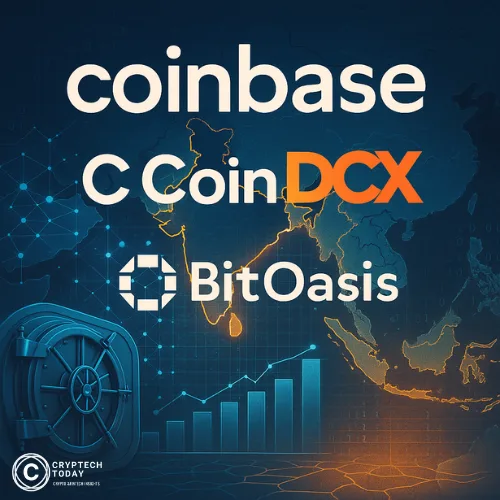
On October 14–15, 2025, Coinbase Global announced a fresh investment in Indian exchange CoinDCX, lifting the platform to a $2.45 billion post-money valuation and marking a clear escalation from prior venture activity by Coinbase Ventures. The Coinbase investment in CoinDCX is explicitly framed as a strategic commitment to two high-growth markets, India and the Middle East, and comes as CoinDCX reports robust 2025 financials even after dealing with a July security breach.
What happened
Coinbase’s move is fresh capital into CoinDCX, not merely a secondary share purchase. The transaction builds on Coinbase Ventures’ earlier backing and represents the first time Coinbase Global itself has doubled down in this way on an Indian exchange. Company statements stress the strategic rationale: large, fast-growing user bases, rising on-chain activity in the region, and regulatory openings that make India and MENA priority markets. The deal is subject to regulatory approvals and closing conditions. (Coinbase)
Why the valuation jump matters
A post-money valuation of $2.45 billion tops CoinDCX’s April 2022 valuation of $2.15 billion and sends two signals. First, global incumbents view India as a top-tier market for crypto adoption and product expansion; second, Coinbase is shifting from passive investor to active regional partner. For Coinbase, this is less about headline multiples and more about strategic footprint: local market know-how, regulatory navigation, and access to MENA flows via CoinDCX’s BitOasis unit. Reuters and Coinbase’s own blog emphasised the market-building rationale.
CoinDCX by the numbers (why investors leaned in)
CoinDCX has shown the operating metrics that justify institutional appetite. As of mid-2025, the company disclosed annualised group revenue of about ₹1,179 crore (~$141m), assets under custody of nearly ₹10,000 crore (~$1.2bn) and annualised transaction volumes of roughly ₹13.7 lakh crore (~$165bn). The platform reports over 20 million users across India and the UAE, and a broad product set including 500+ assets and 200+ trading pairs. These metrics, supplied by CoinDCX and picked up by major outlets, created a credible financial base for Coinbase to expand its stake. (CoinDCX)
The timing — after a security incident
This financing arrives months after a high-profile operational breach in July 2025 that drained roughly $44 million from an internal CoinDCX operational account. CoinDCX and industry trackers say user funds were not affected; the firm covered losses from treasury reserves and launched a large recovery bounty program. The incident triggered scrutiny about internal controls and disclosure timing, but was followed by visible remediation and public financial disclosure that arguably helped restore investor confidence. Coinbase’s investment, therefore, reads as a vote of confidence that the exchange’s security and governance fixes are credible.
The MENA angle: BitOasis and regional scale
CoinDCX’s 2024 acquisition of BitOasis, a leading MENA trading platform, is central to the thesis behind the Coinbase investment. BitOasis gives CoinDCX immediate regulated access across the Middle East. Since the acquisition, BitOasis has expanded (including a licensed launch in Bahrain) and now contributes meaningfully to group revenue. Coinbase’s note and press coverage underscore that the combined India + MENA corridor is attractive because of cross-border flows, remittances and an emerging institutional market in Gulf states. For Coinbase, partnering with a local champion accelerates market entry while avoiding the “greenfield” costs of building entirely from scratch. (TechCrunch)
What Coinbase gets — and what CoinDCX gains
For Coinbase:
- A regional partner with local licensing relationships and product depth.
- Faster access to India’s 100-plus million crypto adopters and MENA capital flows.
- A tested on-the-ground team and product suite (including CoinDCX’s Okto and cross-chain tooling).
For CoinDCX:
- Validation and capital to accelerate product launches (Okto, chain-agnostic SDKs), scale user acquisition from ~20M toward 50M, and expand MENA operations.
- Deeper compliance know-how and potential cooperation on custody, listings and institutional products.
- Both companies state they will prioritise compliance and regulatory engagement as they scale. Coinbase’s public blog highlights this “compliance-first” line. (Coinbase)
Regulatory landscape: opportunity and complication
India’s crypto market is enormous by adoption metrics, but its tax and reporting rules remain strict: a flat 30% tax on gains, limited loss offsets, and a 1% TDS on large transfers. Those policies have pushed some liquidity offshore and complicated product economics. Yet there are signs of softening: the CBDT began consultations in August 2025 about possible tax policy adjustments, and India’s FIU has been active in licensing enforcement; only a handful of major global players are registered. For Coinbase and CoinDCX, success hinges on navigating both tax friction and licensing clarity in India while ensuring MENA operations follow local VASP rules (BitOasis was granted licenses in the UAE/Bahrain).
Product roadmap and priorities after the deal
CoinDCX says the fresh capital will be deployed to:
- Product innovation: expand Okto Web3 services and the Okto Chain SDKs to simplify Web3 development.
- Security & resilience: beef up operational controls, audits and forensic transparency after the July breach.
- User growth: scale to tens of millions of users via localised products and partnerships.
- Regional expansion: grow BitOasis revenue share with regulated rollouts across MENA.
Coinbase’s presence can accelerate institutional product launches and help integrate on- and off-ramps that comply with domestic rules, a practical advantage for a market where regulatory comfort matters as much as product fit.
Market impact and investor signal
This transaction punctures the three-year funding drought that had shadowed India’s crypto startups. It also sends a strong signal to global investors: high-adoption markets with credible local champions can still attract major strategic capital even amid regulatory ambiguity. For incumbents and challengers, the funding raises competitive stakes: global exchanges may prefer strategic alliances over hostile entries, while local firms will seek to demonstrate robust governance to secure similar partnerships.
Risks and unknowns
- Execution risk: Integrating product roadmaps and regulatory approaches across jurisdictions is hard. Coinbase and CoinDCX must convert capital into user trust and product growth.
- Regulatory shifts: India’s tax and registration regime could tighten or relax; both outcomes could materially affect P&L assumptions.
- Security perception: The July operational breach will remain part of the narrative; sustained transparency and third-party audits will be essential to rebuild full market confidence.
- Market dynamics: If retail volumes move offshore or if new entrants undercut fees, revenue assumptions may compress. (CoinDesk)
Author’s thoughts
The Coinbase investment in CoinDCX is pragmatic market-making: it converts a prior venture relationship into a deeper regional partnership at a moment when on-chain activity, regulatory frameworks and cross-border capital are aligning in India and MENA. That makes strategic sense, but the real test will be operational: turning capital into safer systems, useful products and measurable user growth while navigating tax and compliance headwinds. If Coinbase and CoinDCX can deliver on that execution, this deal could accelerate a new wave of regulated crypto infrastructure across two of the world’s fastest-growing adoption markets.
Conclusion
Coinbase’s increased investment gives CoinDCX a valuation of $2.45 billion, reinforces the company’s MENA expansion via BitOasis, and signals renewed investor appetite for regionally focused crypto platforms. The funding arrives after a major, but contained, security incident and at a time when regulatory clarity remains a work in progress. For industry watchers, the partnership is less about immediate multiples and more about whether strategic capital can help build the compliant, scalable infrastructure that India and the Middle East need to move from high adoption to mature markets.