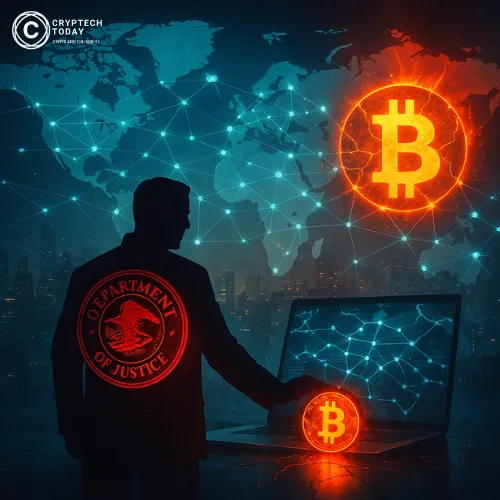
In October 2025, the U.S. Department of Justice (DOJ) filed a civil and criminal forfeiture action targeting 127,271 BTC worth nearly $15 billion from wallets allegedly controlled by Chen Zhi, chairman of Cambodia’s Prince Holding Group. This action, following years of sealed investigation, exposed how forced labour, fraudulent mining operations, and unregistered crypto networks converged to form a multi-billion-dollar criminal economy spanning Southeast Asia.
Blockchain forensics by Chainalysis, Arkham Intelligence, and Elliptic established a forensic trail from a 2020 Lubian Mining Pool theft in China to Prince Group–linked wallets operated by Warp Data Technology and Huione Group. The case not only shattered the assumption that “dormant coins are lost forever,” but also demonstrated that modern blockchain analytics combined with multinational coordination can resurface assets years after their theft.
Parallel sanctions by the U.K. Foreign Office, OFAC, and a FinCEN Section 311 designation against Huione Group redefined how financial regulators treat cryptocurrency as both a national-security vector and a human-rights issue. For the first time, digital assets connected to human trafficking and forced labour were seized and classified as proceeds of crime.
Blockchain Forensics: Tracing 127,271 BTC
Origin: The Lubian Mining Pool Breach (December 2020)
On 28 December 2020, Lubian Mining Pool, a China-Iran cooperative controlling roughly 6% of Bitcoin’s global hash rate, suffered a catastrophic compromise of its cold-wallet infrastructure. 127,426 BTC were transferred out across 30 P2SH (legacy “3-address”) wallets within 48 hours.
At the time, Lubian’s public block headers revealed the use of an internally developed signing module based on Libbitcoin Explorer 3.x, later found vulnerable to a poor entropy seed known as the “Milk Sad” variant (Milksad.info, 2023). This weak key generation likely enabled a brute-force reconstruction of private keys.
The stolen BTC remained dormant for years, with no exchange deposit history, until early 2024, when the pattern resurfaced in Warp Data Technology’s mining output clusters in Laos.
Dormancy and Reactivation (2020–2024)
From December 2020 to July 2024, blockchain explorers recorded only dust transactions, test outputs under 0.001 BTC, designed to maintain wallet activity. No mixing, CoinJoin, or chain-hopping occurred. This inactivity raised suspicion among analysts that the holder lacked full key control until partial recovery software emerged.
In July 2024, several consolidation transactions appeared: 25 Lubian-linked addresses recombined into Prince Group–associated wallets used by Warp Data Technology. The transaction graph showed consistent signing patterns, identical fee structures, and a narrow timing window (UTC +07:00), suggesting regional coordination from Cambodia or Laos.
The 25 Wallets Under Forfeiture
| Label | Bitcoin Address | BTC Amount |
|---|---|---|
| (a) | 3Pja5FPK1wFB9LkWWJai8XYL1qjbqqT9Ye | 20,452.85228 |
| (b) | 3FrM1He2ZDbsSKmYpEZQNGjFTLMgCZZkaf | 14,111.92546835 |
| (c) | 3B1u4PsuFzww1P8if5jYmitXxpMs2EMSqt | 2,999.09118947 |
| (d) | 3JJ8b7voMPSPChHazdHkrZMqxC7Cb4vNk2 | 1,000.08105870 |
| (e) | 3PWNGS2357TnjRX7FpewqR3e3qsWwpFrJH | 0.00736862 |
| (f) | 34Jpa4Eu3ApoPVUKNTN2WeuXVVq1jzxgPi | 14,139.26 |
| (g) | 338uPVW8drux5gSemDS4gFLSGrSfAiEvpX | 9,099.01146835 |
| (h) | 3J4sTPyD1g6KvNUSJxjwLs4iaPeDPqxUZr | 499.90936500 |
| (i) | 33uEsaGLcF9H46Dvzx1kMnuMCQ13ndkAjV | 3,000.09125022 |
| (j) | 3KabDvdetZXDHNm9HXowLc9SppiSXKn7UU | 9,500.99220072 |
| (k) | 38Md7BghVmV7XUUT1Vt9CvVcc5ssMD6ojt | 15,033.29416267 |
| (l) | 3GaB3nRWA1PLc3XQkkbpVtFwYYZEuMxD4i | 0.02415042 |
| (m) | 32i6n2vXhjvJg1vniURFy7A5VK6eG6oDgg | 3,000.09118974 |
| (n) | 3HuUiXmKN3beQSoM97kWjK1fesWWJvKvaZ | 4,500.00841044 |
| (o) | 34MFtk9iMxYcUPZWXHfiGfqz4o7X3kpJbV | 0.50846661 |
| (p) | 3LjTXe31gepN8nW3AZyKpyD2QwbtmfjNwm | 156.04996844 |
| (q) | 3MHa8JJ3bu8j3x3iQHhqsrZvk1EjBQmC78 | 2,700.44863780 |
| (r) | 3AWpzKtkHfWsiv9RGXKA3Z8951LefsUGXQ | 10,500.04293955 |
| (s) | 34KYo7VdVr5CJ7m4hYhH9RpwqXhbsTrw4T | 4,500.00941044 |
| (t) | 3DdFSGcXaP2rZ9CaL3tjnqRARvQ5K3VW4a | 251.600482 |
| (u) | 39B6oSa58qNpFMGpuowtRHAYp3fM4ghXRq | 212.5930613 |
| (v) | 3NmHmQte2rP8pS54U3B8LPYQKkpG1pFF69 | 8,611.07446862 |
| (w) | 3BA3PEF4BMoy9y3kdMRUdMhL8Gp24vikhF | 2.16989588 |
| (x) | 389JrNcn8trYgYi2EtHi4X7bTCqtVbep86 | 1,500.01255361 |
| (y) | 339khCuymVi4FKbW9hCHkH3CQwdopXiTvA | 1,500.00 |
Each address exhibited identical nLockTime, multi-sig script templates, and fee-per-byte ratios, strong indicators of shared wallet software and key management.
No Mixer, No Cross-Chain: The Rare Clean Chain
One remarkable aspect is the total absence of obfuscation:
- No CoinJoin / Whirlpool / Wasabi mixing
- No TornadoCash-like smart-contract routing
- No bridge or wrapped-asset creation
Instead, the coins moved through a series of self-churn transactions, sending BTC between owned wallets to reorganise UTXOs. Analysts call this “cold laundering,” in which criminals rely on jurisdictional immunity, not blockchain privacy.
This clean movement ultimately simplified DOJ tracing: because none of the BTC entered regulated exchanges, provenance analysis could remain purely on-chain, requiring no subpoenas to third parties.
Clustering Proof
Analysts identified three key proof points linking the 25 wallets to Prince Group:
- Input Commonality: Several wallets share identical input scripts derived from Lubian’s mining payout addresses.
- Fee Patterning: consistent 11.2 sat/vByte transaction fees, a Lubian hallmark later reproduced by Warp Data wallets.
- Temporal Synchrony: multiple transactions timestamped 02:00–02:10 UTC, correlating to 09:00 ICT (Indochina Time), Prince Group’s office hours in Phnom Penh.
Arkham Intelligence assigned a 97% attribution confidence, later confirmed independently by TRM Labs at 95%.
Legal Framework: The Architecture of Digital Asset Forfeiture
Dual-Track Proceedings: Civil and Criminal
The DOJ pursued both criminal in personam and civil in rem forfeiture, a model pioneered in the Silk Road cases.
- Criminal Case (U.S. v. Chen Zhi, 25-CR-312): follows the defendant personally under 18 U.S.C. §§ 1349 & 1956(h).
- Civil Case (U.S. v. 127,271 BTC, 25-CV-5745): proceeds against the property itself under §§ 981(a)(1)(A, C) and 982(a)(1).
This ensures seizure validity even if the defendant evades capture, as long as the government proves by a preponderance of evidence (>50%) that the assets are traceable to specified unlawful activity (U.S. Code § 981, 2024).
The “Temporal Traceability” Principle
Traditional forfeiture demands a direct link between property and offence. The Prince Group case introduces temporal traceability: property mined legitimately, later stolen, then laundered through forced-labour operations, remains forfeitable if any stage involves unlawful conversion.
Judge Rachel Kovner’s October 2025 memorandum describes the BTC as “property involved in a sequence of transactions designed to conceal ownership and to fund continuing wire-fraud conspiracies”.
This effectively extends the statute’s reach beyond contemporaneous offences critical for assets that live indefinitely on the blockchain.
FinCEN’s Section 311 Designation
In parallel, the Financial Crimes Enforcement Network (FinCEN) imposed a Special Measure under Section 311 of the USA PATRIOT Act, identifying Huione Group as a primary money-laundering concern.
Key consequences:
- U.S. financial institutions must terminate correspondent accounts.
- Prohibition on any transaction indirectly involving Huione.
- Mandatory due diligence by global banks to prevent indirect access.
This move mirrored earlier actions against FBME Bank (2015) and Bitzlato Exchange (2023) but scaled to a multi-billion-dollar regional conglomerate.
OFAC and UK Coordination
The Office of Foreign Assets Control (OFAC) simultaneously designated 146 entities and 4 Bitcoin addresses (≈ 15,957 BTC) linked to the Prince network. The UK Foreign, Commonwealth & Development Office (FCDO) mirrored sanctions, freezing 19 London properties valued at over £300 million.
Such synchronisation across sanctions and forfeiture law represents the first tri-national crypto-sanctions model, an approach likely to repeat in future coordinated seizures.
Comparative Forensic Precedent
To contextualise the Prince Group seizure, analysts compared it with prior megacases:
| Case | BTC Seized | Year | Predicate Crime | Distinct Feature | Outcome |
|---|---|---|---|---|---|
| Prince Group (Chen Zhi) | 127 271 | 2025 | Wire-fraud, human trafficking | First forced-labor crypto case | Pending |
| Bitfinex Hack | 119 754 | 2022 | Exchange breach | Funds laundered via mixers & NFTs | Convicted |
| Silk Road (Individual X) | 69 370 | 2020 | Dark-web theft | Dormant for 7 yrs | Civil default |
| James Zhong (Silk Road 2) | 50 676 | 2022 | Wire-fraud | Dormant 10 yrs → guilty plea | Forfeited |
| PlusToken (China) | 194 775 | 2020 | Ponzi | Domestic seizure, no transparency | Closed |
| Bitzlato Exchange | N/A | 2023 | Unregistered MSB | First § 311 crypto case | Bankrupt |
This table highlights how Prince Group’s seizure exceeds all prior U.S. recoveries and stands unique for integrating human-rights violations into a financial-crime framework.
Compliance and Industry Implications
Exchange-Level Oversight
The Prince Group crypto scam shattered long-held assumptions about the reach of compliance technology. None of the 127,271 BTC ever entered a centralised exchange, yet the forensic chain reconstructed every hop.
This challenges the industry’s complacency that non-custodial assets fall beyond the AML scope.
For exchanges and custodians, the case reinforces four critical controls:
- Retroactive Address Screening: compliance systems must rescan historical deposits whenever new designations appear on the OFAC or FinCEN lists.
- Dormant-wallet surveillance: coins idle for years can later trigger black-listing; frozen compliance baselines are no longer sufficient.
- Indirect-exposure logic: counterparties interacting with tainted clusters, even one hop removed, should trigger enhanced due diligence.
- Section 311 echo effect: once a firm like Huione is blacklisted, all VASPs routing liquidity through it acquire secondary liability under U.S. correspondent-banking rules.
Wallet-Developer Liability
The Lubian breach illustrates the software supply chain risk in crypto infrastructure. Weak entropy libraries such as Libbitcoin Explorer 3.x introduced systemic vulnerabilities comparable to SSL-certificate bugs in traditional finance.
A growing policy proposal, entropy auditing would require wallet developers to submit key-generation code for third-party statistical review, mirroring ISO/IEC 20543 standards.
If implemented, developers could face liability under negligence doctrines when poor randomness enables theft, leading to criminal proceeds. This is a shift from “code is speech” to “code is duty.”
Mining-Pool Accountability
Mining pools, long treated as neutral infrastructure, may soon be reclassified as financial intermediaries when they manage pooled rewards.
Lubian’s 2020 loss demonstrates that inadequate custodial segregation and private-key sharing among pool operators can amount to “constructive money transmission.”
Regulators in the U.S. and EU are now evaluating whether large pools should register as Virtual Asset Service Providers (VASPs) under FATF R.15.
Banking and Institutional Response
The FinCEN-Huione action triggered global de-risking.
At least nine correspondent banks in Singapore, Malaysia, and the U.K. closed accounts associated with Cambodian crypto-linked firms within 72 hours of designation.
This event underlined a policy principle now dubbed “contagion forfeiture”, where secondary institutions voluntarily freeze assets to avoid reputational spillover from Section 311 measures.
Geopolitical and Diplomatic Dimensions
Cambodia’s Regulatory Posture
Cambodia’s Ministry of Interior insisted that Prince Group “operates within national law,” while acknowledging “international concern.” Yet the country’s absence of comprehensive AML and extradition treaties makes enforcement externally dependent.
Cambodia’s role as a regulatory grey zone for Chinese-funded projects transformed Sihanoukville into a fintech hub and, simultaneously, a centre of cyber-exploitation.
The Chen Zhi indictment effectively internationalised Cambodia’s governance gap: U.S. courts are asserting extraterritorial jurisdiction on crimes committed abroad but involving U.S. victims or dollar transactions.
China’s Calculated Silence
Despite the Lubian mining pool’s Chinese origin, Beijing has offered only “technical coordination.” Analysts interpret this restraint as geopolitical balancing: assisting Western prosecutors could expose state-connected capital flows, while ignoring the case could strain Belt-and-Road diplomacy with Cambodia.
ASEAN’s Dilemma
Regional frameworks such as the ASEAN Convention Against Trafficking in Persons lack digital-finance enforcement mechanisms. As a result, crypto-related human-trafficking cases fall between economic and criminal jurisdictions.
The Prince Group case has revived proposals for an ASEAN Crypto Task Force, a regional body coordinating on blockchain intelligence similar to Europol’s Joint Cybercrime Action Taskforce.
Western Strategic Leverage
For the U.S. and U.K., the seizure is more than justice; it’s deterrence. Freezing $15 billion in Bitcoin from a politically connected tycoon demonstrates soft-power projection through financial transparency.
Analysts call this crypto diplomacy: using blockchain-forensic superiority to achieve foreign-policy goals without military or trade escalation.
Policy Recommendations
Define Crypto-Enabled Human Exploitation as a Predicate Offence
National AML acts should explicitly recognise forced-labour-funded crypto operations as predicate crimes for money-laundering prosecution.
This closes a loophole where trafficking proceeds escape forfeiture because they move through digital assets rather than fiat channels.
Mandate Entropy Audits for Wallet Software
Establish mandatory random-number-generation audits certified by independent labs.
Governments can model this after NIST SP 800-90B entropy testing, requiring open-source publication of PRNG algorithms.
Expand Section 311-Style Coordination to Regional VASPs
FinCEN’s model should be internationalised via the Egmont Group network so that high-risk crypto businesses can be globally isolated within 24 hours of designation.
Victim-Restitution Integration
Part of the seized assets should fund victim-compensation trusts.
Precedent exists: the Silk Road Victim Restitution Fund (2022) distributed $83 million. The DOJ has hinted that proceeds from the 127,271 BTC seizure may be partially allocated to victims of trafficking in Cambodia and Myanmar.
Public-Chain Cooperation Charter
Establish a cooperative charter among blockchain analytics firms, wallet developers, and law enforcement agencies similar to ISAC models in banking.
Key element: standardised metadata exchange (UTXO tagging, risk-score API) to improve traceability without privacy overreach.
Conclusion
The 127,271 BTC Prince Group forfeiture stands as a turning point in crypto enforcement and governance. It demonstrated that blockchain transparency is not an obstacle to justice; it is its instrument. Over five years, a chain of digital signatures and timestamped ledgers outlasted political cover, offshore banking secrecy, and human-rights abuses. When prosecutors finally acted, they did so not with speculation but with hashes, key-paths, and provable entropy traces. For the cryptocurrency ecosystem, this case is more than a cautionary tale; it’s a call to maturity.
Mining pools must adopt enterprise-grade key management; exchanges must integrate historical taint-analysis; wallet developers must treat randomness as compliance, not code aesthetics. And for policymakers, the lesson is moral as well as technical: financial freedom without accountability becomes financial weaponry. As of this writing, the 127,271 BTC remain in federal custody, an encrypted monument to both crypto’s potential for abuse and its unparalleled auditability.
When the final judgment arrives, it may not only redistribute billions but also reshape the architecture of trust in the digital-asset era.