When the grandson of mob boss John Gotti diverted $420,000 in pandemic relief funds into a cryptocurrency venture, he likely assumed digital assets would obscure the money trail. Instead, federal investigators followed the ledger straight to a prison sentence. Here is what the case reveals about blockchain forensics.
Key Takeaways
- Federal Sentencing: In April 2026, Carmine G. Agnello Jr. was sentenced to 15 months in federal prison and ordered to pay $1.268M in restitution for COVID loan fraud.
- The Crypto Diversion: Prosecutors proved that $420,000 of $1.1M in fraudulently obtained Small Business Administration (SBA) disaster loans was diverted into a cryptocurrency business.
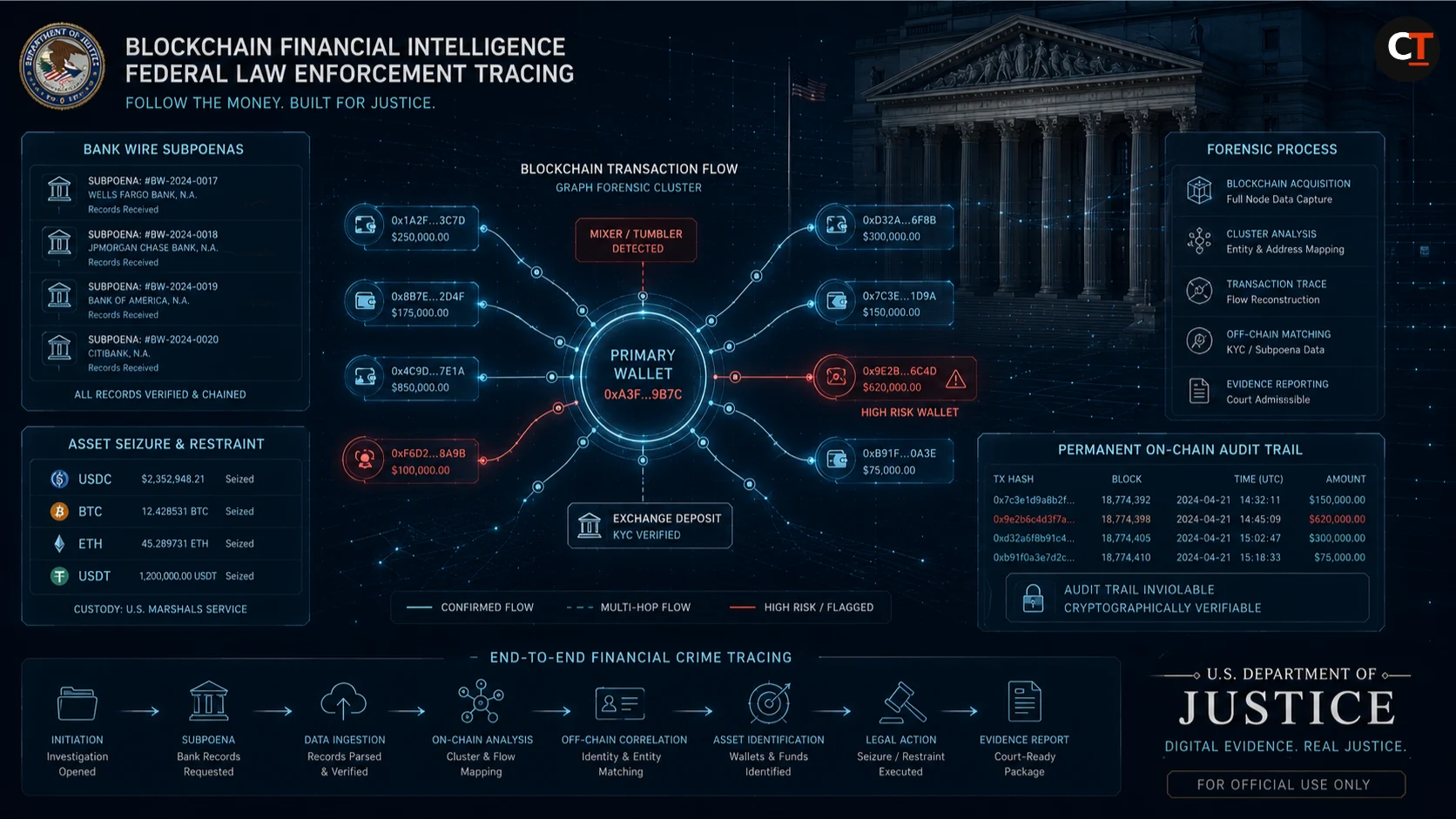
- The Forensics Playbook: Federal agencies combined banking subpoenas, exchange KYC databases, and on-chain cluster analytics to trace the movement of funds from taxpayer coffers to digital wallets.
- The Transparency Reality: Public blockchains do not provide criminal anonymity: they create a permanent, tamper-proof evidentiary trail that makes illicit laundering mathematically traceable.
Few surnames in American organized crime history carry the notoriety of Gotti.
For decades, the Gambino crime family operated in the shadows of cash drops, physical intimidation, and offline bookmaking. In the modern era, however, illicit financial schemes look less like traditional street shakedowns and more like white-collar electronic wire fraud.
In April 2026, that generational transition reached a federal courtroom in Central Islip, New York.
Carmine G. Agnello Jr., the grandson of late Gambino boss John J. Gotti and son of Victoria Gotti, was sentenced by US District Judge Nusrat J. Choudhury to 15 months in federal prison and ordered to pay over $1.26 million in restitution.
The offense was not loan-sharking. It was wire fraud: stealing approximately $1.1 million from emergency pandemic disaster loan programs funded by American taxpayers.
Crucially, federal prosecutors revealed that approximately $420,000 of the stolen relief funds was funneled directly into a cryptocurrency business.
For the digital asset industry, the Agnello case is not a story about celebrity crime. It is a textbook case study in the reality of modern blockchain forensics, demonstrating why using distributed ledgers to conceal stolen funds is one of the most self-defeating strategies in modern financial crime.
The Anatomy of the Fraud: $1.1M in Stolen Pandemic Relief
Between April 2020 and November 2021, while millions of small businesses faced catastrophic lockdowns, the US Small Business Administration (SBA) disbursed emergency capital through the Economic Injury Disaster Loan (EIDL) program.
Agnello operated a Queens-based auto salvage business, Crown Auto Parts & Recycling, LLC. Rather than using the emergency loans for legitimate employee payroll, utility bills, or operational overhead, court filings proved a deliberate pattern of misappropriation:
| Case Element | Official Court Record Details |
|---|---|
| Defendant | Carmine G. Agnello Jr. (Grandson of John J. Gotti) |
| Federal Charge | One count of Wire Fraud (18 U.S.C. § 1343) via guilty plea in September 2024 |
| Fraud Amount | Approximately $1,100,000 across at least three fraudulent SBA EIDL loans |
| Diverted to Crypto | $420,000 invested into a cryptocurrency business venture |
| Sentencing Terms | 15 Months Federal Prison (FCI Fairton), 2 Years Supervised Release, 100 Hours Community Service |
| Financial Restitution | $1,268,302 ordered payable to the Small Business Administration |
After multiple sentencing deferrals related to a proposed kidney donation to his mother, Agnello surrendered to the Federal Bureau of Prisons in August 2026 to begin serving his sentence.
The Crypto Connection: Diverting Taxpayer Capital
The critical detail highlighted by the US Attorney’s Office for the Eastern District of New York was the specific destination of the stolen funds.
Agnello did not merely spend loan proceeds on personal living expenses. He took $420,000, roughly 38% of the total stolen relief funds, and directed it into a cryptocurrency investment.
Federal prosecutors characterized the diversion as blatant theft: taking taxpayer funds intended to keep essential workers employed during a national emergency and diverting them into speculative digital asset ventures.
For many bad actors entering the crypto ecosystem, digital assets are viewed as an anonymous digital Swiss bank account: an impenetrable vault beyond the reach of subpoenas.
The investigative reality is the exact opposite.
The Federal Forensics Playbook: How Agents Followed the On-Chain Trail
Federal agencies, including the SBA Office of Inspector General (SBA-OIG), the FBI, IRS Criminal Investigation (IRS-CI), and the US Secret Service, deploy a standardized, battle-tested forensic methodology to dismantle crypto-linked fraud schemes:
1. Bank-to-Exchange Subpoenas
The money trail begins in the traditional banking system. When emergency EIDL loan proceeds were wired from the US Treasury into the commercial bank accounts of Crown Auto Parts, investigators obtained bank records showing immediate outgoing wire transfers to custodial crypto exchanges or intermediary payment processors.
2. Identity Anchoring at Fiat Gateways
Because regulated exchanges operate under strict Bank Secrecy Act and Know-Your-Customer (KYC) rules, investigators serve administrative subpoenas on the recipient exchanges. The exchange provides:
- The verified identity, passport details, and residential address of the account owner.
- Linked fiat bank account numbers and IP login logs.
- The exact deposit transaction hashes and receiving on-chain wallet addresses.
3. Multi-Hop Blockchain Clustering
Once a receiving blockchain address is identified, investigators input the public key into institutional blockchain intelligence platforms such as Chainalysis Reactor, TRM Labs, or Elliptic.
These platforms apply proprietary clustering heuristics and graph analysis to:
- Map wallet clusters controlled by the same underlying private keys.
- Follow subsequent transaction hops across public ledgers, even if the funds are split across hundreds of intermediate unhosted wallets.
- Detect interactions with smart contracts, decentralized exchanges, or high-risk mixing services.
4. Freezing at Regulated Off-Ramps
To convert cryptocurrency back into usable purchasing power, bad actors must eventually route funds back into fiat banking systems, luxury asset dealers, or regulated payment cards.
Law enforcement agencies issue asset preservation letters and federal seizure warrants directly to the final exchange off-ramps, freezing funds before cash can be liquidated.
To understand how on-chain security vulnerabilities differ from centralized accounting fraud, read our deep dive on the real risks of tokenized assets.
Busting the Anonymity Myth: Why Blockchains Are Forensic Traps for Fraudsters
The conviction of Carmine Agnello underscores the single biggest misunderstanding in digital asset finance: the confusion between pseudonymity and anonymity.
| Financial Attribute | Physical Cash / Hawala | Public Blockchain (BTC, ETH, etc.) |
|---|---|---|
| Audit Trail | Leaves zero permanent transaction record once physical bills change hands. | 100% permanent, public, and mathematically immutable accounting ledger. |
| Identity Layer | Completely untraceable without physical surveillance or serial tracking. | Pseudonymous addresses that anchor to real identities at every regulated fiat gateway. |
| Historical Analysis | Evidence decays over time; memories fade, paper records are destroyed. | Investigators can audit transactions conducted five, ten, or fifteen years ago with exact timestamps. |
| Global Visibility | Concealed across local jurisdictions and opaque offshore bank secrecy laws. | Synchronized across millions of nodes worldwide; accessible to any analyst instantly. |
When a criminal uses physical cash, the evidence trail ends the moment the bills are handed across a table.
When a criminal moves stolen funds onto Bitcoin, Ethereum, or a public stablecoin, they are not hiding the crime. They are broadcasting an unalterable, cryptographically signed ledger of their actions to every law enforcement agency on earth.
Even if an investigator does not solve the case on day one, the public ledger never forgets. An address that appears disconnected today can be unmasked three years later the moment it interacts with a KYC-compliant exchange, a regulated merchant, or a subpoenaed IP address.
The COVID Fraud Strike Force: How Federal Analytics Scaled
The Agnello indictment was not an isolated operation. It emerged from a coordinated nationwide campaign led by the Department of Justice’s COVID-19 Fraud Enforcement Task Force, established to recover tens of billions in misappropriated emergency relief funds.
In the initial months of the pandemic, emergency disbursement speed took priority over upfront verification. Fraudsters exploited automated application portals using forged tax filings and phantom payrolls.
However, the government’s retrospective audit capabilities evolved dramatically between 2021 and 2026:
- Algorithmic Data Matching: Federal analytics engines cross-referenced millions of SBA loan disbursements against IRS quarterly payroll tax returns and state corporate registry records, immediately flagging entities like Crown Auto Parts that received major allocations without matching commercial operations.
- Specialized Digital Asset Units: The FBI’s Virtual Assets Unit (VAU) and IRS-CI Cyber Crimes Unit established continuous data pipelines tracking high-volume fiat outflows from flagged disaster loan bank accounts into custodial exchange accounts.
- Extended Statute of Limitations: In August 2022, Congress passed legislation extending the statute of limitations for COVID-19 relief fraud to 10 years, giving federal investigators a decade to trace blockchain transactions and unmask delayed cash-out attempts.
The Institutional Takeaway: Why Transparency Protects Legitimate Finance
For institutional investors, enterprise tokenization platforms, and compliant fintech firms, cases like Agnello’s are a validation of the underlying technology.
The same transparency that makes it impossible for pandemic fraudsters to conceal stolen money is what makes distributed ledgers uniquely powerful for legitimate capital markets:
- Regulated institutions can prove reserve solvency in real time without relying on quarterly self-reported spreadsheets, as demonstrated in our analysis of stablecoin reserve mechanics.
- Cross-border payment flows become instantly auditable, satisfying international anti-money laundering mandates under the UK FCA crypto regime and Latin America’s Argentina VASP framework.
- Fiduciary custodians can ring-fence client assets with verifiable on-chain proof, preventing the commingling of customer deposits across real-world asset tokenization protocols.
- Sovereign regulators in markets like India can enforce strict transaction tracking under SEBI and RBI guidelines.
The prosecution of Carmine Agnello Jr. is an unmistakable signal to anyone attempting to use digital assets for financial crime.
Cryptocurrency is not a shield for fraud. It is a forensic magnifying glass.
By funneling $420,000 in stolen disaster relief into a crypto business, Agnello did not escape federal scrutiny: he handed prosecutors an immutable evidentiary receipt that cemented his wire fraud conviction and a 15-month federal prison term.