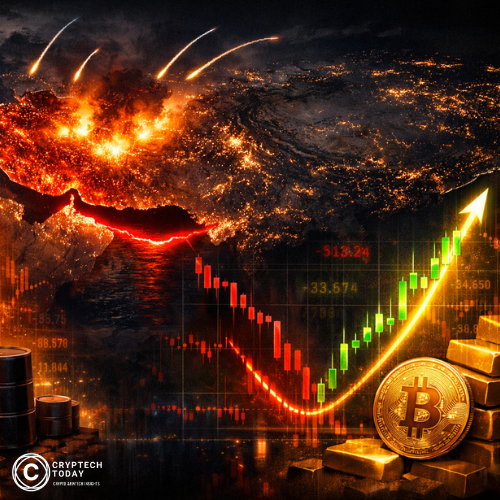
You probably saw the headline. US and Israeli strikes on Iran. Khamenei dead. Oil prices are spiking. Bitcoin is crashing, then recovering. Markets swinging. And then within a day or two, everything seemed to calm down. Stock markets recovered. Bitcoin bounced back. The news moved on to the next thing.
But the war hasn’t ended. There is no ceasefire. Nobody is even talking about one.
Markets have made a quiet assumption: this will be over in two weeks. A short, contained conflict. Clean strikes degrade the enemy, both sides declare victory, the Strait of Hormuz remains open, oil production resumes, and everyone returns to normal. That assumption might be right. But it might not be. And if it isn’t, if this war drags on past 30 days or 60 days, the impact on your daily life, savings, Bitcoin, and cost of living is significant. And almost nobody is talking about it. This is that conversation.
Markets have priced a 2-week war. Nobody has priced a 60-day one. The gap between those two scenarios is where your money is at risk.
Oil: The One That Hits You First
If this war drags on, the first thing you will notice is not your stock portfolio or your Bitcoin wallet. It will be the price at the petrol pump.
Oil spiked 14% in a single day when the strikes were confirmed. It briefly touched $82 a barrel. Then it pulled back slightly because markets assumed the Strait of Hormuz would stay open, OPEC would keep pumping, and the disruption would be short.
Here is the question nobody wants to answer: what if the Strait doesn’t stay open?
Why the Strait of Hormuz Is the Most Important Waterway You’ve Never Thought About
About 20% of the world’s oil passes through the Strait of Hormuz, a narrow passage between Iran and Oman. Every tanker carrying oil from Saudi Arabia, Kuwait, Iraq, and the UAE passes through it. Iran has threatened to close it before. This time, those threats come with strikes on Iranian soil.
If even half of that traffic is disrupted for a month, energy analysts at Wood Mackenzie project oil above $100 a barrel. Goldman Sachs has already identified an $18 risk premium baked into current prices, meaning markets have partially priced the threat, but nowhere near fully priced an actual closure.
| WHAT $100 OIL ACTUALLY MEANS FOR YOU |
|
|
|
|
|
|
The 1973 oil embargo is the reference point that analysts keep coming back to. When Arab nations cut oil supplies to the West in protest at US support for Israel, oil rose 300% in five months. Petrol stations ran dry. Governments imposed rationing. Economies went into recession. That was a deliberate embargo by major producers. What we are facing now is a conflict that threatens the route through which those same producers ship their oil. Different cause, same potential effect.
We are not in 1973. The US now produces a lot of its own oil. But the global market is connected a shock anywhere raises prices everywhere. And the impact on countries like India, which imports roughly 85% of its oil, would be severe and fast.
“Oil is not just an investment. It is the price of food, the price of travel, and the price of almost everything else. When oil goes up, everything eventually follows.”
Bonds: The Signal Most People Miss — But Shouldn’t
Most people do not own bonds directly and do not track bond markets. That’s completely understandable. However, the bond market is currently sending a message that affects everyone, whether they own bonds or not.
Here is the simple version: when a war breaks out, investors normally rush into government bonds because they are considered the safest place to park money in a crisis. When that happens, bond prices rise, and interest rates fall.
That is not what is happening. Interest rates are rising. The US 10-year Treasury yield climbed to just above 4% in the days after the strikes, moving in the wrong direction for a typical war reaction.
What Rising Yields During a War Actually Mean
The bond market is telling you it is more afraid of inflation than it is of the war itself. Oil spiking means inflation coming back. Inflation coming back means the central bank cannot cut interest rates. And if interest rates stay high or go higher, borrowing gets more expensive for everyone.
Your mortgage. Your car loan. Your business loan. Your credit card. All of these are connected, directly or indirectly, to the interest rate environment. When the Federal Reserve’s rate cut plans get cancelled because of war-driven oil inflation, that is not an abstract market event. That is your EMI not falling the way you expected.
| THE STAGFLATION SCENARIO |
|
|
|
|
|
|
|
|
The Fed is not there yet. But the direction of travel, rising oil, rising yields, paralysed central bank is the early-stage checklist for stagflation. Minneapolis Fed President Neel Kashkari said it plainly on March 3: the Iran war obscures the monetary policy outlook. That is a central banker’s way of saying they are stuck.
Gold: The Safe Haven That Did Something Weird
Gold is supposed to be simple. When war breaks out, people buy gold. Gold goes up. It is the oldest financial haven in human history.
That is exactly what happened at first. Gold spiked above $5,390 an ounce when the strikes were confirmed. A new high. Exactly what you would expect.
Then, one day later, gold dropped 4% in a single session, its biggest single-day fall of 2026. During an active war. That seems completely contradictory. What happened?
The Dollar Got in the Way
When Iran threatened to close the Strait of Hormuz, oil prices surged. That surge repriced inflation expectations. Higher inflation expectations meant investors concluded the Federal Reserve would hold rates higher for longer, not cut them. Higher-for-longer rates strengthened the US dollar. And a strong dollar, mechanically, pushes gold down in the short term because gold is priced in dollars.
So gold fell not because people stopped wanting it, but because the same war event that made them want gold also strengthened the dollar enough to temporarily outweigh the safe-haven demand.
This is a temporary, technical dislocation. Gold’s structural story has not changed. Central banks led by China, which bought gold for its 15th consecutive month in January 2026, are accumulating at a scale not seen in decades. J.P. Morgan projected gold toward $5,400 an ounce for 2027. The war took it there in March 2026 ahead of schedule.
| GOLD IN AN EXTENDED WAR — WHAT TO EXPECT |
|
|
|
|
|
|
|
The key thing to understand about gold in this environment: the short-term moves are noise. The direction driven by de-dollarisation, central bank accumulation, inflation fear, and geopolitical uncertainty is structurally upward. An extended war accelerates every single one of those drivers.
Bitcoin and Crypto: Two Completely Different Wars Happening at Once
Bitcoin did something that confused a lot of people last week.
When the bombs fell on February 28, Bitcoin dropped to $63,000. That makes sense. People got scared and sold risky assets. About $490 million in leveraged crypto positions got automatically liquidated in the first 24 hours. Classic panic.
Then, the next day, $458 million flowed into Bitcoin ETFs in a single day. One of the biggest single-day inflows of the year. And a $129 million wall of Ethereum buy orders appeared on Binance, someone placing a massive pre-planned order at a specific price level.
The retail investors panicked and sold. The institutions quietly bought everything they sold.
Why Were Institutions Buying During a War?
This is the question that matters. Large institutional investors, the kind who manage billions, not thousands, were not selling Bitcoin during an active military conflict. They were buying. Why?
Because oil spiking 14% in a day is an inflation signal. And Bitcoin, for institutional portfolios in 2026, is increasingly being held alongside gold as a hedge against exactly that kind of inflation, a non-sovereign asset that no government can print more of. When oil jumps and inflation fears rise, that thesis gets stronger, not weaker.
Bitcoin is now at approximately $68,000, up 8% from the war low of $63,000. Ethereum is around $2,000, up 7% from its own low. The recovery is real. But it is fragile. It depends entirely on the institutional thesis holding, and that thesis has one major vulnerability.
The One Thing That Could Break Bitcoin’s Recovery
If oil sustains above $90 and inflation expectations stay elevated, the Federal Reserve cannot cut interest rates. If the Fed cannot cut rates, the macro environment for risk assets, which Bitcoin still partially is, deteriorates. High real interest rates make cash and bonds more attractive. They reduce the appetite for speculative assets. That is the scenario where Bitcoin does not hold $68,000; it tests $55,000 or lower.
The trading range most analysts are working with right now: $50,000 to $55,000 if the war escalates severely and macro conditions worsen. $65,000 to $70,000 if the war drags but stays contained. $74,000 to $75,000 if ceasefire signals emerge and rate-cut hopes revive.
| WHAT DIFFERENT CRYPTO HOLDERS ARE ACTUALLY EXPERIENCING |
|
|
|
|
|
|
The Story Nobody Is Covering — Iran and the USDT Escape Hatch
While Western investors debate Bitcoin price targets, something far more consequential is happening inside Iran. The rial is already at roughly 1.6 million per US dollar, having lost 62% of its value in the past six months alone. Bank withdrawal limits are capped at the equivalent of about $18 to $30 per day. Yes, per day.
When bombs started falling, Iranians did not rush to their banks. They rushed to Nobitex, the country’s largest crypto exchange, and tried to move their savings out. $10.3 million left in 72 hours before the government imposed internet blackouts and effectively shut down the transactions.
This is not a crypto story. It is a human story about what happens when a currency collapses, and people need an escape route. Venezuela went through this between 2018 and 2020, when hyperinflation reached 1,000,000%, and ordinary Venezuelans turned to Bitcoin and USDT as their primary store of value. Russia went through a version of it in 2022. Iran is now entering that territory.
Iran’s central bank already holds $507 million in USDT as a reserve. When even the central bank is holding stablecoins instead of its own currency, the signal is clear.
“In Tehran right now, the most important financial question is not whether Bitcoin hits $75,000. It is whether you can move your savings out before the rial hits 2 million per dollar.”
Stock Markets: Calm on the Surface, Violent Underneath
Stock markets look deceptively fine. The S&P 500 is near 6,900, roughly where it was before the strikes. If you only looked at the headline index, you might think nothing serious happened.
But underneath that calm surface, money has been moving fast. And the direction it is moving tells you exactly who wins and who loses if this war keeps going.
Who Is Winning
Defence companies had one of their best weeks in years. Lockheed Martin, Northrop Grumman, and drone manufacturers all went up sharply. The iShares Defence ETF hit an all-time high. This makes obvious sense: when a war demonstrates the effectiveness of precision weapons and AI-assisted targeting, the companies that make those weapons see their order books fill up.
Energy companies, oil producers, and refiners are also winning. When oil goes up, their revenues go up. Exxon and Chevron both gained around 4% on day one.
Who Is Getting Quietly Hurt
Airlines are the most direct casualty of high oil prices that most people do not immediately think of. Fuel is 20 to 30% of an airline’s operating cost. Every significant rise in oil directly compresses their margins. If oil stays elevated for 30 days, ticket prices go up, and airline stocks go down. If oil hits $100 and stays there, some carriers start losing money on every flight.
Shipping companies face a different problem: the marine insurance premiums for vessels travelling near the Strait of Hormuz are surging. If you are a shipping company and it suddenly costs dramatically more to insure a tanker passing through the world’s most important oil chokepoint, your economics change overnight.
Consumer companies, the ones that sell you everyday goods, face the slow squeeze. Higher oil means higher logistics costs. Higher logistics costs mean lower margins or higher prices. Either way, something absorbs the hit. Usually, eventually, it is you.
| THE QUIET CASUALTIES OF A LONG WAR |
|
|
|
|
|
|
The honest assessment: if this war stays contained and ends within a month, equity markets probably recover fully. The S&P 500 has historically absorbed short geopolitical shocks with minimal lasting damage. The risk is the slow-burning scenario of oil staying high, margins getting squeezed quarter after quarter, inflation returning, and central banks unable to provide relief.
Iran’s Economy: The Slow Collapse Everyone Is Ignoring
While the world watches oil prices and Bitcoin charts, the most consequential slow-motion story is happening inside Iran, and it matters beyond Iran’s borders.
Before the first bomb fell, Iran’s currency was already in freefall. The rial had lost 62% of its value against the dollar in the preceding six months. Inflation was running at a 34-month high. Bank branches were implementing informal daily withdrawal limits because demand for cash was outpacing supply.
The strikes have not fixed any of this. They have accelerated it.
When a Currency Collapses, What Do People Actually Do?
History gives us a clear answer. When Venezuela’s bolivar collapsed, ordinary people converted their savings to dollars wherever they could find them and increasingly to Bitcoin and USDT because dollars were hard to physically obtain. When Russia’s ruble crashed in 2022, Russians bought crypto within hours of the invasion. Crypto exchanges serving Russian customers saw dramatic volume spikes.
Iran is following the same script, but with one significant difference: the infrastructure is already there. Nobitex, Iran’s largest exchange, handles the majority of the country’s crypto activity. The Iranian central bank itself reportedly holds hundreds of millions in USDT. Crypto is not a novelty in Iran; it is an established parallel financial system.
The rial is heading toward two million per dollar at the current rate of depreciation. When it gets there, and the trajectory suggests it will, sooner rather than later, the pressure on ordinary Iranians to move savings into crypto, dollars, or any hard asset will be immense.
Why This Matters Outside Iran
An Iranian economic collapse has three implications for global markets. First, it removes a significant source of Bitcoin mining from the network, though smaller than initially estimated, at under 1% of global hashrate. Second, it demonstrates in real time that crypto functions as a genuine escape mechanism during sovereign financial crises, strengthening the long-term institutional thesis for holding Bitcoin and stablecoins. Third, and most practically: any new wave of sanctions targeting Iranian crypto exchanges creates regulatory ripple effects across the entire global crypto ecosystem.
What to Actually Watch — Six Simple Things
You do not need to monitor fifty indicators. These six things will tell you whether this situation is getting better or worse. You can check them in under five minutes.
| # | Watch This | Things Are Okay If… | Start Worrying If… |
| 1 | Oil price (Brent crude) | Stays below $80 | Two weeks above $90 with no sign of dropping |
| 2 | Strait of Hormuz news | Tankers moving normally | Any confirmed tanker attack or official closure announcement |
| 3 | Bitcoin price | Holds above $65,000 | Two weekly closes below $63,000 |
| 4 | Gold price | Stable around $5,100–$5,400 | Sharp drop below $4,900 OR spike above $5,600 — both signal something breaking |
| 5 | Your country’s inflation data | Next CPI reading comes in flat or falling | CPI starts rising again — especially if oil is still high |
| 6 | Iran’s internet connectivity | Reports of the internet restored | Blackouts continuing after 2 weeks — signals deepening crisis |