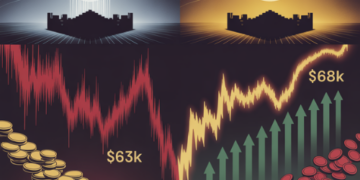
When the first confirmed reports of coordinated US and Israeli strikes on Iranian military infrastructure broke on February 28, 2026, financial markets moved before analysts could. Screens turned red across exchanges. Crypto liquidations cascaded. And underneath the headline chaos, something structural became clear: this conflict would not be remembered only for the missiles fired, but for the technology directing them.
The 2026 Israeli–United States strikes on Iran may well mark the moment that artificial intelligence moved from Silicon Valley conference rooms into publicly acknowledged battlefield workflows. Anthropic, the AI safety company behind the Claude family of large language models, finds itself confirmed at the centre of it. And at the same moment, Bitcoin, the asset millions believed would rally during geopolitical chaos, lost $128 billion in market value in a matter of hours.
|
📊 Key Numbers at a Glance $128 billion — crypto market cap lost within hours of strike confirmation $63,000 — Bitcoin’s initial reaction low after confirmed strikes 2–5% — Iran’s estimated share of global Bitcoin hashrate $7.8–10 billion — estimated value of Iran’s state-linked crypto ecosystem 5 — consecutive red months, crypto had already endured entering this conflict |
The First 48 Hours: How the Conflict Unfolded
On February 28, coordinated US and Israeli forces launched simultaneous strikes across multiple Iranian provinces, targeting missile production facilities, naval infrastructure, and military command sites. Iran responded within hours drones and missiles were directed toward Israeli territory and US military installations across the Gulf region.
Airspace closures rippled outward. Oil markets began pricing in Strait of Hormuz disruption risk. Marine insurance premiums are adjusted in real time. And within financial markets, the reaction was immediate and severe.
|
⚠️ Market Alert Within the first three hours of confirmed strike reports, global crypto markets shed approximately $128 billion in total market capitalisation. Bitcoin led the decline, falling sharply toward $63,000, erasing weeks of recovery from prior monthly losses. A partial rebound followed the confirmation of major political developments inside Iran, but price action remained unstable and choppy throughout subsequent trading sessions. |
What separates this conflict from prior Middle East escalations is not only the participants or the scale. It is the openly confirmed presence of artificial intelligence within the command-and-execution architecture, specifically, AI tools developed by Anthropic.
Anthropic’s Claude: The AI Layer Behind the Strikes
Multiple credible reports have confirmed that the United States deployed Claude-based AI systems developed by Anthropic within defence-related workflows during the 2026 Iran operation. The precise operational parameters remain classified; no official public briefing has disclosed exactly how these models were integrated or what decisions they influenced.
What is publicly known is that Anthropic builds what it calls Constitutional AI, large language models designed to reason across enormous volumes of information, follow layered instruction sets, and produce structured analytical outputs. These capabilities translate directly into applications that modern defence architecture values highly.
What is Constitutional AI and Why Does It Matter Here?
Anthropic was founded in 2021 by former OpenAI researchers with an explicit focus on AI safety. The company’s core methodology, Constitutional AI, trains models using a written set of principles that guide the model’s own self-evaluation during training. The result is AI systems that are more predictable, interpretable, and resistant to manipulation than models trained purely through human feedback loops.
Claude’s architecture makes it particularly capable in environments where information volumes are massive, time is severely constrained, and analytical errors carry significant consequences. These qualities, long-context processing, structured reasoning, and reliable instruction-following, are precisely what modern defence workflows demand. Anthropic publishes extensive research on this methodology at anthropic.com/research.
How Claude Likely Functions in Military Workflows
- Claude can ingest and cross-reference vast volumes of signal intelligence, satellite imagery descriptions, and intercept data, compressing hours of analyst work into structured briefings within seconds. Intelligence Synthesis:
- AI models evaluate multiple strike scenarios simultaneously, weighing collateral risk parameters, strategic value, and response probability, augmenting rather than replacing human decision-making at the command level. Risk and Target Modelling:
- Post-strike, Claude-based systems can rapidly process reconnaissance data to assess operational effectiveness, freeing analysts to focus on next-phase planning rather than manual data compilation. Battle Damage Assessment:
- In drone-heavy conflict theatres, AI detects flight patterns, differentiates genuine threats from decoys, and flags anomalies in real-time critical capability when swarm attacks deploy at speed. Drone Pattern Recognition:
The Ethical Tension: AI Safety Meets AI Warfare
Anthropic’s stated mission is the responsible development of advanced AI for the long-term benefit of humanity. The company has published some of the most substantive research on AI interpretability, the science of understanding what AI models are actually doing internally and has actively advocated for structured AI governance frameworks globally.
The confirmation of Claude’s presence in defence workflows is not merely a business development story. It is a philosophical stress test for the entire AI safety movement. A company built around AI transparency and safety finds its models deployed in one of the least controllable, most consequential environments conceivable.
|
“A company built around AI safety finds its models deployed in one of the least controllable environments imaginable. This is not just a business story; it is a stress test for the entire AI safety movement.” |
The Bigger Implication: Sovereign AI Acceleration
Defence-AI integration at this scale is likely to trigger a cascade of policy responses worldwide. Nations without access to US-developed frontier AI capabilities will accelerate their own sovereign AI infrastructure programs. Export controls on advanced AI models, much like those imposed on advanced semiconductor technology, may become the next geopolitical frontier.
The confirmation of Claude in battlefield workflows may be the moment AI joins nuclear, cyber, and space as a defined and actively contested domain of strategic national competition.
Why Crypto Crashed Instead of Rallied
The market reaction was, for many in the crypto community, counterintuitive. The long-running narrative around Bitcoin positions it as digital gold, a censorship-resistant, seizure-proof store of value that should appreciate during geopolitical crises, just as physical gold tends to attract haven bids when uncertainty spikes.
The 2026 Iran strikes produced the opposite dynamic. Bitcoin fell sharply. Gold rallied. Oil rose. The divergence was stark and immediately visible across asset class performance.
|
Asset |
Reaction to Strike Confirmation |
Market Direction |
Current Narrative |
|
Bitcoin (BTC) |
Dropped to ~$63,000; $128B market cap lost |
▼ Bearish |
Risk asset/liquidity beta |
|
Gold (XAU) |
Attracted strong bids; rallied sharply |
▲ Safe Haven |
Geopolitical insurance |
|
Oil (WTI/Brent) |
Rising on Strait of Hormuz disruption pricing |
▲ Rising |
Supply disruption hedge |
|
Equities |
Broad red; tech-led selloff across indices |
▼ Risk-Off |
Global deleveraging |
The structural explanation is not complicated. Crypto had already endured five consecutive months of losses entering this conflict. Leverage across perpetual markets remained elevated. US spot Bitcoin ETF flows had become the dominant short-term price directional signal. In that environment, geopolitical shock does not trigger a flight-to-crypto safety bid. It triggers liquidations, deleveraging, and risk reduction, all of which pressure prices mechanically downward.
Options market positioning reinforces this reading. Strong demand for downside protection clustered around the $60,000 strike level indicates institutional participants are hedging for further weakness, not positioning for a breakout. Bitcoin is currently behaving as liquidity beta, not crisis insurance.
Iran’s Bitcoin Mining: The Hidden Hashrate Risk
Beneath the headline price action lies a dimension of this conflict that most mainstream financial coverage is missing entirely: Iran’s substantial, state-linked cryptocurrency mining ecosystem.
Analysts estimate that Iran operates a crypto economy worth between $7.8 and $10 billion, with Bitcoin mining serving a specific and deliberate geopolitical function, generating hard-currency flows for an economy operating under sustained international sanctions. When conventional payment rails are blocked, mining offers an alternative path to dollar-equivalent value.
|
📊 Iran Hashrate Intelligence Estimated global BTC hashrate contribution: 2–5% from Iran-based operations Infrastructure type: Large-scale ASIC farms, partly state-subsidised through subsidised energy pricing Critical vulnerability: ASIC mining requires a constant, stable electricity power grid; disruption equals immediate hashrate loss Impact scenario: Sustained infrastructure strikes could take 3–5% of global hashrate offline within hours Bitcoin network response: Difficulty recalibration absorbs the shock within two adjustment cycles; the network itself is not threatened Real impact: Iran loses access to a significant sanctions-evasion hard-currency revenue stream |
For traders, the actionable signal here is global hashrate data. A sudden unexplained decline of 3–5% in measured hashrate would signal Iranian mining disruption before any news headline confirms it. Block times would lengthen temporarily. Transaction fees would rise on congested mempools. Miners outside Iran would see improved per-block revenue during the adjustment period.
Why This Conflict Feels Structurally Bearish for Crypto
The deeper story here is not just about a single geopolitical event. It is about where Bitcoin currently sits in the macroeconomic architecture and why that position makes it structurally vulnerable to exactly this kind of external shock.
- Crypto was already in an active deleveraging cycle before the first strike was confirmed. There was no reservoir of bullish momentum to absorb geopolitical shock. Five red months entering the conflict
- High open interest relative to spot volume means shock events accelerate liquidations mechanically, amplifying price moves downward beyond fundamental justification. Elevated leverage across derivatives markets
- Institutional Bitcoin ETF inflows and outflows now drive short-term price direction more powerfully than on-chain fundamentals. Geopolitical risk triggers ETF redemptions. US ETF flows as the dominant price signal
- A sustained oil spike from Strait of Hormuz disruption would push inflation expectations higher, pressure central bank messaging, and reduce risk appetite across all asset classes. Oil rising tightens global financial conditions
- Derivatives markets are priced for caution, not opportunity, at current levels. Institutional smart money is protecting against further downside, not buying calls. Options positioning shows downside hedging over upside speculation
What Happens Next: Key Signals to Watch
The trajectory of both the conflict and the crypto market now depends on a handful of critical variables. Track these indicators in real time:
|
🔭 Watch List — Escalation Signals 1. Strait of Hormuz operational status — any confirmed disruption sends oil sharply higher and tightens global financial conditions aggressively 2. Conflict geographic scope — widening into Lebanon, Gulf states, or additional fronts extends the risk-off timeline significantly 3. Bitcoin hashrate charts (mempool.space) — a sudden 3–5% unexplained drop confirms Iranian mining disruption before news headlines arrive 4. US Bitcoin ETF flow data — sustained outflows from spot ETF products signal institutional risk reduction and predict continued price weakness 5. AI export control signals — Congressional or executive action on AI defence deployment could create immediate policy uncertainty for companies, including Anthropic |
If the campaign extends beyond a week of active operations, volatility across both equities and crypto is likely to persist. A ceasefire or diplomatic framework would trigger a sharp relief rally — but relief rallies in oversold crypto markets are not the same as structural trend reversals.
The Bottom Line
The 2026 Iran strikes have done two things simultaneously. They have confirmed that artificial intelligence, specifically Anthropic’s Claude, is now openly embedded in modern military operations, transforming how conflicts are analysed, planned, and executed at speed and scale.
And they have handed Bitcoin its clearest macro identity test in years, one in which the asset failed to perform as geopolitical insurance and instead behaved as high-volatility technology equity, moving in lockstep with equities rather than against them.
The coming days will determine whether the conflict escalates or de-escalates, whether $60,000 holds as a meaningful support level, and whether Bitcoin can reclaim its haven narrative with institutional investors.
Until then, the battlefield runs on AI, and the markets are still deciding what Bitcoin really is.