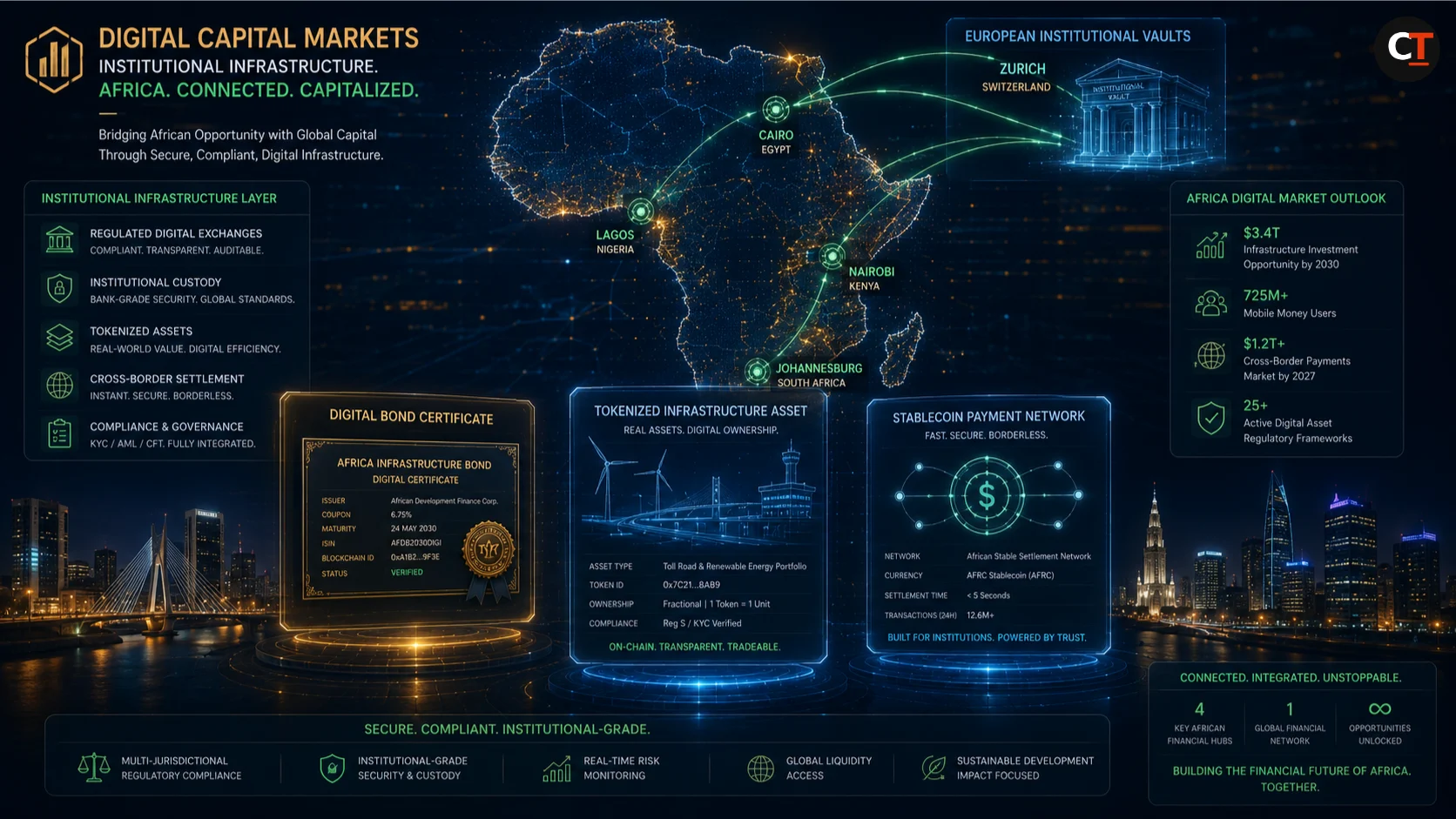
While global commentary still frames African crypto around speculative retail trading, the real story in 2026 has moved to institutional plumbing. From the Africa Finance Corporation’s historic CHF 350M digital bond in Zurich to $1.44B in venture debt and equity, here is how distributed ledgers are financing real African infrastructure.
Key Takeaways
- Historic Institutional Milestone: Africa Finance Corporation (AFC) issued a CHF 350M (~$431M USD) 5-year digital bond on the SIX Digital Exchange (SDX), the largest digital bond in Swiss market history.
- H1 2026 Funding Dynamics: African tech startups raised $1.44B across 146 deals. Fintech captured 41% of all capital, with Egypt, Nigeria, Kenya, and South Africa driving 58% of total volume.
- Invisible Settlement Rails: Stablecoins have shifted from retail trading to institutional cross-border infrastructure, with platforms like Onafriq scaling USDC across 40+ countries to bypass $5B in annual SWIFT fees.
- Regulatory Codification: Kenya, South Africa, and Nigeria completed the transition from informal warnings to formal VASP licensing, regulated digital securities platforms, and mandatory cross-border surveillance.
For a decade, the international narrative surrounding African financial technology focused on peer-to-peer mobile money.
Platforms like M-PESA demonstrated that emerging economies could bypass physical bank branches entirely. When cryptocurrency arrived, millions of citizens in Lagos, Nairobi, and Johannesburg adopted digital assets to protect their savings against local currency devaluations and escape punishing bank wire fees.
In 2026, that retail adoption has evolved into an institutional reality.
African development finance institutions, commercial banks, and fintech infrastructure giants are no longer running small-scale pilot programs. They are issuing multi-hundred-million-dollar tokenized debt instruments on regulated European digital exchanges, tokenizing trade receivables to finance small businesses, and using dollar stablecoins as the invisible clearing rail for continental commerce.
This shift connects directly to the core premise of real-world asset tokenization: replacing fragmented, high-friction legacy plumbing with programmable, 24/7 digital ledgers.
The Landmark Issuance: AFC’s CHF 350 Million Digital Bond
On August 12, 2026, the Africa Finance Corporation (AFC), the continent’s premier infrastructure development finance institution, executed an issuance that reshaped the global digital debt market.
Under its US$5 billion Global Medium-Term Note (GMTN) Programme, the AFC issued a CHF 350 million (approximately $431 million USD) 5-year senior digital bond at a fixed coupon of 1.4925%.
This was the first digital bond from an African institution to be listed, traded, and settled entirely through regulated digital market infrastructure, and stands as the largest digital bond ever issued in the Swiss franc market.
| Bond Parameter | Structure & Execution Details |
|---|---|
| Issuer | Africa Finance Corporation (AFC) [S&P ‘A’ Positive / Moody’s ‘A3’ Stable] |
| Total Volume | CHF 350,000,000 (~$431M USD equivalent at issuance) |
| Tenor & Coupon | 5-Year Senior Unsecured / 1.4925% Annual Fixed Coupon |
| Exchange & Trading | SIX Swiss Exchange (Zurich) |
| Digital Depository | SIX Digital Exchange (SDX) via Distributed Ledger Technology |
| Clearing & CSD | SIX SIS AG (World’s first FINMA-approved hybrid Central Securities Depository) |
| Investor Demand | 90% Swiss Domestic Institutional (57% Banks, 37% Asset Managers, 6% Hedge Funds) |
The structural mechanics of this bond illustrate the maturation of institutional tokenization.
The bond was not issued on an experimental, permissionless blockchain with speculative retail liquidity. It was recorded natively on DLT within the regulated perimeter of the SIX Digital Exchange (SDX) and bridged to SIX SIS, allowing traditional institutional fund managers to purchase and custody the digital asset using their standard custodial interfaces.
By issuing on digital rails, the AFC secured pricing inside its secondary curve while opening up an entirely new pool of European institutional liquidity to finance power grids, transport corridors, and telecommunications infrastructure across Africa.
African Tech & Fintech Funding in H1 2026: Fewer, Bigger Checks
While multilateral institutions unlocked wholesale digital debt markets, African venture funding demonstrated stability despite global macroeconomic tightening.
According to data tracked across the continent in H1 2026:
- Total Capital Raised: Approximately $1.36 billion to $1.44 billion, holding flat compared to H1 2025.
- Deal Consolidation: Disclosed transactions dropped from 252 deals in H1 2025 to 146 deals in H1 2026, indicating that capital concentrated heavily into mature, revenue-generating platforms.
- Instrument Breakdown: 66% equity ($900 million) and 33% debt ($450 million), reflecting a rising preference for venture debt to finance balance-sheet lending.
- Sector Concentration: Fintech captured 41% of all funding, followed closely by climate tech at 39%.
| Country Hub | H1 2026 Capital | Market Share | Key Ecosystem Drivers |
|---|---|---|---|
| Egypt | ~$327 Million | 27% | Led by massive clean-mobility financing (Spiro $270M raise) and enterprise B2B payments. |
| Nigeria | ~$254 Million | 21% | Equity funding leader across Africa with 40 major deals ($214M in pure equity), driven by payment switches and cross-border trade platforms. |
| Kenya | ~$126 Million | 10% | Dominant hub for East African digital remittances, asset financing, and mobile agricultural credit. |
| South Africa | ~$83 Million | 7% | Focused on institutional CASP compliance, B2B digital banking, and regulated asset management. |
Use Cases Driving On-Chain Capital: Remittances and Private Credit
The growth of African blockchain infrastructure is propelled by two fundamental structural problems: the high cost of cross-border payments and the small-business credit gap.
1. Cross-Border Settlement: Bypassing the $5 Billion SWIFT Tax
Traditional correspondent banking in Africa has historically been the most expensive in the world. Intra-African transfers frequently route through correspondent banks in New York, London, or Paris, taking three to five business days and extracting 8% to 15% in foreign exchange spreads and intermediary fees.
In 2026, stablecoins have become the primary settlement rail:
- Onafriq Network Scale: The pan-African payments network is scaling USDC-based settlement across more than 40 African markets, directly targeting the estimated $5 billion in annual fees lost to legacy correspondent banking friction.
- Mobile Money Integration: In a pilot launched across the Democratic Republic of Congo by Visa, M-PESA Africa, and Onafriq, consumers send and receive local currency through their mobile wallets while the backend clearing settles over stablecoin rails in real time.
- Worker Remittances: A 2026 study by BVNK found that stablecoins represent roughly one-third of total earnings for African digital cross-border workers, with 95% of surveyed workers preferring payment in dollar stablecoins to protect against domestic currency inflation.
2. Tokenized Private Credit and Working Capital
The second breakthrough is tokenized debt for small and medium-sized enterprises (SMEs).
Across Africa, the SME financing gap exceeds hundreds of billions of dollars. Public procurement suppliers frequently face government payment arrears averaging 3.3% of national GDP, leaving viable businesses starved of working capital.
By converting verified government invoices and trade receivables into tokenized debt notes, lenders can fractionalize cash-flowing assets and sell them to regional and international institutional investors.
Global digital asset arms like Nomura’s Laser Digital have partnered with RWA platforms like ZIGChain to structure institutional private credit vaults, targeting over $100 million in on-chain credit for emerging markets.
For a deep dive into how institutional sovereign debt yield products compare to emerging market private credit, read our guide on tokenized US Treasuries.
Regulatory Postures: Kenya vs. South Africa vs. Nigeria
African regulators have replaced informal circulars with comprehensive, statutory licensing regimes:
| Jurisdiction | Primary Regulators | Core Legislative Framework | Key Requirements & Timelines |
|---|---|---|---|
| Kenya | Central Bank of Kenya (CBK) & Capital Markets Authority (CMA) | Virtual Asset Service Providers Act 2025 & Regulations 2026 (LN 134) | Split mandate: CBK regulates stablecoins (KES 300M capital, 30% local bank trust reserves); CMA regulates tokenized securities. Compliance deadline: November 4, 2026. |
| South Africa | Financial Sector Conduct Authority (FSCA) & Reserve Bank (SARB) | FAIS Act (General Notice 1350) & Draft Cross-Border Crypto Manual 2026 | Over 310 CASP licenses approved by March 2026. Mandatory reporting to SARB Financial Surveillance (FinSurv) for all cross-border token transfers within exchange control allowances. |
| Nigeria | Securities and Exchange Commission (SEC) & Central Bank (CBN) | Investments and Securities Act 2026 & SEC Digital Asset Rules | ₦2 billion paid-up capital for digital exchanges/custodians. SEC approved the NASD Digital Securities Platform (NDSP) on Blockstation for tokenized equities and bonds. |
How Cross-Border Flows Work in Practice
Unlike early permissionless transfers, a compliant cross-border token transaction in 2026 operates through a structured four-stage architecture:
- Onboarding & Tiered KYC: Investors complete identity verification through an authorized CASP or broker-dealer, verifying tax residency and allowable foreign remittance limits.
- On-Chain Creation & Custody: Tokenized securities (such as bonds on Nigeria’s NDSP or Switzerland’s SDX) are held in legally ring-fenced fiduciary custody, separating client tokens from exchange balance sheets as detailed in our guide on SPVs and legal wrappers.
- Settlement & Foreign Exchange: The trade executes on-chain via smart contracts while fiat conversions settle through central bank or authorized dealer channels.
- Regulatory Reporting: In South Africa, the transaction is automatically reported to SARB’s FinSurv database; in Kenya and Nigeria, AML/CFT transaction monitoring data is transmitted directly to statutory oversight authorities.
The Global Perspective: Emerging Markets Leading Adoption
Africa’s progression from retail trading to institutional digital securities mirrors developments across other forward-looking emerging markets:
- Latin America’s adoption of regulated stablecoins and VASP registries under Argentina’s CNV framework.
- Central Asia’s dedicated mining valleys and exchange tiers under Uzbekistan’s NAPP rules.
- India’s institutional wholesale bond pilots and Digital Rupee settlement under SEBI and RBI oversight.
- The United Kingdom’s comprehensive FSMA Part 4A regime under UK FCA regulation.
- European institutional DLT settlement infrastructure operating under EU MiCA regulation, the same framework governing the Swiss SIX Digital Exchange used in the AFC bond.
- Enterprise settlement and RWA tokenization on the XRP Ledger, powered by the RLUSD stablecoin and XRPL protocol stack.
Investors and platforms navigating this transition must also account for technical and servicing vulnerabilities. Before committing capital to tokenized African debt instruments, read our companion breakdown of the real risks of tokenized assets, and our guide on whether you can actually sell a tokenized bond in a downturn.
Africa is not merely participating in the tokenization economy. It is providing the real-world proof of its utility.
When legacy financial rails impose 15% transaction costs and exclude viable infrastructure projects from global capital, blockchain technology ceases to be an academic debate. It becomes necessary infrastructure.
From Zurich-listed sovereign development bonds to pan-African stablecoin clearing networks, the integration of distributed ledgers into African finance is building a faster, cheaper, and more inclusive capital market for the next century.