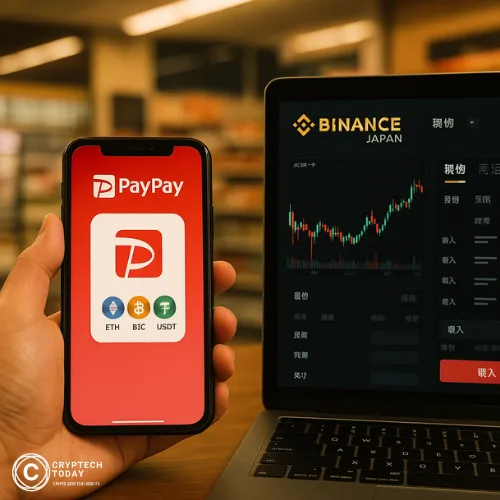
SoftBank-backed PayPay’s acquisition of a 40% equity stake in Binance Japan is a clear signal that Japan’s cashless-payments world is moving closer to cryptocurrency markets. Announced on October 9, 2025, the deal makes Binance Japan an equity-method affiliate of PayPay and paves the way for PayPay’s 70 million users to buy and sell crypto directly using PayPay Money inside the Binance app. The move is strategic: it pairs one of Japan’s most ubiquitous payment rails with a global crypto exchange at a moment when Tokyo is actively reshaping crypto rules. (PayPay株式会社)
For PayPay, the logic is straightforward. The app already processes billions of QR-code transactions and commands a dominant share of Japan’s mobile-pay market; adding crypto onramps deepens engagement and opens new revenue streams from trading, custody and value-added services. For Binance Japan, which re-entered the market by acquiring Sakura Exchange Bitcoin in 2022 and rebranding in 2023, the alliance accelerates mainstream distribution and regulatory legitimacy through a Japanese heavyweight partner. Early product details promise direct fiat crypto purchases via PayPay Money and crypto-to-fiat withdrawals into PayPay wallets, a convenience that will materially lower friction for everyday users. (Binance)
Why the PayPay–Binance tie-up matters now
The timing could not be more consequential. Japan’s Financial Services Agency has been moving to recategorise certain crypto assets under the Financial Instruments and Exchange Act, a shift that would treat many tokens as financial products by 2026 and introduce stricter market rules, clearer investor protections and a potentially lower, uniform tax regime for gains. By aligning with PayPay, Binance Japan gains a partner with deep local distribution and compliance know-how just as regulatory clarity approaches. For PayPay, the deal diversifies its product set at a time when the company is preparing for high-profile fundraising and possible listings.
How the integration could reshape payments and markets
The partnership promises more than a simple payment integration. By embedding crypto trading and custody into a mass-market wallet, PayPay and Binance Japan can create workflows where tokenised assets plug directly into daily payments, rewards and merchant settlement. Imagine loyalty points convertible into tokenised assets, or merchants accepting crypto that settles into PayPay Money instantly; those are the product pathways on the table.
For merchants, lower settlement friction and the prospect of instant settlement or programmable payouts could reduce float and settlement fees; for consumers, frictionless crypto access may accelerate adoption among users who previously avoided exchanges. PayPay’s scale, with some estimates putting its QR-pay market share at 60–70% turns those hypothetical use cases into high-impact experiments. (Yahoo Finance)
The compliance playbook
A critical element behind the scenes will be compliance architecture. Japan’s exchange regime is among the most stringent in Asia, and Binance Japan, as a licensed exchange since its SEBC acquisition, operates under the Payment Services Act and other AML/CFT rules. PayPay’s involvement raises expectations that integrated user flows will meet rigorous KYC, transaction monitoring and custody standards. Both firms have publicly stressed regulatory cooperation in their announcements, suggesting they view compliance as a competitive advantage rather than a cost centre. (PR Newswire)
Risks and policy questions
Even so, the union raises thorny questions. Integrating crypto into mainstream payment rails could amplify AML, consumer protection and operational risks unless safeguards are tightened. Regulators will be watching closely: will PayPay users face different tax or reporting regimes when they buy crypto via an app that doubles as a payments wallet? How will instant withdrawals to PayPay Money be reconciled with existing capital flow and disclosure rules? And politically, the optics of a SoftBank-backed payments champion owning a major piece of Binance’s local unit will draw scrutiny from both lawmakers and privacy advocates. (blockpass.org)
Market structure issues also matter. If large volumes of retail users migrate to Binance Japan via PayPay, liquidity, custody load, and AML monitoring demands could increase rapidly. Exchanges and payment platforms will need to invest heavily in real-time monitoring, scalable custody (including institutional-grade cold storage and insurance), and customer education to prevent fraud and operational errors.
What it means for incumbents and competitors
Traditional banks and card networks in Japan face a choice: accelerate their own token integrations or establish tighter settlement partnerships with companies like PayPay and fintechs. For incumbent exchanges, competition will intensify as distribution becomes a primary battleground. For regulators, the deal tests whether Japan’s evolving legal framework can strike a balance between investor protection and product innovation, and whether tax changes (such as the proposed shift toward a uniform 20% capital gains tax on crypto) will significantly alter retail behaviour.
Author’s Thoughts
The PayPay Binance Japan 40% stake deal is a textbook example of crypto moving from the margins into core financial infrastructure. It is not merely about offering a new feature inside an app; it’s a structural bet that payments, trading and custody can be stitched into a single experience. If the partners execute on compliance, custody and merchant integration, Japan could become a lab for mass-market crypto services under clear regulatory supervision. But that future only arrives if regulators, banks and platforms treat user protection as a precondition, not an afterthought.