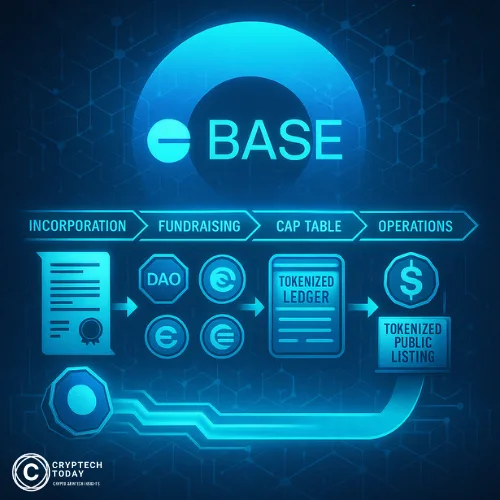
Coinbase’s latest moves make one thing obvious: the company is no longer satisfied with being “just” an exchange. By acquiring on-chain fundraising platform Echo, doubling down on its Base Layer-2 and publicly sketching a future where startups incorporate, fundraise, operate, and list on-chain, Coinbase is trying to lock together an end-to-end capital-formation stack. If it works, the startup lifecycle from pitch deck to public market becomes dramatically faster, more global and more programmable. If it fails, the effort will expose thorny regulatory, custody and market-structure questions that no single company can solve alone.
What Coinbase is building — the components of an on-chain lifecycle
At its most basic, Coinbase’s thesis stitches together several technical and product pillars:
- On-chain incorporation & governance. Entities could be formed as DAOs or tokenised vehicles with coded governance, replacing paper-based incorporation steps with smart contracts and verifiable on-chain records.
- On-chain fundraising. Echo’s Sonar product and similar tooling enable private and public token sales denominated in stablecoins like USDC, while automating allocation, vesting and cap-table updates. Echo’s track record (helping projects raise >$200m) is now being folded into Coinbase’s offering via the recent acquisition.
- Tokenised cap tables & secondary markets. Equity (or equity-like) tokens can represent ownership, with secondary trading and custody integrated through Coinbase’s custody stack and marketplace.
- On-chain operations & treasury. Payroll, payments, and treasury management could run through stablecoins and DeFi primitives on Base or other Layer-2s, enabling instant settlements and programmable flows.
- On-chain IPOs / tokenised public listings. Coinbase positions itself to host compliant, regulated on-chain public offerings, a convergence of token economics and capital markets infrastructure.
Taken together, these elements promise a single platform where cap tables, fundraising rounds, investor rights and liquidity events are reflected automatically in smart contracts, real-time, auditable and global.
Why Echo matters (and why Coinbase bought it)
Echo brings practical plumbing. Its Sonar product hosts both private and public token raises, automates investor onboarding, and maintains on-chain allocation records. By folding Echo into Coinbase, the exchange gains an immediate pipeline for tokenised capital formation and accelerates the practical rollout of tokenised securities and regulated offerings. Coinbase’s deal (≈$375m cash + stock) signals an aggressive strategy to own the fundraising layer, not merely provide rails for trading.
Echo’s integration also tackles the most painful parts of token offerings: investor accreditation, anti-money-laundering checks, and distribution mechanics. That technical progress reduces friction, a prerequisite for any credible push toward on-chain IPOs.
Base and the monetisation thesis
Coinbase’s Base Layer-2 is the intended settlement and execution environment for much of this activity. The economics are clear: increased on-chain activity on Base could create substantial monetisation opportunities for Coinbase, and banks like JPMorgan are publicly optimistic about Base’s upside potential. JPMorgan’s recent modelling suggests a very large value pool tied to Base’s growth, reinforcing Coinbase’s incentive to bootstrap an ecosystem of tokenised fundraising and on-chain startups. But building network effects is costly and competitive, and the platform must deliver predictable costs, privacy controls and developer ergonomics for enterprises to migrate.
The promise: faster, cheaper, more democratic capital formation
If the vision succeeds, the benefits are tangible:
- Speed: Fundraising that today takes weeks or months (legal, escrow, wire transfers) could close in hours with programmable distributions and on-chain escrow.
- Lower costs: Legal and banking fees could shrink as compliance and allocation processes are codified and automated.
- Global accessibility: Accredited or retail investors worldwide can participate without the friction of cross-border banking rails, enabling broader retail inclusion.
- Continuous liquidity: Tokenised secondary markets enable earlier liquidity for founders and employees, potentially democratizing access to pre-IPO gains.
These are not hypothetical Echo’s prior raises, and Sonar pilots show on-chain deals can function at scale. Coinbase’s custody, compliance tooling and exchange front end give the model a plausible delivery path.
Hard realities: regulation, securities law and investor protection
The biggest challenge is legal, not technical. Securities laws in the US and other major markets were not written for tokenised equity or open secondary trading of private company tokens. On-chain fundraising raises immediate issues:
- Securities classification & registration. Tokenised equity will likely be treated as securities in many jurisdictions; compliance needs robust KYC, accredited-investor checks, prospectuses or exemptions, and registration regimes.
- Cross-border enforcement. Global retail participation creates conflicts between issuer-home regulators and investor-home jurisdictions. Whose disclosure regime governs? How are fraud claims litigated?
- Custody & trustee responsibilities. Tokenised equity custody implicates fiduciary duties that exchanges and custodians must meet; Coinbase already faces scrutiny on custody and listings practices that will only intensify with a primary and secondary on-chain market. (Coinbase)
Coinbase is engaging regulators (it says) and piloting within existing frameworks, but the legal scaffolding for on-chain IPOs at scale remains incomplete. Any rush to market could trigger enforcement actions that set back the broader program.
Market structure and liquidity fragmentation
Another non-technical risk is market fragmentation. If multiple chains, token standards and venues support tokenised securities, liquidity could splinter across platforms, undermining price discovery and increasing spreads. Coinbase’s strategy to centre much activity on Base helps, but competing Layer-2s and institutional preferences mean aggregation or interoperability layers will be essential to sustain deep markets.
There’s also the behavioural question: will venture capitalists and boards embrace earlier liquidity? Institutional incentives carry, control, and governance may resist wholesale tokenisation unless secondary trading is designed to preserve established investor protections.
Security, governance and UX challenges
Tokenised cap tables and on-chain governance can be powerful, but they also concentrate operational risk (smart-contract bugs, private-key loss, front-running). Enterprise adoption demands battle-tested custody, multisig models, robust upgrade paths and user experiences that hide cryptographic complexity behind trusted workflows. Coinbase’s custody stack and developer tooling (and its acquisitions) are intended to address this, but implementation complexity remains nontrivial.
How big is the opportunity — and who benefits?
Estimates vary: investment banks and research houses highlight multi-billion dollar opportunities tied to Layer-2 adoption and on-chain monetisation. JPMorgan’s analysis of Base suggests upside in the tens of billions if Coinbase captures network effects and new product glue (custody, tokenisation, transaction fees). For startups outside traditional venture hubs, tokenised fundraising could democratize access; for exchanges and custody providers, it’s a new product line with sticky revenue. But the value will accrue only to platforms that win trust, regulatory alignment and developer mindshare.
Author’s thoughts — pragmatic optimism with guardrails
Coinbase’s on-chain startup thesis is plausible and timely: fundraising frictions are real, and programmable settlement lends itself to novel liquidity and governance models. Echo gives Coinbase immediate capability; Base provides the rails. Yet, the initiative’s success depends more on regulatory harmonisation, institutional safeguards and clear investor protections than on the technical stack alone. If Coinbase advances slowly with transparent pilots, audited processes and active regulator engagement, it can create a meaningful new market. If it pushes too fast, enforcement and fragmentation risks could slow progress for everyone.
Generational opportunity, but not a fait accompli
Coinbase is assembling the pieces for a radical re-wiring of capital formation. Echo and Base give it plausible pathways to bring incorporation, fundraising, operations and public listings on-chain. The potential gains, speed, lower costs, and global access are real. But the policy and market building necessary to render that promise durable will require time, cross-border cooperation and careful governance design. For founders and investors, Coinbase’s blueprint is an invitation: the rails are being laid, but the market still must agree on the rules of the road.