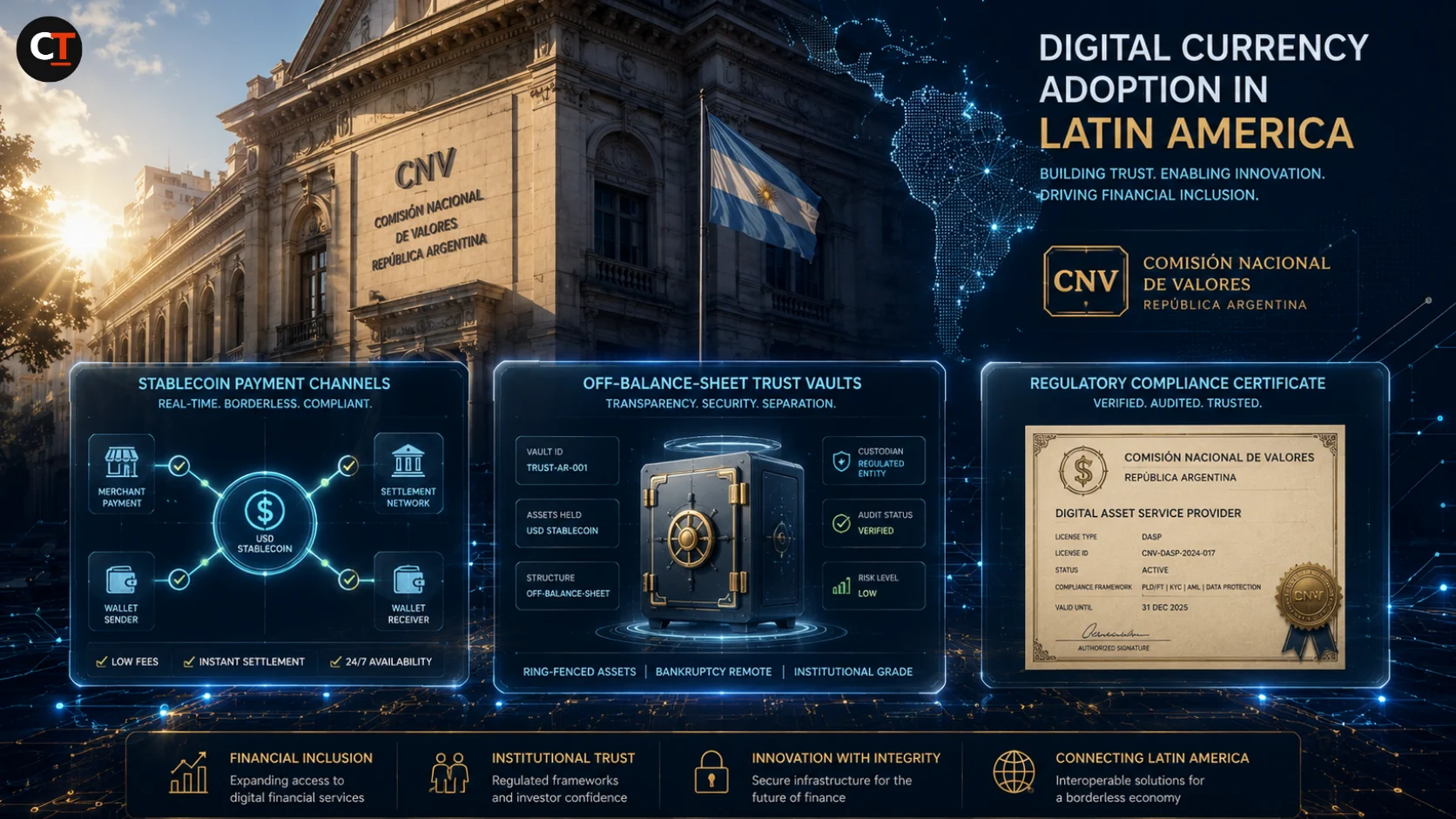
While most nations debate crypto theory, Argentina uses digital dollars to survive inflation. Now, the Milei administration and the CNV have built a formal supervisory regime balancing FATF compliance against everyday monetary freedom. Here is how the Argentine licensing framework works.
Key Takeaways
- Mandatory PSAV Registration: All domestic and foreign platforms targeting Argentine users must register with the National Securities Commission (CNV) under Law 27,739.
- Strict Asset Segregation: General Resolution 1058/2025 mandates off-balance-sheet custody, ring-fencing client assets from company bankruptcy and banning unauthorized token lending.
- Currency Freedom in Contracts: Presidential Decree DNU 70/2023 allows parties to settle legal contracts, commercial transactions, and employee compensation directly in Bitcoin or stablecoins.
- Personal Director Liability: Corporate shields can be pierced under General Companies Law 19,550, exposing exchange executives to unlimited personal liability for custody breaches.
In most Western economies, buying cryptocurrency is an investment decision.
In Argentina, it has long been an act of basic household preservation.
Decades of chronic currency debasement, recurring sovereign debt restructurings, and stringent foreign exchange restrictions (known locally as the cepo cambiario) forced millions of Argentine citizens to treat digital dollars as an everyday monetary lifeline. Over 60% of all cryptocurrency volume in the country flows through stablecoins like USDT and USDC.
Yet for years, this massive market operated in a legal twilight zone. Local fintechs grew rapidly, foreign exchanges onboarded millions of users, and international freelance salaries flowed across blockchains with little formal regulatory oversight.
That informal era ended with the enactment of Law No. 27,739 and the rollout of General Resolution CNV No. 1058/2025.
Under the libertarian administration of President Javier Milei, Argentina has pulled off a delicate balancing act: constructing a rigorous, FATF-compliant licensing regime for Virtual Asset Service Providers (VASPs) while simultaneously enshrining full freedom of currency for contracts and commerce.
The Statutory Foundation: Law 27,739 and FATF Alignment
Argentina’s regulatory transition was driven by a pressing international deadline: the fourth-round mutual evaluation by the Financial Action Task Force (FATF).
To prevent the country from being placed on the FATF “Grey List” (which would have severely restricted international banking lines and foreign investment), the Argentine National Congress passed Law No. 27,739 in early 2024, amending the primary Anti-Money Laundering statute (Law No. 25,246).
Law 27,739 officially defined Virtual Asset Service Providers (Proveedores de Servicios de Activos Virtuales or PSAV) and designated the National Securities Commission (Comisión Nacional de Valores, CNV) as the sole national supervisory authority empowered to create, maintain, and enforce the mandatory PSAV registry.
Under this legislation, crypto platforms are formally designated as reporting entities (sujetos obligados) before the Financial Information Unit (Unidad de Información Financiera, UIF). This mandates:
- Appointment of dedicated, vetted AML/CFT Compliance Officers (Oficial de Cumplimiento).
- Implementation of institutional Know-Your-Customer (KYC) and transaction monitoring protocols.
- Mandatory submission of Suspicious Transaction Reports (STRs / Reportes de Operaciones Sospechosas).
- Strict enforcement of FATF Recommendation 16 (the Travel Rule) for virtual asset transfers exceeding statutory thresholds.
Who Must Register: Domestic vs. Foreign Platform Scope
The CNV regulatory net is intentionally broad. Any company providing exchange, custody, transfer, administration, or financial intermediation involving virtual assets within Argentine territory must obtain PSAV registration.
| Platform Category | Representative Examples | Key Regulatory Requirements |
|---|---|---|
| Domestic Entities | Lemon Cash, Ripio, Belo, Buenbit | Must incorporate locally as an S.A. or S.R.L., maintain a registered Argentine legal address, meet minimum net worth rules, and comply with full ARCA tax reporting. |
| Foreign Entities | Binance, Bitget, OKX, Bybit | Captured if using “.ar” web domains, running targeted local marketing, offering direct Peso fiat rails/P2P, or deriving >20% of global business volume from Argentina. |
| De Minimis Traders | Individual peer-to-peer traders | Exempt from mandatory registration if aggregate monthly transaction volume does not exceed 35,000 Purchasing Power Units (UVA). |
The inclusion of foreign exchanges with a 20% volume threshold or local marketing operations eliminated the traditional offshore loophole. Major international exchanges like Bitget and Binance moved quickly to formalize their registrations with the CNV to protect their Argentine user bases.
CNV Resolution 1058/2025: The 4 Pillars of Asset Custody
While registration established the registry, General Resolution CNV No. 1058/2025 created the substantive prudential rulebook, focusing heavily on Category 4 providers (Custody and Administration of Virtual Assets).
The resolution enforces asset protection across four strict operational pillars:
1. Off-Balance-Sheet Accounting (Cuentas de Orden)
Under Article 16 of RG 1058/2025, customer virtual assets can never be booked as balance sheet assets of the crypto platform. They cannot be computed toward the company’s required minimum net worth, which is set at USD 150,000 for custodial providers.
Customer holdings must be tracked strictly through off-balance-sheet memorandum accounts (cuentas de orden). This creates absolute legal ring-fencing: if the exchange goes bankrupt, client assets do not form part of the general liquidation estate and cannot be seized by corporate creditors.
This legal mechanism mirrors the bankruptcy-remote trust models used in institutional tokenization, as detailed in our guide on SPVs and legal wrappers.
2. Prohibition of Unauthorized Rehypothecation
Argentine custodians are strictly prohibited from lending, staking, pledging, or deploying client deposits into proprietary trading or decentralized finance (DeFi) protocols without explicit, unambiguous, and separate written client consent.
Platforms must configure their key management hierarchy (cold, warm, and hot wallets) to ensure that customer assets remain immediately available for unhindered withdrawal at all times.
3. Sub-Custodian Pass-Through and Liability
Many domestic fintechs rely on third-party institutional infrastructure providers (such as BitGo, Fireblocks, or Coinbase Prime) or offshore parent entities for key storage. RG 1058/2025 establishes strict rules for these arrangements:
- Non-Delegable Liability (Responsabilidad Plena): The registered Argentine entity retains 100% legal responsibility before the CNV and end users for any security breach, hack, or operational loss occurring at the third-party sub-custodian level.
- Fiduciary Sub-Account Partitioning: Sub-custodian accounts must be legally tagged in the name of the Argentine PSAV as third-party client accounts (cuenta de terceros), strictly segregated from the sub-custodian’s own corporate balance sheet.
- Real-Time Mirror Ledgers: Platforms must maintain an internal, real-time mirror ledger that maps every satoshi or token fraction in an aggregated sub-custody wallet to individualized customer account IDs.
4. Verifiable Proof of Reserves and Audits
Providers must maintain auditable logging systems capable of demonstrating to CNV inspectors that the total sum of individualized customer liabilities exactly matches verifiable on-chain wallet balances and third-party custodial holdings in real time.
Taxation of Crypto in Argentina Under the Milei Administration
Under President Javier Milei, Argentina underwent a significant fiscal and institutional overhaul. The former Federal Administration of Public Revenue (AFIP) was dismantled and replaced by the streamlined Agency for Collection and Customs Control (ARCA).
Concurrently, the fiscal package under Law No. 27,743 (the Ley Bases fiscal framework) restructured the tax treatment of digital assets:
| Tax Category | Applicable Rates & Rules | Practical Impact on Investors |
|---|---|---|
| Income Tax (Ganancias) | 15% flat rate on net capital gains for foreign currency/crypto pairs; 5% for Argentine Peso pairs. Corporate trading taxed at standard progressive rates up to 35%. | Provides tax certainty for individual traders, avoiding punitive discretionary brackets. |
| Personal Assets Tax (Bienes Personales) | Crypto holdings held on December 31 are included as taxable wealth. Substantially increased exemption thresholds indexed to inflation. | Significantly shields average retail savers while gradually reducing the maximum marginal wealth tax rate. |
| Asset Regularization (Blanqueo) | 0% penalty tax on previously undeclared digital assets up to USD 100,000 declared under the formal amnesty program. | Incentivized massive repatriation and formal reporting of offshore crypto savings into the regulated system. |
| Contractual Freedom | Decree of Necessity and Urgency (DNU 70/2023) established complete contractual freedom. | Parties can legally price and settle private contracts, commercial leases, and employee salaries in Bitcoin or stablecoins. |
Director and Executive Personal Liability: Piercing the Corporate Shield
One of the most consequential aspects of the Argentine regime is the direct personal exposure faced by exchange executives and board members under the General Companies Law (Ley General de Sociedades No. 19,550, LGS).
If a crypto platform mismanages client funds, executives cannot hide behind the corporate entity:
1. The Standard of Diligence (Article 59 LGS):
Directors and managers must act with the loyalty and diligence of a “good businessperson” (buen hombre de negocios). Any failure to maintain proper custody or comply with CNV mandates breaches this standard.
2. Unlimited Joint-and-Several Liability (Article 274 LGS):
Any violation of the law, company bylaws, or CNV regulations automatically triggers unlimited personal liability. Directors must cover customer losses and regulatory fines with their own personal wealth.
3. Piercing the Corporate Veil (Article 54, Paragraph 3 LGS):
If a corporate structure is used to defraud depositors, violate public order, or breach custodial segregation, the separate legal personality of the company is disregarded, merging corporate liabilities directly into the personal estates of controlling executives.
4. Criminal Fraud Prosecution:
Executives who commingle client deposits or deploy user tokens into speculative protocols face criminal charges for fraudulent administration (defraudación por administración fraudulenta) under Article 173(7) of the Argentine Criminal Code, carrying prison sentences of up to six years.
Regional Comparison: Argentina vs. Brazil vs. El Salvador
Latin America has become a global laboratory for digital asset policy, but each major nation has chosen a distinctly different path:
| Regulatory Dimension | Argentina (CNV / UIF) | Brazil (BCB / CVM) | El Salvador (CNAD) |
|---|---|---|---|
| Primary Regulator | Comisión Nacional de Valores (CNV) & Financial Information Unit (UIF). | Banco Central do Brasil (BCB) & Securities Commission (CVM). | National Commission of Digital Assets (CNAD). |
| Core Legal Statute | Law 27,739 & CNV Resolution RG 1058/2025. | Law No. 14,478/2022 (Virtual Assets Legal Framework). | Bitcoin Law (2021) & Digital Assets Issuance Law (2023). |
| Legal Tender Status | Not legal tender, but fully valid for contracts and payments via DNU 70/2023. | Not legal tender; classified as a payment method and financial asset. | Bitcoin is official sovereign legal tender alongside the US Dollar. |
| Market Focus | AML compliance, retail stablecoin hedging, inflation protection, and contract freedom. | Institutional tokenization, corporate debt issuance, and the Drex CBDC pilot. | Sovereign Bitcoin adoption, Volcano bonds, and zero-tax crypto residency. |
| Custody Model | Mandatory off-balance-sheet memorandum accounts and strict sub-custodian liability. | Central bank licensing with segregated patrimony rules under evaluation. | Dual licensing for Bitcoin Service Providers (BSP) and Digital Asset Providers. |
This comparative matrix illustrates the structural divergence across Latin America.
Brazil has pursued an institutional, top-down model centered on major banking institutions and tokenized credit. El Salvador pursued a radical sovereign experiment by adopting Bitcoin as legal tender.
Argentina, by contrast, built a bottom-up framework reflecting economic reality: recognizing that millions of citizens rely on stablecoins for daily survival, ensuring those stablecoin balances are protected in segregated vaults, and giving businesses the legal freedom to contract in whatever currency they choose.
The Global Context: Aligning with International Standards
Argentina’s PSAV framework is part of the broader worldwide maturation of crypto regulation:
- The United Kingdom is implementing its comprehensive FSMA Part 4A regime, as explored in our guide to UK FCA crypto regulation.
- Europe enforces unified CASP standards across 27 nations under EU MiCA regulation.
- India regulates tokenized sovereign bonds and domestic virtual digital asset taxation under SEBI and RBI oversight.
- Central Asia structures tiered licensing for exchanges, depositories, and mining pools under Uzbekistan’s NAPP regime.
- Argentina demonstrates how an emerging market with volatile fiat dynamics can satisfy global FATF transparency demands without destroying retail financial access.
For a foundational understanding of how digital assets are structured on-chain, read our primer on asset tokenization explained. To understand security vulnerabilities and custody breakdowns that threaten on-chain assets regardless of local jurisdiction, review our analysis on the real risks of tokenized assets.
How to Register as a PSAV in Argentina: Step-by-Step
For foreign exchanges, custodians, and fintech platforms targeting Argentine users, the PSAV registration process under CNV and CONAIF runs through the following stages:
- Domicile the Argentine Entity: A locally incorporated Argentine legal entity (SA or SAS) with a registered Buenos Aires address is required. Foreign holding structures cannot register as PSAVs directly; a subsidiary or branch with full Argentine legal personality is mandatory.
- Open the CONAIF Online File: Applications are submitted through the CONAIF (Comisión Nacional de Valores / other regulator as applicable) digital portal. The file opener must be the designated legal representative resident in Argentina with a valid CUIT tax number.
- Documentation Required: The application package includes certified corporate bylaws (estatutos sociales), UBO (Ultimate Beneficial Ownership) declaration for all shareholders above 10%, audited opening balance sheet demonstrating minimum technical capital adequacy, AML/CFT Manual (Manual SIPLAFT) prepared by a certified compliance officer, and a segregated custody plan demonstrating how client cryptoassets will be kept fully off-balance sheet per CNV Resolution 1058.
- Compliance Officer Registration: Each PSAV must designate a named Compliance Officer (Oficial de Cumplimiento) enrolled directly with UIF (Unidad de Información Financiera). This officer is personally liable for all AML/CFT reporting under FATF Recommendation 16 and any future UIF instructions.
- CNV Review and PSAV Registry Entry: The CNV reviews the dossier and publishes the approved PSAV’s name, legal address, and registration number on its public registry. Once listed, the PSAV may legally serve Argentine users. Review timelines are not fixed by statute, but practice runs 60 to 120 business days for complete files.
- Ongoing Obligations Post-Registration: PSAVs must submit quarterly UIF reports on suspicious transaction activity, maintain client asset segregation monthly certifications, and notify the CNV of any material change in ownership, operating model, or technical infrastructure within five business days.
Argentina’s crypto regulatory framework is neither an uncritical endorsement of crypto speculation nor an authoritarian crackdown.
It is a pragmatic response to monetary reality.
By establishing clear rules for PSAV registration, enforcing ironclad off-balance-sheet asset segregation under Resolution 1058, and maintaining contractual freedom under DNU 70/2023, Argentina has transitioned from a volatile frontier market into one of the most clearly regulated, high-adoption digital asset ecosystems in the world.