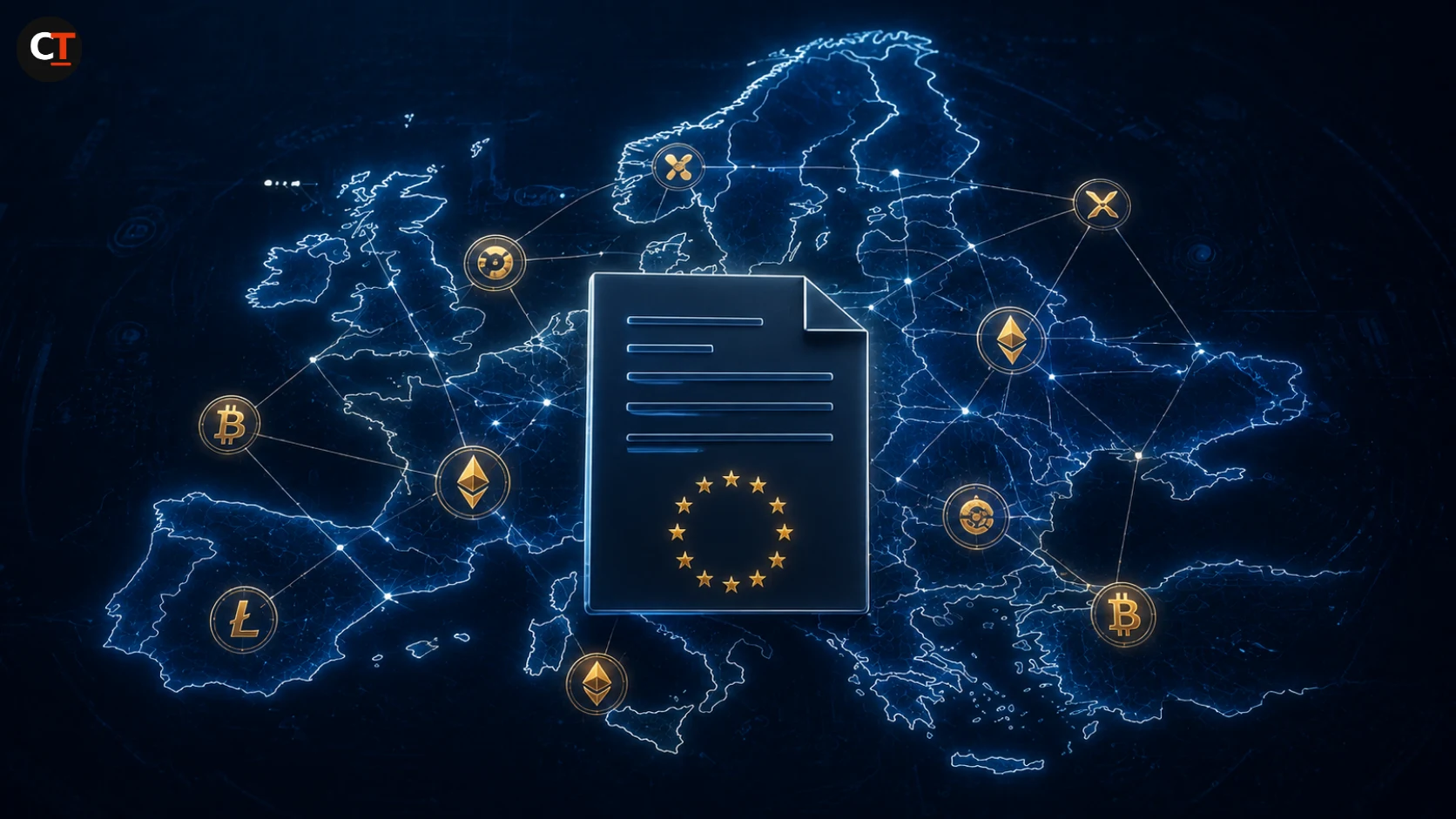
The EU has replaced a patchwork of national crypto rules with one unified framework. MiCA is live. If you hold crypto on a European exchange, use stablecoins, or send crypto across borders inside the EU, this affects you directly.
- MiCA (Markets in Crypto-Assets Regulation) is fully in force as of December 2024, covering exchanges, custodians, stablecoin issuers, and crypto advisers across the EU.
- Exchanges need an official MiCA licence to operate for EU customers. Coinbase and Kraken have secured authorisation; Binance’s status remains incomplete in key EU jurisdictions.
- Stablecoins face the strictest rules: EU-established issuers, 1:1 reserves, redemption rights. Offshore stablecoins not meeting MiCA conditions face restricted access to EU platforms.
- The crypto Travel Rule now applies to every transfer, with no minimum value threshold. Your name and wallet information travel with your crypto.
Why MiCA Matters Even If You Are Not in Europe
Crypto is borderless. Regulation is not.
The EU’s Markets in Crypto-Assets Regulation, formally Regulation (EU) 2023/1114, is the most comprehensive crypto regulatory framework enacted by any major economic bloc. It covers roughly 450 million people and the world’s largest single market. When the EU sets rules for exchanges, stablecoins, and crypto transfers, the consequences reach platforms and investors far beyond European borders.
For an Indian investor using an EU-licensed exchange, a global crypto trader holding USDT or USDC, or a crypto startup thinking about European expansion, MiCA is not an abstract regulatory discussion. It directly shapes which assets are available, how your transfers work, and whether your preferred platform is legally operating in its target market.
This article covers what MiCA actually requires, what it means for you as a user, and what the framework demands from businesses trying to operate inside the EU.
What MiCA Actually Is
Before MiCA, EU crypto regulation was fragmented. France had its DASP regime. Germany had its own rules. Malta, Gibraltar, and others had separate frameworks. A crypto exchange serving 27 EU member states needed to navigate 27 different sets of rules.
MiCA replaced all of that with a single, directly applicable EU-wide regulation.
It covers crypto-assets and related services that are not already regulated as conventional financial instruments under existing EU financial law. The regulation rolled out in two phases:
- 30 June 2024: Stablecoin rules (e-money tokens and asset-referenced tokens) began applying.
- 30 December 2024: The full regime for crypto-asset service providers (CASPs) and all other token issuers came into force.
MiCA does not cover every type of digital asset. NFTs, certain utility tokens, and financial instruments already regulated under MiFID II remain outside its scope. But it captures the core of what most people actually use: crypto exchanges, custodians, stablecoins, and advisory services.
What Changes for You as an Investor or User
Your Exchange Needs a Licence
Any crypto exchange, broker, custodian, or platform serving EU customers must now hold a MiCA authorisation or operate under a permitted transition arrangement. National regulators in each member state grant licences, which then passport across the entire EU. One licence, 27 countries.
In practice, this has already shifted the landscape. Coinbase obtained its MiCA licence through its Irish entity in early 2025, giving it full access to the EU market. Kraken secured authorisation through its existing European structure. Bitstamp, based in Luxembourg, was well-positioned given its long-standing EU regulatory relationships.
Binance’s position is more complicated. Its EU-facing operations have faced ongoing scrutiny, and as of mid-2026 it has not secured full MiCA authorisation across all major EU jurisdictions. Users on unlicensed platforms face real risk: regulators can block, restrict, or wind down operations, and unlicensed platforms have no obligation to meet MiCA’s consumer-protection standards around asset safeguarding.
The practical check for any EU-based crypto user: verify your platform appears on the relevant national regulator’s authorised CASP registry. If it does not, it is operating outside the MiCA framework.
Your Assets Are Protected Differently Now
MiCA requires licensed CASPs to segregate client crypto from their own assets. Platforms cannot use client funds for proprietary trading without explicit consent. This directly addresses the FTX-style failure mode, where customer funds were commingled with house funds and then lost.
That is not a trivial protection. For investors who keep crypto on centralised exchanges rather than self-custody, a MiCA-authorised platform carries meaningful additional safeguards compared to an unlicensed offshore exchange.
Market Manipulation Is Now Illegal
MiCA introduces crypto-specific market integrity rules that mirror those applied to traditional securities markets. Insider trading in crypto assets, unlawful disclosure of material non-public information, and market manipulation are now prohibited across the EU under a unified framework.
Before MiCA, coordinated pump-and-dump schemes, wash trading on crypto exchanges, and front-running by insiders operated in a legal grey zone across most of the EU. That grey zone is now substantially narrowed.
What Token Projects Must Disclose
Any issuer offering a crypto-asset to EU users must generally publish a crypto-asset white paper. This document must cover the project, the technology, the rights attached to the token, the use of proceeds, and the risks. Regulators can demand corrections or block offerings that fail these standards.
For investors, this creates a baseline disclosure floor that did not exist before. You can now expect a regulated minimum of project transparency from any issuer targeting EU users.
Stablecoins: The Tightest Rules in MiCA
MiCA draws a clear line between two categories of stablecoins, with different requirements for each.
E-Money Tokens (EMTs)
These are tokens pegged to a single official currency, such as a euro-linked stablecoin. They are treated similarly to electronic money under existing EU law. The issuer must be an EU-authorised entity, maintain 1:1 reserves in liquid assets, and honour redemption requests at par value on demand.
Asset-Referenced Tokens (ARTs)
These are tokens designed to maintain value by referencing a basket of assets: multiple currencies, commodities, other crypto-assets, or a combination. The rules are stricter. The issuer must be EU-established, authorised by a national competent authority, maintain at least 1:1 reserves, publish detailed disclosures, and face the possibility of heightened requirements or usage restrictions if the stablecoin becomes systemically significant.
What This Means for USDT and USDC
USDT and USDC are dollar-pegged stablecoins. Under MiCA, their issuers need to meet EMT requirements to offer their tokens freely on EU-licensed platforms. Circle, the issuer of USDC, moved to secure MiCA compliance through its EU entity relatively early. Tether (USDT) has had a less clear path toward full MiCA compliance.
A practical consequence: EU-licensed exchanges can face restrictions on listing stablecoins whose issuers have not satisfied MiCA’s conditions. This does not necessarily mean those stablecoins disappear from the EU entirely, but their accessibility on regulated platforms depends on issuer compliance. Watch for platform-level announcements about which stablecoins remain listed on EU-licensed exchanges through 2026.
The Travel Rule: Your Transfers Are Now Traceable
MiCA is accompanied by the revised Transfer of Funds Regulation, Regulation (EU) 2023/1113, which applied from 30 December 2024. This is the EU’s implementation of the Financial Action Task Force (FATF) “Travel Rule” for crypto.
What it requires is simple to state and consequential in practice: whenever a CASP handles a crypto transfer, it must collect and transmit identifying information about both the originator (sender) and the beneficiary (recipient). There is no minimum transaction value threshold. Every transfer, regardless of size, carries this requirement.
For users, this means several things:
- Sending crypto between two licensed exchanges now involves your identity information travelling with the transaction, much like a traditional bank wire.
- Transfers to or from self-hosted wallets (hardware wallets, personal software wallets) trigger additional verification or risk-control steps. The CASP handling your withdrawal must assess the risk, and for higher-risk situations it can require you to prove ownership of the destination wallet.
- Exchanges can delay, reject, or report suspicious transfers under their compliance procedures without prior notice.
For privacy-focused crypto users, this is a significant shift. Pseudonymous transfers through regulated EU platforms are effectively over. The traceability was already partially there through KYC requirements at exchange level. The Travel Rule extends it into the transfer layer itself.
AML Rules Get Stricter in 2027
A third piece of the framework completes the picture: the EU Anti-Money Laundering Regulation (AMLR), Regulation (EU) 2024/1624, which will apply from 10 July 2027.
The AMLR brings CASPs fully into the EU’s harmonised AML rulebook. The key requirements include customer due diligence, beneficial ownership verification where relevant, suspicious activity reporting, and enhanced controls for higher-risk situations.
One notable prohibition: CASPs will be banned from maintaining anonymous crypto-asset accounts or accounts that permit transaction obfuscation. This explicitly covers anonymity-enhancing cryptocurrencies such as Monero (XMR) and Zcash (ZEC). If you hold privacy coins on a regulated EU platform, expect those assets to become unavailable through those channels well before the 2027 deadline, as platforms delist in advance of the compliance cutoff.
For Businesses: What MiCA Compliance Actually Requires
If you are building, investing in, or advising a crypto business with EU ambitions, the capital and governance requirements are where MiCA’s real commercial weight sits. The headline numbers look modest. The full picture is more demanding.
Capital Requirements: Three Classes
MiCA classifies CASPs into three tiers based on the services they offer, with minimum capital requirements for each.
| Class | Services Included | Minimum Capital |
|---|---|---|
| Class 1 | Order execution, order reception and transmission, advice, portfolio management, transfer services | €50,000 |
| Class 2 | Any Class 1 service, plus custody and administration, crypto-for-fiat or crypto-for-crypto exchange | €125,000 |
| Class 3 | Any Class 2 service, plus operating a crypto-asset trading platform | €150,000 |
These numbers look accessible. They are not the binding constraint in practice.
MiCA also requires every CASP to maintain a buffer equal to the higher of its applicable class minimum or one quarter of its preceding year’s fixed overheads. This is effectively a three-month operating expense reserve, recalculated annually. A Class 3 exchange with €1.2 million in annual fixed costs must maintain a €300,000 buffer, not €150,000. A serious EU exchange with a real operational footprint will be carrying significantly more capital than the headline tier suggests.
The buffer must be in own funds, an approved insurance policy or guarantee, or a combination, subject to the national regulator’s assessment.
Governance: No Letterbox Entities
The European Securities and Markets Authority (ESMA) has made clear through its supervisory briefing that regulators will scrutinise whether an EU-authorised CASP has real operational substance in the EU, not just a registered address.
What “real substance” means in practice:
- The EU entity must be capable of making autonomous decisions about its EU business. Group coordination from a non-EU headquarters is permitted; effective management residing outside the EU is not.
- At least one executive board member must be located in the authorisation jurisdiction. For smaller member states, limited flexibility applies if the executive can physically appear within two business days.
- The CEO is generally expected to devote 100% of their time to CASP duties. Other executive board members should commit at least half their time.
- Directors need working knowledge of both EU regulatory requirements and the technical workings of the crypto services they oversee.
This is designed to prevent the “letterbox entity” structure used extensively in traditional finance, where a nominal EU office handles regulatory relationships while real operations sit elsewhere. For crypto businesses accustomed to building a product team in one country and a compliance entity in another, MiCA’s substance requirements demand a rethink of the organisational structure.
Control Functions
MiCA requires three internal control functions: risk management, compliance, and internal audit. Each must be adequately resourced and sufficiently independent.
- Risk management covers operational, market, legal, compliance, ICT, fraud, AML, and conflicts-of-interest risks. A documented risk register, defined risk appetite, and at least annual framework evaluation are expected.
- Compliance must be led by a dedicated compliance officer in all but the smallest firms, with an annual compliance plan and direct reporting access to the management body.
- Internal audit provides independent assurance over controls. Combining internal audit with compliance or risk attracts heightened supervisory scrutiny. Small firms can operate with some functional overlap, but not at the cost of genuine independence.
Outsourcing: Allowed, But Not as a Loophole
Firms can outsource functions, including to group entities, but the CASP remains fully responsible for compliance. Regulators can and will examine outsourced custody, risk, compliance, AML, ICT, and key-management functions. Outsourcing to a third country cannot prevent the regulator from accessing information, premises, or relevant data.
Custody can only be outsourced to other MiCA-authorised custodians or firms operating under a valid transition arrangement. A CASP that outsources its custody infrastructure to a non-authorised entity will fail its authorisation assessment.
Ownership Thresholds for Investors in CASPs
If you are investing in a MiCA-regulated crypto business, ownership above certain thresholds triggers regulatory assessment. Post-authorisation, a prospective acquirer must notify the CASP’s home-state regulator before crossing these ownership levels:
| Post-Transaction Stake | Regulatory Requirement |
|---|---|
| 20% | Prior notification and regulatory assessment required |
| 30% | Prior notification and regulatory assessment required |
| 50% | Prior notification and regulatory assessment required |
| Subsidiary status | Prior notification required regardless of percentage |
The regulator has up to 60 working days to complete its assessment, with potential pauses for information requests. Treat this as a pre-closing regulatory condition in any deal timeline, not a post-closing notification. A completed acquisition that was not pre-approved is a compliance violation.
The thresholds apply to both capital and voting rights. An investor holding 15% of equity but 22% of voting rights crosses the 20% notification threshold on the voting-rights measure.
The India Angle: How MiCA Reaches Indian Users and Exchanges
MiCA is EU law. But its reach is practical, not merely jurisdictional.
For an Indian investor who uses a globally operating exchange like Coinbase or Kraken, MiCA’s consumer protections now apply to that platform’s EU operations. If that exchange operates under a single global standard (as most major platforms do), Indian users benefit indirectly from the asset-segregation, conflict-of-interest, and market-integrity rules that MiCA now enforces.
For Indian exchanges with any EU-facing operations or customer base, the calculus is direct: serving EU users without MiCA authorisation is non-compliant. Indian exchanges looking at European expansion need to assess whether to establish an EU-authorised subsidiary, pursue a partnership with an authorised entity, or restrict EU access entirely.
There is also a market-structure effect. As MiCA standardises the EU market, it creates a template that regulators in other jurisdictions (including India) observe and reference. The framework India eventually builds around its own Virtual Digital Asset regulation will be shaped partly by what works and what does not in the EU’s live experiment.
One area where India’s regime currently diverges sharply: the Travel Rule equivalent. India’s 1% TDS under Section 194S serves a revenue-collection function, not primarily a traceability function. MiCA’s Travel Rule is specifically designed for sanctions compliance and AML enforcement across every transfer regardless of size. These are different instruments serving different regulatory goals, though the practical effect on pseudonymous transfers is similar.
Comparing MiCA to Other Major Crypto Regulatory Frameworks
| Framework | Jurisdiction | Status | Key Distinction |
|---|---|---|---|
| MiCA | European Union | Live (Dec 2024) | Comprehensive CASP licensing, stablecoin rules, market integrity, EU passporting |
| US Framework | United States | Evolving / fragmented | SEC and CFTC jurisdiction disputed; stablecoin legislation pending; no unified CASP licence |
| India VDA | India | Partial (PMLA, 30% tax) | AML registration via FIU-IND; 30% flat tax on gains; 1% TDS; no comprehensive licensing yet |
| UAE VARA | UAE | Live | Activity-based licensing in Dubai; designed to attract global crypto businesses |
MiCA is notable not just for its content but for its structure. By creating a passportable EU-wide licence, it avoids regulatory arbitrage within the bloc while still allowing national regulators to apply it. The US framework, by contrast, remains a contested, fragmented overlap between the SEC, CFTC, FinCEN, and state money-transmission licences. Any crypto business that has navigated US compliance understands the contrast with a single harmonised EU authorisation.
The Bottom Line
MiCA is not a future risk. It is current reality. The regulation is live, national regulators are issuing authorisations, and the Travel Rule is already collecting your transfer information at licensed platforms.
As a crypto user in the EU, or using an EU-licensed platform anywhere in the world, you now have more investor protections than you had two years ago. Asset segregation, market manipulation prohibitions, stablecoin reserve requirements, and disclosure standards are now legally enforceable, not voluntary.
As a crypto business targeting European users, MiCA is the cost of access to 450 million potential customers. It is a serious compliance burden. It is also a competitive moat: once authorised, a single licence unlocks the entire EU market, while unauthorised competitors are blocked. The firms that invested early in MiCA compliance are positioned to capture EU market share as enforcement tightens through 2026 and 2027.
And for everyone watching from outside the EU: this is the regulatory template that will influence frameworks in the UK, Singapore, India, and beyond. Understanding MiCA now is understanding where global crypto regulation is heading.