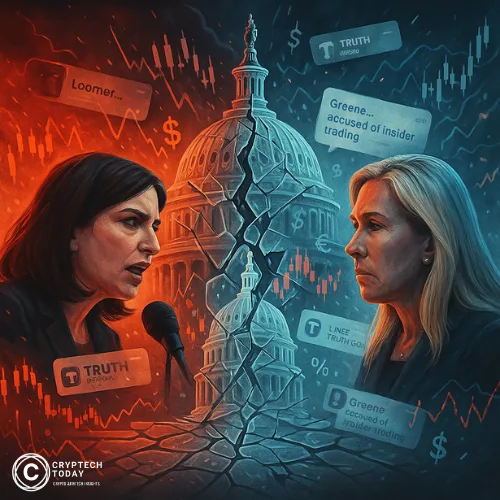
Laura Loomer, a prominent far-right activist with documented influence inside Trump-aligned circles, has publicly accused Congresswoman Marjorie Taylor Greene of suspiciously timed stock purchases after the market turmoil triggered by President Trump’s April tariff announcements. Loomer’s claims centre on a cluster of trades Greene disclosed in early April 2025, purchases that critics say lined up inconveniently well with a policy reversal that sent affected stocks sharply higher. The allegations have reignited debates about congressional trading, transparency and whether political actors enjoy unfair informational advantages.
From the start, Loomer framed the episode as part of a broader campaign to police financial conduct within the MAGA movement. Her public posts and media statements highlight a sequence of trades Greene made between April 3–4 and April 8–9, buying shares in large technology and consumer names that plunged after an initial tariff shock and then rebounded sharply when the White House announced a 90-day pause on reciprocal tariffs. Loomer’s messaging ties Greene’s activity to broader concerns raised by Democrats and press coverage: the timing looks suspicious, and several lawmakers have asked for formal reviews.
The Trades, the Timeline, and why critics are uneasy
Public disclosures show Greene purchased shares in companies including Apple, Amazon, Nvidia, Tesla and other widely followed issuers during the market lows that followed the first tariff announcement. When the administration announced a temporary pause and President Trump posted an exhortation on Truth Social, calling it a “great time to buy”, many of those same stocks experienced sharp rebounds. Critics argue the pattern raises questions about advance information, coordination, or at least poor optics for an elected official trading individual equities weeks after a dramatic policy move.
Greene and her team deny any wrongdoing. She has stated publicly that her financial advisor controls her trades under a fiduciary arrangement and that all transactions are disclosed under the STOCK Act. That defence echoes common responses in these cases: delegation to advisors, adherence to disclosure windows, and claims of no material non-public information. Yet the political context, a heated tariff episode with enormous market impact, has made the optics politically explosive and has prompted calls for inquiries from Democratic members of Congress.
Loomer’s campaign and political dynamics
Loomer’s allegations cannot be divorced from a fractious intra-MAGA rivalry. In 2025, she and Greene exchanged public blows; Loomer accuses Greene of disloyalty to the Trump agenda and has pushed narratives that aim to undercut Greene’s credibility inside the movement. Observers note two dynamics at play: genuine questions about congressional trading practices, and a political tactic using public allegations to mar an intra-faction rival’s standing. Either way, Loomer’s campaign has amplified the story, drawing attention from major outlets and from lawmakers demanding transparency.
Lawmakers and the push for investigations
The allegations have drawn bipartisan attention. Sen. Adam Schiff and Rep. Ruben Gallego are among Democrats publicly urging investigations into potential insider trading by individuals close to policymaking. Some Democrats framed the affair as part of a pattern: when policymakers trade in individual stocks, trust in government can erode and insider-trading rules can appear toothless. Several members called for ethics committees and federal prosecutors to review the trades and determine whether the STOCK Act or securities laws were violated.
At the same time, the political pressure has buttressed bipartisan legislative momentum to restrict lawmakers’ personal trading. The Restore Trust in Congress Act would ban members and their families from trading individual stocks, requiring divestment into broad-based funds, a reform that would remove ambiguity about whether trading by legislators, intentionally or otherwise, creates conflicts.
Legal and evidentiary hurdles
Proving insider trading is difficult. Regulators must show that an individual traded on material, non-public information and intended to profit from it. Delegation to an adviser is a common defence; absent evidence of direct instructions or leaked policy plans, investigators face an uphill evidentiary climb. The political angle complicates enforcement, as social-media amplification can create pressure for probes before investigators have assembled a case.
Market manipulation concerns and the broader pattern
Beyond individual culpability, observers worry about whether policy volatility is being used opportunistically. Some commentators allege a broader pattern in which tariff pronouncements, social-media posts and policy reversals create tradable arcs that politically connected traders can exploit. Those claims prompted calls for monitoring of market-relevant communications by policymakers and for stronger recusal or blind-trust rules for elected officials.
Author’s Thoughts
Allegations like Laura Loomer’s against Marjorie Taylor Greene expose two enduring truths. First, proximity to power provides informational asymmetry that markets can’t easily price. Second, current disclosure and advisory rules fail to eliminate the perception and perhaps the reality of unfair access. Whether you see Loomer’s campaign as opportunism or activism, the outcome may be the same: mounting bipartisan will to ban individual trading by lawmakers and restore some public trust.