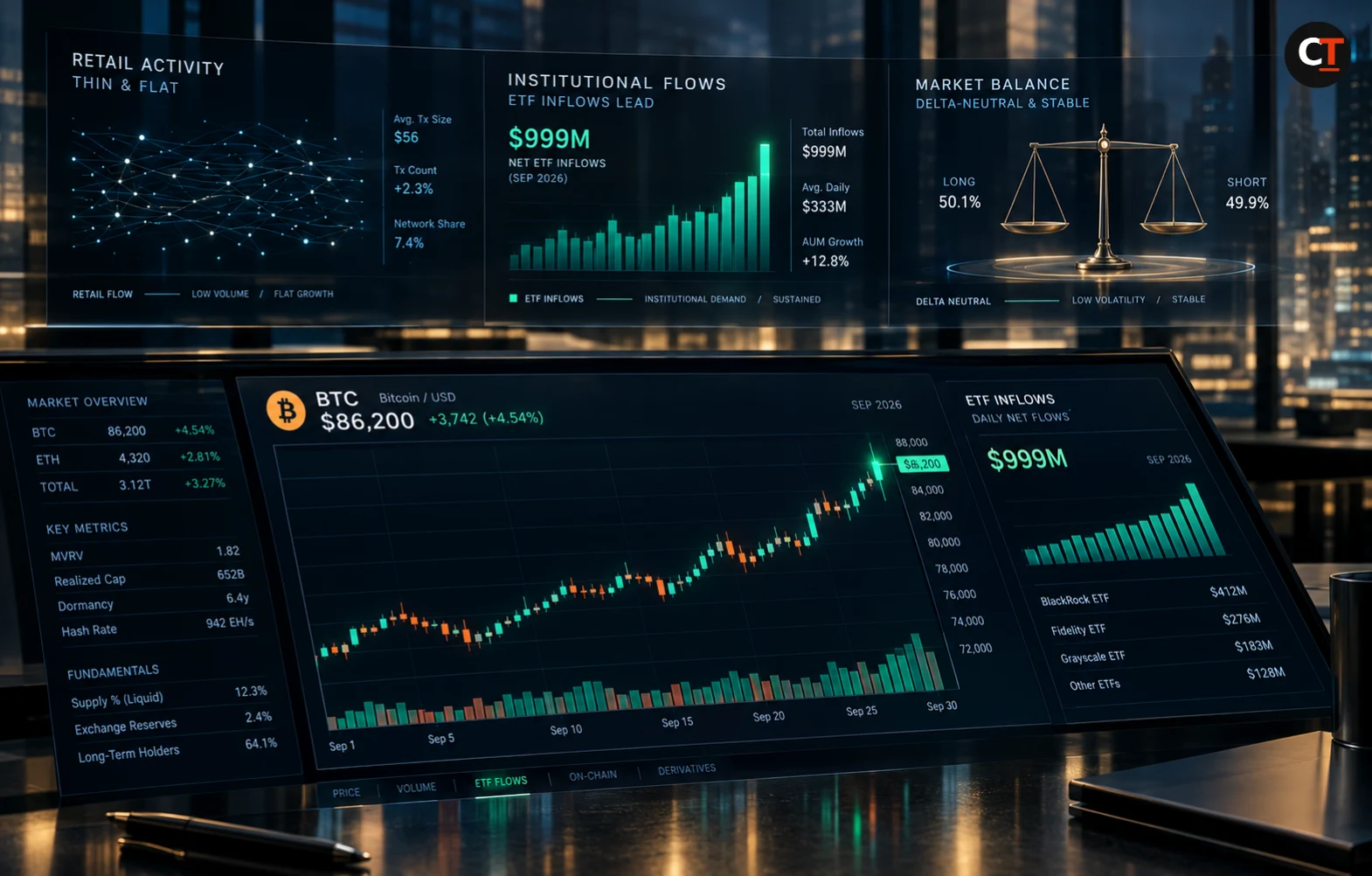
Bitcoin spiked past $86,290 on the back of a single-day $999 million spot ETF inflow record. But beneath the green candles sits a cold reality: retail traders are nowhere to be seen, derivatives funding is dead flat, and institutional desks are using basis trades to harvest spread rather than bet on an explosive cycle top.
Key Takeaways
- The ETF Surge: U.S. spot Bitcoin ETFs hauled in $998.96 million in net inflows on September 21, 2026, marking the largest single-day institutional cash influx in twelve months. BlackRock’s IBIT absorbed over $687 million alone.
- Delta-Neutral Basis Spread: CME Bitcoin futures basis expanded to an annualized 11.2%, signaling that hedge funds are buying spot ETF shares while shorting futures to pocket yield, with zero directional exposure.
- Retail Ghost Town: Google Trends search volume for “Bitcoin” sits at twenty-four out of one hundred, active on-chain addresses remain stuck below 820,000, and App Store rankings for crypto exchanges have barely budged.
- Telemetry Divergence: Real-time order book data from CryptechToday Terminal shows perpetual funding rates hovering at a neutral 0.009%, confirming this rally lacks the leveraged frenzy seen in authentic bull cycle tops.
- Strategic Playbook: Investors must distinguish between asset allocation rebalancing from overstretched equities and genuine organic demand before chasing green candles into multi-month resistance.
1. A Quiet Desk in Lower Manhattan
At 4:05 PM Eastern Time on Monday, the trading floor of a midtown quantitative fund was unusually subdued. There was no cheering. No frantic shouting across execution desks. A digital alert flashed across three screens: Bitcoin had just cleared $86,290, printing an eight-month high.
Ten minutes later, the fund’s chief risk officer approved an automated block transaction. It was not a celebratory purchase of call options. It was a programmatic order to short three hundred CME Bitcoin futures contracts, paired with a matching allocation of BlackRock’s iShares Bitcoin Trust (IBIT).
To the outside observer glancing at a CoinGecko ticker widget, crypto was back. To the execution algorithms processing institutional money, it was merely an arbitrage opportunity with an 11.2% annualized cash-and-carry spread.
The headline numbers look spectacular. On September 21, 2026, U.S. spot Bitcoin ETFs logged an astonishing $998.96 million in net daily inflows. That single trading session represented the largest institutional intake since the autumn of 2024. Yet, anyone relying strictly on the price chart is missing the structural mechanics of modern finance.
This is not 2021. It is not even March 2024. What we are witnessing is an institutional capital rotation: a clean rebalancing out of high-multiple technology equities into sovereign-grade collateral assets, accompanied by delta-neutral yield harvesting. Confusing this rotation with a structural retail bull wave is the fastest way for investors to lose capital.
2. The $999 Million Catalyst: Breaking Down the ETF Ledger
When almost a billion dollars pours into an asset class in twenty-four hours, market structure responds violently. The September 21 inflow print shattered expectations across Wall Street desks. To understand where the pressure originated, examine the vehicle distribution:
BlackRock’s IBIT was the primary vacuum, sucking up $687.4 million in net capital. Fidelity’s FBTC absorbed $184.2 million. The remaining balance was distributed across Bitwise (BITB) and Ark 21Shares (ARKB). Grayscale’s GBTC, historically a fountain of chronic outflows, recorded negligible redemptions of less than $12 million.
In simple math, ETF authorized participants had to purchase approximately 11,570 physical bitcoins from authorized custodians like Coinbase Custody within a single settlement cycle. Daily network issuance from post-halving mining blocks produces only 450 BTC. Inflow demand outstripped newly minted supply by more than 25-to-1.
Under basic microeconomics, that supply-demand mismatch forces spot market makers to lift ask liquidity across secondary books. Price surged from $81,400 to $86,290 within eighteen hours.
Yet, price is merely what you pay. Structure is what you own. While the volume bars on spot exchanges printed tall green columns, the broader crypto ecosystem told a drastically different story.
3. The Delta-Neutral Engine: The CME Basis Trade
Why did institutional capital flood the spot ETFs so aggressively on a single Monday? The answer lies outside of crypto entirely. It sits in Chicago, on the CME Group derivatives exchange.
As documented in our comprehensive guide to Bitcoin on-chain signals, the arrival of regulated spot vehicles created a frictionless bridge between traditional finance and crypto pricing discrepancies. The dominant strategy deployed by multi-strategy hedge funds in 2026 remains the basis trade, also known as the cash-and-carry trade.
Here is how the trade works in practice:
When front-month CME Bitcoin futures contracts trade at a premium over physical spot, hedge funds capture that spread without taking directional risk. They buy shares of IBIT or FBTC in New York and simultaneously open an equivalent short position in CME futures. When the contracts expire, the premium collapses to spot, locking in a predictable annualized return.
On September 21, the three-month CME futures premium widened from 7.4% to 11.2% annualized. With the U.S. Federal Reserve easing policy rates toward 4.0%, earning an 11.2% delta-neutral return backed by institutional clearinghouses represents one of the most lucrative sovereign-risk-adjusted trades on Wall Street.
When analysts review the record $998.96 million ETF flow, they celebrate institutional adoption. In reality, proprietary desks estimate that between 45% and 55% of that daily volume was non-directional. Every dollar of spot purchasing was systematically counterbalanced by a dollar of short selling on the futures exchange.
The capital did not arrive because hedge funds believed Bitcoin was embarking on an explosive sprint to $150,000. It arrived because the spread blew out, offering institutional managers a double-digit yield with zero delta exposure.
4. On-Chain Telemetry: What CryptechToday’s Token Intel Reveals
The clearest evidence of a mirage appears when you examine the live blockchain and derivatives telemetry. Real-time telemetry tracked via the CryptechToday Terminal exposes deep structural divergences between this push and previous historical breakouts.
| Metric Category | March 2024 Breakout ($73K) | November 2024 Push ($99K) | September 2026 Move ($86.2K) | Market Interpretation |
|---|---|---|---|---|
| Perpetual Funding Rate | 0.065% (Extreme Greed) | 0.042% (High Leverage) | 0.009% (Neutral / Flat) | Zero retail speculative long chasing across offshore venues. |
| Aggregate Open Interest | $36.8 Billion | $44.1 Billion | $31.4 Billion | Offshore derivatives books did not build aggressive directional exposure. |
| Active Addresses (7d MA) | 1,040,000 | 960,000 | 812,000 | Network utilization is at cyclical lows; retail participants are absent. |
| Whale Cohort Balance (30d) | Aggressive Accumulation | Heavy Distribution | Net Outflows (-18,400 BTC) | Long-term holders are using ETF liquidity windows to offload inventory. |
| Google Search Index (US) | 82 / 100 | 100 / 100 | 24 / 100 | Public search interest reflects total mainstream apathy. |
Consider funding rates on perpetual contracts. During an authentic, organic speculative run, offshore traders flood exchanges like Binance, OKX, and Bybit with leveraged longs. As buyers crowd the order books, funding rates skyrocket to 0.04% or 0.08% per eight-hour window as longs pay shorts to keep positions open.
Throughout the climb from $81,000 to $86,290, funding rates barely moved. They sat anchored at 0.009%, the baseline neutral equilibrium. Traders were not FOMO-leveraging into the push.
Simultaneously, spot Cumulative Volume Delta (CVD) showed a stark geographical split. During U.S. market hours (9:30 AM to 4:00 PM Eastern), aggressive market-order buying dominated Coinbase and regulated venues. But as soon as New York closed, European and Asian sessions witnessed consistent limit-order selling. Institutional spot buyers pushed the market up; long-term native holders used that exit window to distribute coins into strength.
5. The Retail Ghost Town
Every enduring crypto bull wave in history shared one common ingredient: viral consumer participation.
In late 2017, the Coinbase app crashed under the weight of college students and suburban dentists opening accounts. In early 2021, stimulus checks and Reddit message boards sparked a retail frenzy that lifted everything from Bitcoin to meme tokens. Even during the early 2024 run to $73,000, retail participation was vigorous enough to push crypto apps into the top twenty on the Apple App Store.
In September 2026, the retail market is a ghost town.
Google Trends search volume for the query “Bitcoin” is hovering at twenty-four on a scale of one hundred. That is less than a quarter of the interest recorded during prior major summits. Queries for “how to buy crypto” or “best altcoins” are virtually flatlined at cyclical multi-year lows.
On the Apple App Store and Google Play Store, consumer crypto exchange apps remain buried outside the top two hundred general finance rankings. Retail investors in North America and Western Europe have not returned. Burned by previous volatility, high borrowing costs, and real-world inflation, the average individual is sitting this rally out.
For traders who evaluate market health through breadth, this is a glaring warning sign. Altcoins, the traditional beneficiary of downstream retail liquidity, have failed to participate. While Bitcoin touched $86,290, Ethereum remained pinned below its multi-month trading range, and the wider altcoin complex saw minimal spot volume. Money is pooling exclusively in the deepest institutional instrument.
6. Macro Rebalancing: The Real Engine Behind the Move
If retail traders are absent and hedge funds are running delta-neutral basis trades, who is providing the genuine directional bids that drove the remaining half of the ETF flows?
The answer is macroeconomic capital reallocation.
Over the past quarter, global financial markets have encountered a distinct crosscurrent. Mega-cap technology equities in the United States, which traded at extended price-to-earnings multiples, began showing signs of earnings fatigue. At the same time, central banks across the developed world resumed monetary easing cycles to stimulate slowing manufacturing activity.
Sovereign wealth funds, corporate treasuries, and family offices are faced with a dilemma: cash yields are decaying as policy rates drop, while equities offer questionable risk-reward at twenty-five times forward earnings.
Bitcoin, in its post-ETF evolution, has cemented its status as an unencumbered digital reserve asset. Portfolio managers are allocating small, programmatic slices: one percent to three percent of total fund mandates, directly into regulated Bitcoin ETFs.
This is not ideological enthusiasm. It is balance sheet diversification. Institutional allocators view Bitcoin as digital gold with superior liquidity and zero counterparty insolvency risk. When global portfolio models trigger a fifty-basis-point trim from overweighted tech equities, hundreds of millions of dollars automatically flow into Bitcoin products over forty-eight hours.
That explains the sheer velocity of the inflow, but it also defines its limitations. Capital rotations are episodic, not continuous. Once an asset allocation model completes its scheduled reweighting, the institutional bid ceases until the next rebalancing window. It does not cascade into the self-reinforcing retail euphoria that generates vertical bull runs.
7. What Could Invalidate This Thesis?
Intellectual rigor demands examining the conditions that would disprove our thesis. What market developments would convert this capital rotation into a true structural bull wave?
Three specific indicators would signal that this rally has evolved beyond an institutional rotation:
- Sustainable Active Address Expansion: Weekly active on-chain addresses must sustainably break above 950,000 entities. That would confirm that new individual users are acquiring and moving physical coins on-chain, rather than shares shuffling inside depository trust accounts.
- Basis Spread Compression with Rising Price: If Bitcoin continues climbing through $88,000 and $90,000 while the CME futures basis compresses below 6%, it would demonstrate that hedge funds are taking directional long risk rather than delta-neutral basis harvesting.
- Broad Market Liquidity Dispersion: A healthy bull market distributes liquidity outward. If Ethereum, high-utility Layer-1 platforms, and tokenized real-world assets show synchronized spot buying accompanied by expanding decentralized exchange volumes, the market has transitioned into organic expansion.
Until those three criteria are met, the balance of probabilities favors caution over unbridled enthusiasm.
8. The Investor Playbook: Navigating the $86K Resistance Shelf
How should sophisticated investors handle the current environment? The playbook depends on your operational horizon.
For Long-Term Allocators
If your horizon spans multiple market cycles, programmatic accumulation remains the superior strategy. Do not chase green spikes into institutional resistance shelves. History demonstrates that large single-day ETF inflow records are frequently followed by multi-week consolidation phases as market makers digest order inventory. Allow the market to retrace toward Short-Term Holder realized cost basis before deploying fresh cash reserves.
For Swing Traders and Derivatives Desks
Monitor perpetual funding rates and basis spreads on the CryptechToday Terminal. As long as funding remains neutral, the likelihood of a violent long liquidation cascade is relatively low. However, upside momentum without retail spot CVD support will inevitably stall at overhead order book liquidity clusters between $88,500 and $92,000. Take partial profits into strength and avoid high-leverage breakout trades.
For International & Indian Traders
International traders operating under strict local mandates, such as India’s crypto tax framework, must remember that high-frequency trading in choppy rotational markets incurs heavy tax drag due to non-offsettable capital gains rules and withholding taxes. Navigating structural rotations demands fewer, higher-conviction entries rather than intraday chasing.
9. The Verdict
Bitcoin at $86,290 is a triumph of market architecture. The pipes connecting traditional capital pools to cryptographic settlement have never been wider, faster, or more efficient. A billion dollars can enter the market in six hours without crashing exchange infrastructure.
That is institutional maturity. But maturity is not synonymous with mania.
Do not mistake the calculated rebalancing of global multi-asset funds and the basis harvesting of quantitative arbitrage desks for the beginning of a retail frenzy. The numbers on the ticker look identical. The mechanics beneath them could not be more different. Treat this rally for what the data says it is: an orderly, sophisticated capital rotation. Respect the data, manage your risk, and let the tourists buy the mirage.