When a security appliance designed to guard your perimeter becomes the easiest way through it, traditional defense architecture collapses. Here is how a silent path traversal bug evolved into a global ransomware pipeline.
Key Takeaways
- Unauthenticated Remote Exploit: Vulnerability CVE-2024-24919 allows remote attackers to read arbitrary files from underlying Gaia OS without supplying credentials, targeting the exposed
/clients/MyCRLweb endpoint. - Dual Attack Ecosystem: Both financially motivated ransomware operators (Qilin, NailaoLocker) and nation-state cyber espionage syndicates (PurpleHaze, Fox Kitten, RedNovember) actively weaponized the flaw within days of public proof-of-concept availability.
- Credential Harvesting at Scale: Exploitation yields
/etc/shadowpassword hashes and cleartext Active Directory domain join configurations, turning edge firewalls into automated credential vaults for internal lateral movement.
Imagine stationing armed guards at the main entrance of an impenetrable bank vault, only to discover that anyone whispering a specific sequence of syllables into the guard booth speaker receives the master keys to every safety deposit box inside.
That is the operational reality of Check Point vulnerability CVE-2024-24919.
For decades, corporate IT strategy operated on a simple perimeter doctrine: keep untrusted traffic outside, trust authenticated connections inside, and place a high-grade security gateway right at the boundary. Yet throughout recent campaigns, that boundary collapsed from within.
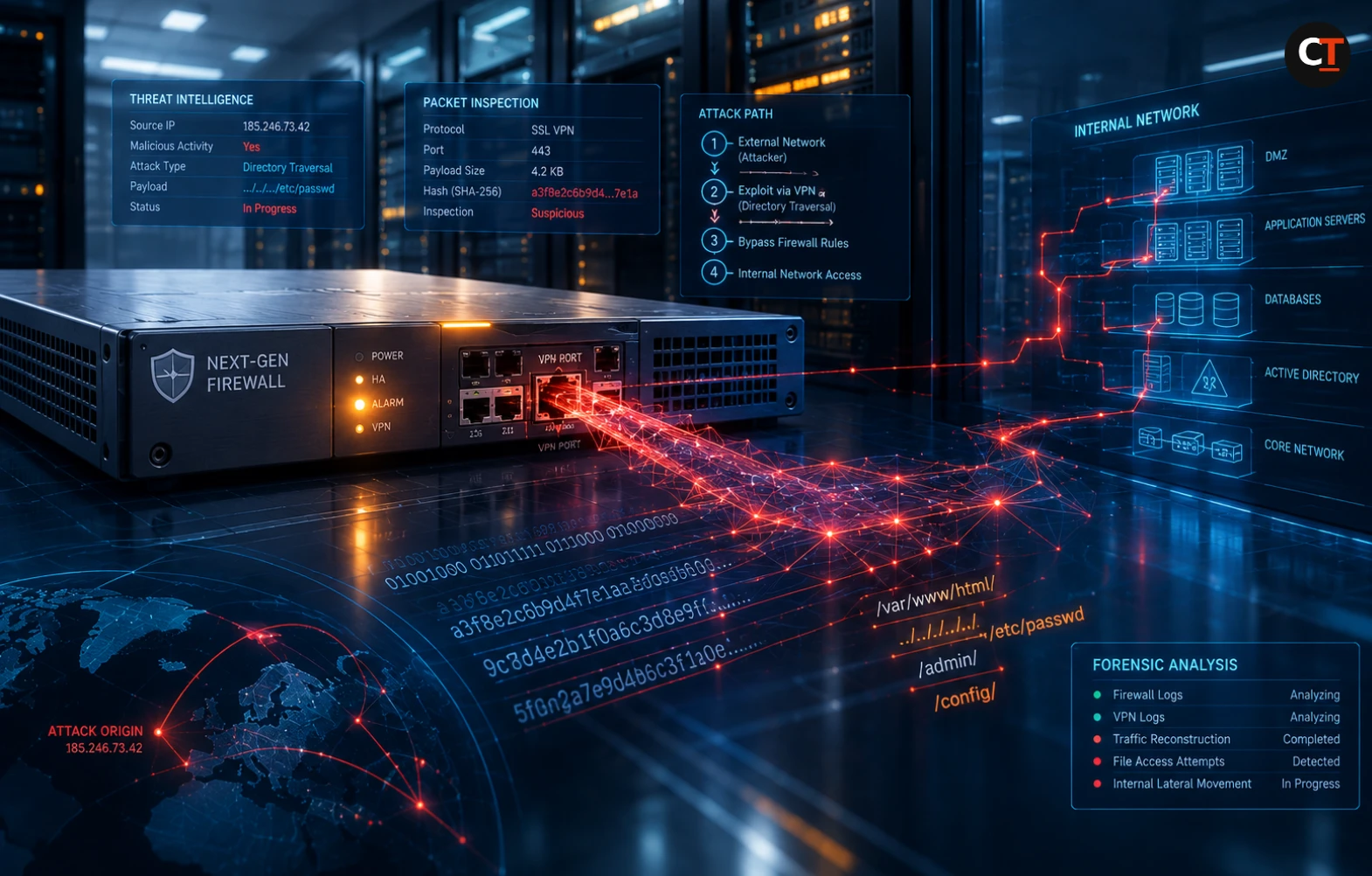
What initially circulated in security warnings as an edge appliance flaw turned out to be an unauthenticated, pre-login path traversal bug. Attackers did not need a valid username. They did not need a session token or two-factor authentication. By sending a single crafted HTTP request to an internet-facing appliance, adversaries could read system configuration files, extract password hashes for root accounts, and walk directly into the internal network.
This flaw illustrates a dangerous shift across the threat landscape: edge appliances have become high-value initial access vectors for cybercriminals and state intelligence teams alike.
The Anatomy of CVE-2024-24919: What Actually Happened
Much confusion surrounded this vulnerability when early alerts circulated. Multiple industry advisories initially misattributed the bug to Check Point’s central Management Server. In reality, CVE-2024-24919 resides squarely on the Security Gateway itself, specifically within the web service handling Remote Access VPN and Mobile Access software blades.
Check Point appliances run Gaia OS, a hardened Unix-like operating system derived from Linux. To support remote workers, gateways expose a web portal on TCP port 443. Within this web architecture sits an internal endpoint responsible for handling Certificate Revocation Lists (CRL): /clients/MyCRL.
Under normal operations, this endpoint processes certificate validation queries. However, improper input sanitization allowed external callers to supply relative directory path traversal sequences directly in the URL structure.
Host: [Target-Gateway-IP]
User-Agent: Mozilla/5.0
Content-Length: 0
Notice the prefix marker: aCSHELL/. This internal token bypassed the appliance’s path verification filters. By traversing upward through directory trees, the request instructs the underlying web daemon to read and return arbitrary local files with root privileges.
Because the web server operates with elevated system access, an external user could retrieve:
/etc/shadow: The operating system file containing SHA-512 crypt password hashes for all local accounts, includingadminandexpertmaintenance accounts./etc/passwd: System user account names, revealing system service layout.Active Directory integration secrets: Cleartext or reversible credentials utilized by Mobile Access blades to query corporate LDAP directories for user authentication.SSH host private keys: Enabling silent man-in-the-middle decryption or direct command shell logins if management ports were externally reachable.
| Vulnerability Metric | Official Specification |
|---|---|
| CVE Identifier | CVE-2024-24919 |
| CVSS v3.1 Base Score | 8.6 (High Severity: CVSS:3.1/AV:N/AC:L/PR:N/UI:N/S:U/C:H/I:N/A:N) |
| Vulnerability Class | CWE-22: Improper Limitation of a Pathname to a Restricted Directory (Path Traversal) |
| Authentication Required | None (Pre-Authentication Remote Exploitation) |
| Prerequisite Blade | IPsec VPN / Remote Access VPN or Mobile Access Blade enabled |
| Official Advisory | Check Point Support Advisory sk182336 |
| Government Catalog Listing | Included in CISA Known Exploited Vulnerabilities (KEV) Catalog |
The vulnerability affected an enormous footprint of enterprise infrastructure: Quantum Security Gateways, CloudGuard Network Security virtual appliances, Quantum Maestro chassis, and Quantum Spark branch firewalls across firmware releases spanning R80.20 through R81.20.
The Attack Chain: From Single HTTP POST to Complete Domain Hijack
An arbitrary file read bug sounds passive compared to a remote code execution (RCE) flaw. Yet in modern network environments, an arbitrary file read on an identity gateway is functionally equivalent to handing over your front door keys.
The weaponization chain executed by intrusions in the wild followed a predictable, devastating progression:
Phase 1: Automated Perimeter Reconnaissance
Adversaries deployed mass-scanning tools across IPv4 spaces, looking for Check Point gateway HTTP response headers and accessible /clients/MyCRL endpoints on port 443. Because thousands of enterprises maintain remote access portals with default naming conventions, discovery took minutes.
Phase 2: Pre-Auth Credential Exfiltration
Attackers fired automated scripts executing the traversal sequence against target gateways, pulling the /etc/shadow file. The gateway returned an HTTP 200 OK containing password hashes in the response body.
Phase 3: High-Speed Offline Password Cracking
Unlike brute-forcing logins against a live server where account lockouts or rate-limiting kick in, an attacker holding the hash operates entirely offline. Using GPU clusters equipped with Hashcat and customized dictionaries, threat actors cracked weak and medium-complexity administrator passwords within hours. If the organization reused local admin passwords across firewalls, the breach spread instantly across multiple branch offices.
Phase 4: SmartConsole and Active Directory Pivoting
With local credentials in hand, attackers logged into the Gaia OS portal or SSH console. From there, they extracted cached Active Directory service account credentials used by the firewall for user group mapping. Those domain accounts were frequently granted broad privileges across internal network directories.
Phase 5: Lateral Network Propagation
Using the firewall itself as an unmonitored proxy node, intruders tunneled internal traffic via tools like SystemBC or legitimate remote monitoring software. Because firewall traffic is rarely inspected by internal intrusion detection systems, attackers traversed security zones unimpeded.
The Threat Actors: Who Weaponized the Bug?
What makes CVE-2024-24919 a seminal case study is the speed with which two completely different categories of cyber threat groups converged on the exact same vulnerability.
According to threat research by Tenable and SentinelOne, edge appliances are now contested terrain where state-sponsored espionage syndicates and extortion cartels compete for early access.
Within seventy-two hours of the first public proof-of-concept release, multiple threat groups began concurrent campaigns against unpatched gateways. The same open door served both political intelligence extraction and multi-million-dollar extortion.
1. The Qilin Ransomware Cartel
The most aggressive commercial user of the zero-day was the Qilin ransomware operation (also known as Agenda). Operating under a Ransomware-as-a-Service (RaaS) affiliate model, Qilin specializes in high-pressure double extortion against critical infrastructure, manufacturing, and healthcare providers.
Qilin affiliates utilized CVE-2024-24919 as their primary foothold into enterprise targets. Once inside, they established persistence using Cobalt Strike beacons and installed legitimate remote management tools such as AnyDesk, ScreenConnect, and Splashtop.
Their operators dumped memory from the Local Security Authority Subsystem Service (LSASS) on internal Windows servers, harvested Active Directory databases (NTDS.dit), and used living-off-the-land tools like PsExec and WMI to stage mass exfiltration. Hundreds of gigabytes of corporate data were siphoned to mega-cloud storage providers before Qilin deployed its proprietary Go-based ransomware binaries, encrypting critical hypervisors and backup repositories.
2. State-Sponsored Espionage: PurpleHaze, Fox Kitten, and RedNovember
While ransomware crews made loud headlines, state-aligned advanced persistent threat (APT) groups operated quietly.
Analysis from Recorded Future detailed how Chinese state-sponsored espionage group RedNovember (tracked as TAG-100 and Storm-2077) weaponized the vulnerability to compromise government, defense, and technology contractors. RedNovember used the access not to deploy disruptive ransomware, but to place persistent backdoors including ShadowPad and PlugX, maintaining quiet surveillance over diplomatic and technological communications.
Concurrently, the Iranian threat group Fox Kitten (also monitored as Lemon Sandstorm or Pioneer Kitten) exploited the flaw across defense and financial networks. French cybersecurity authority Orange Cyberdefense CERT documented attacks deploying the NailaoLocker ransomware variant alongside stealthy command shells across Asia-Pacific financial entities.
The Edge Appliance Crisis: Comparing the Wave of Perimeter Zero-Days
The Check Point zero-day did not occur in a vacuum. It represents the continuation of a relentless industry pattern that has battered enterprise perimeters.
In recent years, security researchers and criminal syndicates realized that securing endpoints with Endpoint Detection and Response (EDR) agents made attacking laptops and desktop workstations much harder. Firewalls and VPN appliances, by contrast, are closed proprietary black boxes. You cannot install third-party CrowdStrike or SentinelOne endpoint sensors on a proprietary firewall kernel. That architectural blind spot turned edge devices into the premier entry point of choice.
| Appliance / Vendor | Vulnerability ID | Flaw Category | Exploiting Groups |
|---|---|---|---|
| Check Point Quantum | CVE-2024-24919 | Pre-Auth Arbitrary File Read (Path Traversal) | Qilin, RedNovember, Fox Kitten, PurpleHaze |
| Palo Alto PAN-OS | CVE-2024-3400 | Pre-Auth Command Injection (CVSS 10.0) | State APTs, Midnight Blizzard affiliates |
| Ivanti Connect Secure | CVE-2023-46805 & CVE-2024-21887 | Auth Bypass and Command Injection Chain | Multiple Ransomware Syndicates, UNC5221 |
| Fortinet FortiOS | CVE-2024-21762 | Pre-Auth Out-of-Bounds Write | Volt Typhoon, Ransomware Affiliates |
| Citrix NetScaler | CVE-2023-4966 (Citrix Bleed) | Sensitive Information Disclosure / Session Hijack | LockBit 3.0, Medusa, Akira |
This comparative reality highlights a grim truth: every major vendor powering modern corporate borders has suffered a high-impact, pre-authentication gateway flaw. The perimeter is no longer a solid shield; it is a complex software surface running millions of lines of legacy code directly facing hostile public networks.
This issue prompted rare public rebukes. The United States Cybersecurity and Infrastructure Security Agency (CISA) and the FBI issued joint guidance urging software manufacturers to eliminate path traversal vulnerabilities, characterizing their persistence in modern enterprise products as fundamentally unacceptable for security vendors.
The Regional Fallout: What It Means for Indian Enterprises and Critical Infrastructure
The geographic distribution of these attacks reveals important strategic lessons for regional markets, including India and the broader APAC corridor.
Check Point maintains a substantial customer footprint across India, particularly among private banking institutions, NBFCs, IT services multinationals, and public sector undertakings (PSUs). While CERT-In routinely disseminates advisories concerning network gateway vulnerabilities, the operational challenge in India stems from patch application lag.
Many Indian financial and technical organizations operate intricate branch networks across Tier-1 and Tier-2 data centers. In these environments, deploying hotfixes to mission-critical gateways often gets delayed by change management windows, fear of causing failover disconnects, or reliance on third-party managed security service providers (MSSPs).
As documented in forensic reports on regional banking breaches, APT syndicates routinely test public-facing corporate gateways across Mumbai, Bengaluru, and Hyderabad. When an edge device leaks password hashes, attackers bypass perimeter defenses without setting off conventional alarms.
For Indian organizations subject to strict regulatory compliance, including the Reserve Bank of India (RBI) Cyber Security Framework and SEBI cloud guidelines, a compromised gateway constitutes a catastrophic compliance breach. The mandate under the Indian Computer Emergency Response Team (CERT-In) directives requires reporting cybersecurity incidents within six hours of detection. Failing to detect that an attacker read your shadow file until ransomware detonates weeks later exposes leadership to severe regulatory penalties.
If you manage enterprise compliance or interact with digital asset infrastructure, pairing secure perimeter maintenance with rigorous financial auditing is non-negotiable, a point we explored in detail in our analysis of India FIU-IND compliance obligations.
The Enterprise Action Playbook: Immediate Remediation Steps
If your organization operates Check Point gateways, relying on standard automated patching cycles is insufficient. Because exploitation leaves minimal traces on unmonitored systems, administrators must execute a full verify-and-remediate protocol.
If your Check Point gateway had Remote Access VPN or Mobile Access blades enabled and remained unpatched between April and June 2024, you must treat your local accounts as compromised. Applying the hotfix stops future file reads, but it does not invalidate password hashes attackers already stole.
1. Apply Check Point Hotfix Releases Immediately
Ensure your gateways are updated to the official Jumbo Hotfix Accumulator levels or later, as outlined in advisory sk182336:
- R81.20: Jumbo Hotfix Accumulator Take #100 or higher
- R81.10: Jumbo Hotfix Accumulator Take #82 or higher
- R81: Jumbo Hotfix Accumulator Take #25 or higher
- R80.40: Jumbo Hotfix Accumulator Take #200 or higher
- Quantum Spark: Update to the latest maintenance firmware branch for R81.10.x, R80.20.x, or R77.20.x
2. Mandatory Credential and Secret Invalidation
Patching the software is only step one. Step two is neutralizing any data stolen during the zero-day exposure window:
- Reset Local Operating System Passwords: Immediately change the passwords for all Gaia OS local accounts, specifically
adminandexpertmode passwords. - Rotate Domain Join and LDAP Credentials: If your gateway was connected to Active Directory for authentication, generate fresh passwords for those service accounts in your Active Directory domain.
- Cycle SSH Host and User Keys: Replace all SSH key pairs stored on the appliance file system.
- Review SmartConsole Administrator Accounts: Inspect administrator lists in SmartConsole for unauthorized newly created administrator or read-only auditing accounts.
3. Perform Retrospective Log Forensics
Query your security information and event management (SIEM) systems and local appliance web server logs (/var/log/httpsd.log and /var/log/access.log) for historical requests matching known exploitation indicators:
- Searches for HTTP POST requests containing
/clients/MyCRLcoupled with directory traversal sequences like..%2foraCSHELL. - Requests originating from untrusted commercial VPN exit nodes, Tor relays, or hosting providers targeting the CRL validation path.
- Follow-up SSH or WebUI logins from public IP addresses within minutes or hours of a CRL request.
4. Hardening and Architectural Isolation
Eliminating single points of failure at the perimeter requires structural defenses:
- Restrict Management Access: Under no circumstances should SmartConsole or Gaia OS web administration interfaces be accessible from the public internet. Restrict administration to dedicated out-of-band management subnets or jump boxes using Trusted Clients settings.
- Decommission Unused Blades: If your organization shifted corporate remote access to modern Zero Trust Network Access (ZTNA) solutions, disable legacy Mobile Access and Remote Access blades entirely. A feature that is disabled cannot be exploited.
- Enforce Machine Certificates: Migrate remote access user pools away from legacy username-and-password profiles toward mandatory device certificate authentication. Even if an attacker cracks an administrator password hash, lack of a valid cryptographic hardware certificate prevents VPN session establishment.
The Strategic Takeaway: The Death of Implicit Perimeter Trust
The exploitation of CVE-2024-24919 delivers a blunt message to Chief Information Security Officers, infrastructure engineers, and systems architects everywhere.
The classic castle-and-moat security model is defunct. When an attacker can exploit the moat itself to climb into the throne room, relying on boundary appliances for corporate safety is a dangerous illusion.
Security gateways remain essential tools for packet routing, policy enforcement, and bandwidth inspection. But they can no longer be treated as inviolable boundary lines. True enterprise resilience demands zero trust segmentation inside the network: every database, every server, and every identity directory must demand continuous authentication regardless of whether traffic originates from a home office, a cloud instance, or the interface of a high-end firewall.
Perimeter hardware will always have vulnerabilities. The organizations that survive them are those that design their interior architecture so that losing the perimeter does not mean losing the business.