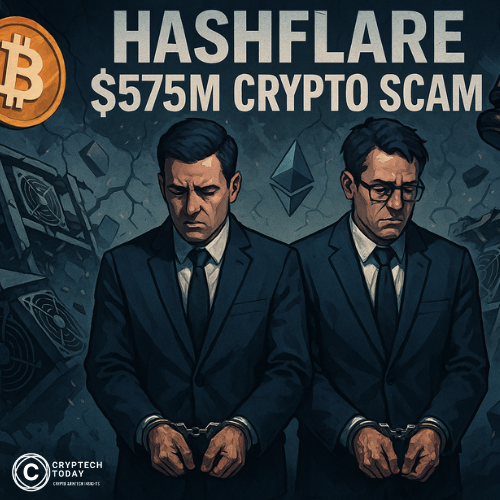
In what may become a landmark moment for international crypto fraud prosecutions, the HashFlare Ponzi scheme case is nearing its final chapter. Estonian nationals Sergei Potapenko and Ivan Turõgin, who pleaded guilty in February 2025 to defrauding global investors through a fake cryptocurrency mining operation, are now at the centre of a fierce legal battle over how they should be punished.
The sentencing hearing, set for August 14, 2025, in a Seattle federal court, has become the focal point of intense debate between US prosecutors, who are demanding 10-year prison sentences, and defence lawyers arguing for no additional jail time.
What was the HashFlare fraud?
Launched in 2015, HashFlare presented itself as a cloud-based cryptocurrency mining service, offering customers the ability to buy mining contracts and earn a share of mined Bitcoin and Ethereum. But according to the US Department of Justice, the company was a front for a Ponzi scheme, using funds from new investors to pay out earlier ones. The platform claimed to own vast mining hardware, yet reportedly had less than 1% of the computing power it sold.
Between 2015 and 2019, Potapenko and Turõgin lured in over 440,000 customers, including 50,000 Americans, selling more than $575 million in fraudulent contracts. They diverted large sums into luxury cars, high-end real estate, and personal crypto wallets while maintaining the illusion of a profitable mining operation. When U.S. authorities cracked down, the pair were arrested in Estonia in 2022 and extradited to the United States by mid-2024.
Hashflare masterminds enter guilty plea
After years of investigation and legal wrangling, both men pleaded guilty in February 2025 to conspiracy to commit wire fraud, a charge carrying up to 20 years in prison. As part of the plea deal, they agreed to forfeit more than $400 million in assets for victim compensation. Prosecutors argued that the founders had caused at least $300 million in real losses, while the defence countered that customers ultimately received more in crypto payouts than they originally invested, largely due to price appreciation during the crypto bull market, CoinDesk reported.
August 2025: The sentencing battle intensifies
With sentencing scheduled for August 14, the courtroom tension has sharply escalated. Prosecutors have filed a formal memorandum urging US District Judge Robert Lasnik to impose a 10-year prison sentence for each defendant. They argue the sheer scale of the fraud — the number of victims, global reach, and calculated deception — warrants nothing less than the maximum deterrent. Prosecutors describe it as the “largest fraud ever tried” in the district, stressing that the founders lied systematically, ran a “textbook Ponzi scheme”, and funded “lavish lifestyles” off of fake operations.
In stark contrast, the defence team is asking the court to impose no further prison time, citing the 16 months the men spent in Estonian detention and their voluntary cooperation with U.S. authorities. They also highlight that customers, on the whole, withdrew over $2.3 billion from the platform — far more than the total $487 million originally invested — suggesting that many made profits due to cryptocurrency price gains during the years HashFlare was active.
Defence lawyers further argue that the asset forfeiture agreement and willingness to help with victim restitution show good faith, asking the court to recognise their clients’ “cooperation and remorse” instead of focusing solely on punishment.
Deportation drama adds a twist
In a surprising bureaucratic mishap, the Department of Homeland Security (DHS) mistakenly sent “self-deportation” letters to Potapenko and Turõgin in April 2025, ordering them to immediately leave the United States, even though the court had explicitly ordered them to stay in King County, Washington, until sentencing. This created confusion, and after intervention by prosecutors, the DHS reversed course and granted a one-year deferral.
Ironically, both defendants have expressed a desire to return to Estonia after sentencing to reunite with their families. Their attorney, Mark Bini, noted that his clients prefer deportation to continued imprisonment—a rare situation where the accused are asking to be removed from the country rather than avoiding it, as per Cointelegraph.
Why the HashFlare case matters for crypto’s future
The outcome of this sentencing will have far-reaching consequences for global cryptocurrency regulation and law enforcement. With over $130 million invested by U.S. residents, the HashFlare prosecution sends a strong message that foreign nationals who defraud Americans can and will be brought to justice, regardless of where they operate from.
The case is also being watched closely in the context of evolving U.S. crypto enforcement. With the DOJ recently signalling a shift away from “regulation by prosecution” toward clearer policy frameworks, some experts wonder whether harsh sentencing will still play a key role in shaping behaviour in the crypto sector, or whether civil penalties and stricter compliance rules will gradually take over.
What happens next?
The final chapter is set to unfold:
- Sentencing Date: August 14, 2025, at 10:00 AM (Seattle Federal Court)
- Judge: Robert Lasnik, U.S. District Court, Western District of Washington
- Prosecution Request: 10 years’ imprisonment
- Defence Request: Time served and deportation
- Maximum Sentence Allowed: 20 years
Until the judge makes his decision, Potapenko and Turõgin remain free on bail in Seattle. The verdict will not only decide their fate—it could also set the tone for how international cryptocurrency scams are prosecuted in the future.
Have you invested in HashFlare?
If you or someone you know was a HashFlare customer between 2015 and 2019, you may be eligible for compensation. The FBI is still collecting victim information to process claims and ensure proper restitution.
Also Read
What to make of the rising number of Bitcoin holders in India?