For nearly four years, Ripple’s public narrative was trapped in courtroom filings. In 2026, with the SEC litigation fully dismissed and BNY Mellon appointed as custodian, the XRP Ledger has emerged as an institutional tokenization powerhouse. Here is what has been built.
Key Takeaways
- The RLUSD Milestone: Ripple’s NYDFS-chartered enterprise stablecoin surpassed $2 billion in circulation, with BNY Mellon providing institutional cash and sovereign bond custody.
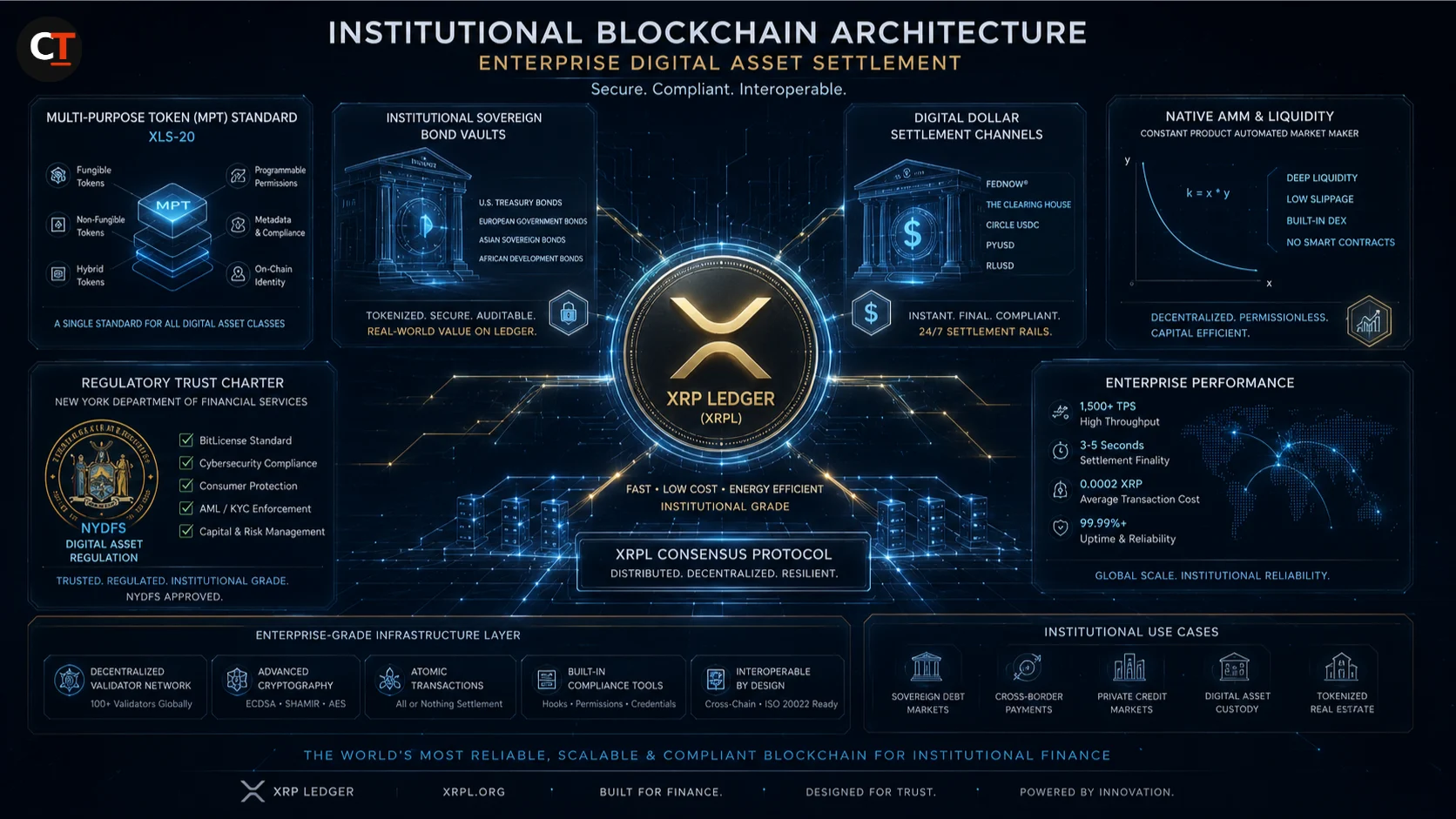
- Native RWA Architecture: The XRP Ledger (XRPL) activated protocol-level primitives including Multi-Purpose Tokens (MPT), W3C Decentralized Identity (DID), and Confidential MPT encryption (XLS-96).
- Post-SEC Institutional Wave: New financial institution partnerships surged 340% year-over-year following the complete dismissal of Second Circuit appellate proceedings in August 2025.
- Sovereign CBDC Implementations: Live pilots across Palau, Bhutan (over $340M processed), and Montenegro demonstrate private XRPL ledger utility for central bank digital currencies.
Between December 2020 and late 2024, discussions about Ripple rarely focused on software engineering.
They focused on legal discovery, court jurisdiction, and the classification of past programmatic token distributions under the 1946 Howey Test.
In 2026, that multi-year legal overhang has been dismantled.
Following the formal dismissal of all appellate proceedings between Ripple and the SEC in August 2025, the enterprise blockchain platform executed a massive operational pivot.
Ripple did not simply return to marketing cross-border remittance software. It engineered an end-to-end institutional financial stack: launching a New York Department of Financial Services (NYDFS) regulated dollar stablecoin (RLUSD), shipping protocol-level tokenization standards directly into the XRP Ledger (XRPL), and integrating top-tier global custodian BNY Mellon to bridge Wall Street capital with on-chain settlement.
Understanding the modern XRP Ledger in 2026 requires looking past legacy crypto tribalism and evaluating the technical and regulatory architecture running under the hood.
1. Ripple USD (RLUSD): The Enterprise Stablecoin Architecture
The cornerstone of Ripple’s 2026 strategy is Ripple USD (RLUSD), an enterprise-grade fiat stablecoin designed to provide a compliant digital settlement asset for banks, brokers, and institutional payment operators.
Regulatory Status and Multi-Jurisdictional Footprint
Unlike unregulated offshore stablecoins, RLUSD is issued through Standard Custody and Trust Company (SCTC), a dedicated digital asset trust company operating under a New York State Department of Financial Services (NYDFS) limited purpose trust charter.
Beyond New York, RLUSD has established a global compliance footprint:
- United States: NYDFS Trust Charter oversight with direct statutory safeguarding mandates.
- Japan: Formal approval from the Financial Services Agency (JFSA).
- European Union: Compliant with the EU MiCA regulation framework for Asset-Referenced and E-Money Tokens.
- Dubai (DIFC): Recognized by the Dubai Financial Services Authority (DFSA) for institutional commercial settlement.
Reserve Structure and BNY Mellon Custody
To satisfy institutional risk committees, RLUSD enforces strict reserve segregation:
| Reserve Asset Category | Allocation & Duration | Custodial Safeguards |
|---|---|---|
| US Treasury Bills | Short-dated sovereign bills (≤3 months maturity) | Held with BNY Mellon in bankruptcy-remote statutory trust accounts. |
| US Dollar Cash Deposits | Commercial cash in FDIC-insured financial institutions | Segregated strictly from Ripple corporate working capital balance sheets. |
| Overcollateralization Buffer | Minimum 3% to 6% surplus reserve buffer | Monthly public attestations conducted by Deloitte verifying >103% reserve coverage. |
In August 2026, RLUSD crossed $2 billion in total market capitalization, with nearly $1 billion issued natively on the XRP Ledger (representing over 80% of total stablecoin liquidity on the network).
The stablecoin operates natively across both XRPL and Ethereum, using Wormhole’s Native Token Transfer (NTT) standard to move seamlessly across Ethereum Layer 2 networks including Base and Optimism.
RLUSD vs. USDC vs. USDT: How It Compares
For institutional treasurers and compliance officers evaluating dollar-denominated on-chain settlement, three stablecoins dominate consideration. Here is how RLUSD positions against the two dominant incumbents:
| Attribute | RLUSD (Ripple) | USDC (Circle) | USDT (Tether) |
|---|---|---|---|
| Primary Issuer | Standard Custody and Trust Company (SCTC), a Ripple subsidiary | Circle Internet Financial (US-regulated) | Tether Holdings Ltd (BVI-incorporated) |
| Regulatory License | NYDFS Trust Charter + JFSA + DFSA + MiCA CASP (4 jurisdictions) | FinCEN MSB + NY BitLicense + MiCA EMT | No bank or trust charter in the US or EU. Operates under Tether’s own governance. |
| Reserve Backing | Short-dated US Treasuries (≤3 months) + FDIC-insured cash. Deloitte monthly attestations. Min 103% coverage. | US Treasuries + cash. Deloitte monthly attestations. 100% backing target. | Mix of Treasuries, commercial paper, secured loans, and other assets. Grant Thornton quarterly attestations. |
| Primary Custodian | BNY Mellon (segregated statutory trust accounts) | BNY Mellon + other regulated custodians | No named Tier-1 global custodian |
| Native Chain | XRPL + Ethereum + ETH Layer 2s (via Wormhole NTT) | 15+ chains including Ethereum, Solana, Base, Polygon | 20+ chains including Ethereum, Tron, Solana, XRPL |
| Institutional Focus | Enterprise cross-border settlement, CBDC interoperability, RWA issuance | DeFi liquidity, retail payments, B2B treasury | Retail trading liquidity globally, high emerging market penetration |
RLUSD occupies a deliberate institutional niche. Its four-jurisdiction regulatory footprint and BNY Mellon custodial relationship make it the only major dollar stablecoin designed from the ground up for regulated enterprise settlement rather than retail trading volume.
For a broader comparative analysis of how private stablecoins contrast with sovereign digital money, read our breakdown of stablecoins vs. CBDCs. To understand how on-chain yield from tokenized US Treasuries compares to RLUSD reserve assets, see our guide on tokenized US Treasuries.
2. RWA Tokenization Primitives: The Built-In XRPL Stack
For a foundational primer on what real-world asset tokenization means structurally, see our guide on asset tokenization explained before diving into the XRPL-specific primitives below.
Most smart contract blockchains require developers to write, audit, and deploy complex custom smart contract code (such as Solidity contracts on EVM chains) to tokenize assets.
The XRP Ledger takes a fundamentally different engineering approach: embedding core financial primitives directly into the underlying Layer 1 protocol code.
By implementing tokenization rules, compliance hooks, and liquidity pools natively into the XRPL core protocol rather than custom smart contracts, the ledger eliminates the smart contract vulnerabilities that have historically caused multi-million-dollar exploits in decentralized finance.
Multi-Purpose Tokens (MPT) Standard (XLS-33 & XLS-89)
Activated on mainnet under XLS-33 (MPTokensV1) and expanded through 2026, the Multi-Purpose Tokens standard is XRPL’s dedicated primitive for real-world asset tokenization.
Key built-in compliance controls include:
- Clawback Permissions: Enables authorized issuers to recover tokens in the event of legal court orders, lost private keys, or fraudulent transfers- a non-negotiable requirement for institutional securities.
- Transfer Authorization Flags: Whitelists only verified KYC/AML-screened wallets, preventing unauthorized peer-to-peer transfers of restricted securities.
- On-Chain Metadata Schemas (XLS-89): Standardized fields for interest payment schedules, maturity dates, tranche rankings, and legal SPV identifiers embedded natively in the token.
- Confidential MPTs (XLS-96 / XRPL v3.3.0): Released in August 2026, this upgrade uses EC-ElGamal encryption and Bulletproof range proofs to enable “accountable privacy”: hiding transaction amounts and wallet balances while leaving counterparty account addresses verifiable for audit compliance.
This protocol-level architecture makes XRPL an efficient venue for issuing tokenized debt notes, money market fund units, and trade receivables. To understand the legal entity mechanics underneath on-chain tokens, explore our guide on SPVs and legal wrappers.
Decentralized Identity (DID) on XRPL (W3C Standard)
Implemented under the W3C DID v1.0 standard, every XRPL account can anchor a decentralized digital identity controlled by its cryptographic keys.
This allows regulated financial institutions to attach verifiable credentials (such as accredited investor status or MiCA compliance certificates) directly to an on-chain identity without leaking private personal data to public block explorers.
Native Automated Market Maker (AMM)
XRPL’s native AMM operates directly alongside its traditional Central Limit Order Book (CLOB). Institutional pairs (such as RLUSD/XRP and tokenized treasury notes) can provide automated continuous liquidity, allowing continuous trading without requiring off-chain market makers to maintain open bids around the clock.
Institutional Lending and Permissioned Domains
Beyond token issuance and automated market makers, XRPL activated two critical institutional upgrades in 2026:
1. Permissioned Domains (February 2026):
This protocol amendment allows institutional operators to establish private, compliance-gated trading environments directly on the public XRPL ledger. Only pre-whitelisted, KYC-verified institutional counterparties can execute trades within these domains, enabling banks and prime brokers to satisfy regulatory ring-fencing requirements without fragmenting liquidity onto isolated private chains.
2. Protocol-Level Institutional Lending:
Integrated natively into the ledger, uncollateralized and fixed-term loan pools allow institutions to borrow and lend RLUSD and tokenized money-market funds directly on-chain, with automated interest compounding and maturity settlement enforced through protocol consensus rather than third-party smart contract logic.
3. Post-SEC Adoption Metrics: The 340% Surge
The resolution of the SEC litigation removed the primary corporate governance barrier that prevented US and international banks from signing commercial contracts with Ripple.
The legal milestones concluded cleanly:
- August 2024 Final Judgment: Federal District Court ordered a $125 million civil penalty and entered an injunction barring future unregistered securities offerings.
- May 2025 Escrow Settlement: The SEC agreed to accept $50 million from funds held in escrow as full and final satisfaction of civil penalties, returning the remaining $75 million to Ripple.
- August 7, 2025 Joint Dismissal: The SEC and Ripple filed a joint stipulation dismissing all appeals and cross-appeals before the US Court of Appeals for the Second Circuit, permanently ending the litigation.
| Metric Domain | 2023-2024 Litigation Era | 2026 Post-Settlement Reality |
|---|---|---|
| RippleNet Institutional Partners | Under 100 active global institutions | Over 300 connected institutions across 55+ countries (cumulative volume >$95B). |
| New Partnership Velocity | Constrained by US regulatory uncertainty | 340% Year-over-Year surge (127 new financial institutions joined in 12 months). |
| Primary US Custodian | None / Crypto-native custodians only | BNY Mellon (Appointed primary custodian for RLUSD reserves). |
| Stablecoin Ecosystem | 0% native regulated dollar volume | $2B+ RLUSD market cap with multi-chain Ethereum Layer 2 routing. |
4. Sovereign CBDC Deployments and Central Bank Pilots
Beyond private-sector institutional payments, Ripple has deployed private instances of the XRP Ledger for sovereign governments testing Central Bank Digital Currencies (CBDCs):
1. Republic of Palau (Palau Stablecoin, PSC):
Operating on mainnet since 2023, the Palau Stablecoin is a direct fiat-collateralized sovereign dollar token designed to reduce cash distribution costs across island communities.
2. Kingdom of Bhutan (Digital Ngultrum):
In an active partnership with the Royal Monetary Authority of Bhutan, Ripple’s private ledger infrastructure processed over $340 million in domestic payments during its six-month operational pilot, testing cross-border payment interoperability with Indian and regional banking networks.
3. Montenegro & Emerging Market Evaluations:
The Central Bank of Montenegro continues to evaluate a retail digital currency pilot on Ripple’s private ledger architecture, alongside exploratory evaluations conducted with the central banks of Colombia and Georgia.
How XRPL Fits Into the 2026 Tokenization Landscape
The digital asset market of 2026 is no longer defined by a single dominant blockchain. Different networks are specializing into distinct functional layers:
- Ethereum: The primary hub for decentralized finance composability and complex smart contracts.
- XRP Ledger: The institutional settlement layer for regulated fiat stablecoins (RLUSD), low-cost payment messaging, and native multi-purpose asset tokens without smart contract attack surfaces.
- Stellar: Focused on retail cross-border remittances and humanitarian aid disbursements.
- Permissioned Institutional DLTs: Regulated exchange networks like the SIX Digital Exchange in Switzerland (which hosted the historic AFC digital bond analyzed in our report on Africa’s digital bonds).
As institutional capital flows into sovereign yields and private credit, platforms combining regulatory trust charters (such as NYDFS) with audited custodial infrastructure represent the primary bridge between Wall Street and on-chain capital.
The regulatory context around RLUSD’s institutional use cases spans multiple jurisdictions. RLUSD’s MiCA CASP authorisation connects to the EU MiCA framework. Its FX settlement corridor aligns with the commercial standards established by the UK FCA Part 4A regime. For Latin American cross-border use cases, including Ripple’s Brazil corridor with Banco Genial, see Argentina’s PSAV framework as a comparable regulatory model. For an understanding of how tokenized sovereign debt products compare structurally to RLUSD’s reserve assets (short-dated Treasuries), read our guide on tokenized US Treasuries.
For investors assessing technical vulnerabilities across on-chain yield products, review our analysis on the real risks of tokenized assets.
The story of Ripple and the XRP Ledger in 2026 is not about hype or retail speculation.
It is about institutional engineering.
By putting multi-year litigation behind it, establishing NYDFS regulatory backing for RLUSD, and shipping native compliance standards like MPT and DID directly into the protocol, Ripple has positioned the XRP Ledger as a production-grade infrastructure rail for the future of global digital finance.