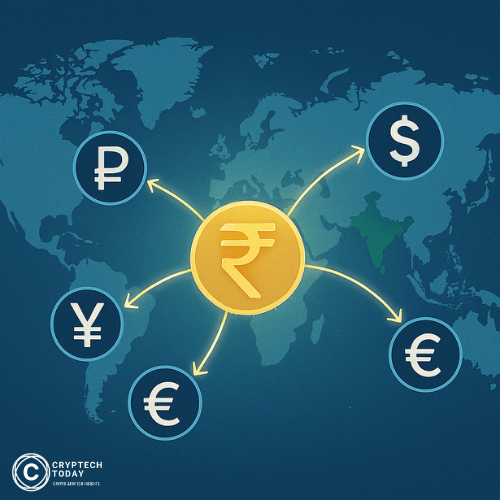
Traditionally, Indian exporters settling payments with countries like Russia or Africa had to rely on US Dollars or Euros, adding costs, delays, and dependence on global financial centres. The Special Rupee Vostro Accounts’ (SRVAs) mechanism changes this by enabling direct rupee settlements for international trade, reducing reliance on foreign currencies.
In 2022, India introduced the Special Rupee Vostro Account (SRVA), a mechanism that lets Indian exporters receive payments directly in rupees, while foreign buyers use their currency — bypassing dollars and euros.
What is an Special Rupee Vostro Accounts (SRVAs)?
At its core, an SRVA is a special type of account that foreign banks hold with Indian banks, authorised by the Reserve Bank of India (RBI). The word “Vostro” is derived from Latin and means “yours”. In banking terms, a Vostro account is “your account with us.”
In practice, if a Russian bank opens an SRVA at Punjab National Bank in India, rubles can be deposited, converted into rupees, and used to settle trade. Indian exporters receive payment in rupees into their local account.
This avoids the middleman currencies like USD or EUR, which not only cuts costs but also insulates trade from sanctions and currency shocks.
How does Special Rupee Vostro Accounts (SRVAs) work in real life?
Let’s walk through an example:
A Russian company wants to import pharmaceuticals from India. Instead of first converting rubles to dollars, sending them to a US correspondent bank, and then routing them to India, the process is now much simpler.
- The Russian importer deposits rubles into the SRVA held by a Russian bank at an Indian bank.
- The Indian bank converts those rubles into rupees.
- The Indian exporter receives the payment in INR.
The trade is complete — without a single dollar changing hands.
It’s like two neighbours trading mangoes for rice using tokens accepted at the same local shop, instead of converting into an international coin first.
Why did India introduce SRVAs?
The timing was not accidental. In July 2022, the RBI issued a circular laying down the rules for international trade settlements in INR. This came at a moment when global sanctions on Russia had made dollar-based trade tricky. Countries like Russia, Iran, and others suddenly needed alternative routes to keep trade flowing.
For India, the system offered multiple benefits:
- Reducing dependence on dollars: Each transaction in rupees strengthens the currency’s global presence.
- Shielding exporters: Payments can be settled even if the dollar system is blocked due to sanctions.
- Boosting INR demand: The more foreign countries hold rupees for trade, the more it supports the rupee’s long-term stability.
In short, SRVAs are not just a payment tool — they’re part of a larger vision of giving the Indian Rupee a seat at the global trade table.
The latest RBI update: Why it matters
On August 5, 2022, the RBI revised its guidelines to make SRVA operations more efficient. This update clarified compliance rules, settlement procedures, and how exporters could access benefits like government incentives while being paid in INR.
This was crucial. Without clear rules, banks and traders might hesitate. With the circular in place, more Indian banks began opening SRVAs for foreign counterparts. As of today, more than 18 countries — including Russia, Sri Lanka, and Mauritius — have set up SRVAs with Indian banks.
What does this mean for India and the world?
The SRVA system is small in scale compared to global dollar flows, but its symbolic value is large. It represents India’s ambition to make the rupee more international, much like China has done with the yuan.
For countries facing sanctions or dollar shortages, SRVAs provide a lifeline. For Indian exporters, it reduces the friction of dealing with volatile foreign exchange markets. And for India’s financial system, it builds a foundation for greater global currency use.
Of course, challenges remain. Not every country wants to hold large rupee balances, and the global trust in the dollar is still unmatched. But SRVAs are like planting seeds—the more trade is settled this way, the more confidence grows.
Writer’s personal opinion
When I think about SRVAs, I picture two rivers. For decades, almost all trade had to flow through the wide, powerful river called the US dollar. It was the main channel — fast, reliable, but also controlled at one end by Washington.
India’s Special Rupee Vostro Account (SRVA) system is like carving out a smaller tributary in the landscape. At first, only a few boats take it — Russian ships here, Sri Lankan ones there. But over time, if enough traffic builds, the tributary deepens into a river of its own. That river is the Indian Rupee in global trade.
The journey won’t be quick, but it marks an important shift: India is not just sailing with the current — it’s slowly shaping the waterways.