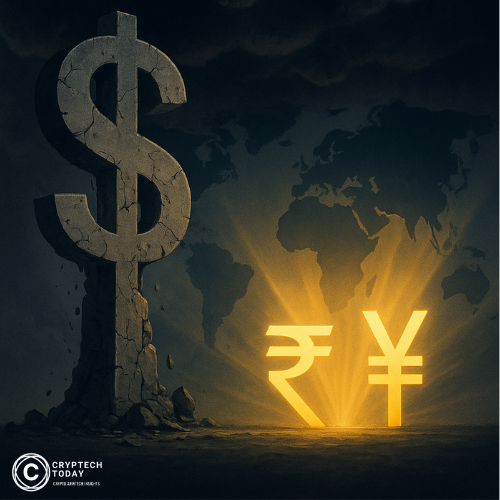
“De-Dollarisation” has gradually migrated from academic journals and financial circles into the press in the last several years. In its simplest form, de-dollarisation is the global trend of countries becoming less reliant on the U.S. dollar for commerce, reserves, and other financial operations. In a world where the dollar has been the primary currency for a considerable period, the objective is not to eliminate the dollar but rather to facilitate the availability of alternative options.
The timing of this debate is not accidental. The U.S. dollar has been the backbone of the global financial system since the mid-20th century, anchored first by the Bretton Woods Agreement in 1944 and later by the “petrodollar” system in which oil and other commodities were priced and settled almost exclusively in dollars. This dominance gave the U.S. not only economic strength but also immense geopolitical leverage. Countries and corporations worldwide must access dollars for trade, borrow in dollars, and often hold their reserves in U.S. Treasury securities.
However, the past decade has highlighted the vulnerabilities of such dependence. Nations like Russia, Iran, and Venezuela, targeted by U.S. sanctions, have been effectively cut off from the dollar-based system. Even large economies such as China and India have felt the pressures of dollar volatility and liquidity shortages. This has triggered a push for alternatives—whether through bilateral trade agreements in local currencies, regional payment systems, or experiments with digital currencies.
For India, the issue is particularly significant. As one of the world’s fastest-growing economies and a major importer of energy, India has traditionally relied heavily on the U.S. dollar for its trade settlements. In fact, over 85% of India’s imports (by value) are invoiced in dollars, even when the U.S. itself is not the trading partner. This creates vulnerabilities: when the dollar strengthens, India’s import bills rise; when global liquidity tightens, Indian businesses feel the crunch.
At the same time, India faces a balancing act. On one side, it has deepening ties with the United States—now one of its largest trading and strategic partners. On the other hand, India’s geography and energy needs tie it closely with Russia, the Gulf states, and other emerging economies, many of which are at the forefront of de-dollarisation efforts. For instance, India has been exploring the use of Special Rupee Vostro Accounts (SRVAs) to settle trade with Russia. It is part of ongoing dialogues within BRICS on alternatives to the dollar.
In short, de-dollarisation is not just an idea for India; it is a real policy problem that impacts everything from the price of gas to the stability of foreign exchange reserves. The story of how India navigates this change offers a glimpse into the complexities of the global economy during a time of geopolitical turmoil.
As we go deeper, we’ll talk about why countries are migrating away from the dollar, how India is trying out new ways to settle debts, and what chances and dangers this change will bring.
Why Countries Are Moving Away from the Dollar
The world dollarisation economy is like a town where everyone shops at one big store. The U.S. dollar is like a big grocery store; it has food, clothes, tools, and even medicine. People stop going to small stores over time and only shop at big places. It is up to the store to decide what to sell, how much to charge, and even who can shop there. It seems like a good plan at first. Why go somewhere else when this place has everything you need?
What will happen if the grocery store suddenly charges more, runs out of items, or stops letting some people in? The town as a whole is at risk. That’s the danger nations face when they depend too much on the U.S. dollar.
The Core Reasons Behind De-Dollarisation
For a long time, the United States has used the dollar’s strength as an instrument of global policy. Russia, Iran, and Venezuela are among the countries that have either been kicked out of the SWIFT payment system or had their access to dollar reserves severely limited. For countries that aren’t involved, these events provide a clear warning: if political ties with Washington break down, the dollar can be used as a strong weapon. After Russia invaded Ukraine in 2022, Western banks froze around $300 billion of Russia’s foreign savings. This is a clear example. This event woke up other countries that have a lot of dollars in their reserves.
Changes in the Dollar and the Cost of Imports
A strong currency makes things cheaper for Americans by cutting the cost of imports, but it also makes things more expensive for countries that rely on dollar-based imports. For example, India gets more than 80% of its crude oil from other countries, and when the dollar goes up, it directly raises the cost of fuel. This has an influence on the whole economy, raising prices in areas like transportation and food. The U.S. Federal Reserve’s aggressive interest rate hikes in 2022 pushed the dollar index to a 20-year high, which made India’s import bill even higher and put more pressure on the rupee.
Spreading out risk
Nations are starting to disperse their foreign reserves among several currencies, just like investors do to lower their risk. If they only use the dollar, they are at risk of volatility caused by rapid changes in U.S. monetary policy. Central banks throughout the world are adding more euros, yuan, and gold to their reserves to make this less likely to happen. The IMF’s COFER data shows that the dollar’s proportion of global reserves has dropped a lot, from 71% in 1999 to about 58% in 2023.
The Rise of Competing Currencies
The rise of other currencies has also made it easier to get rid of the dollar. China has been working hard to get the yuan (renminbi) used more in international trade. It has done this by creating deeper ties with other nations and through its Belt and Road Initiative. The BRICS group includes Brazil, Russia, India, China, and South Africa. They have all talked about the concept of making trade easier by using their own currencies or creating a common currency. In the meantime, Gulf states are exploring ways to make oil transactions with Asian partners that don’t use the currency. In 2023, China and Brazil decided to trade directly in yuan and reais, which means the dollar won’t be involved.
India’s Position in This Debate
For India, the logic is straightforward: reduce vulnerability, save costs, and increase financial independence. By trading with Russia in rupees or exploring digital payment systems within Asia, India can protect itself from dollar fluctuations and sanctions risk, while also strengthening the rupee’s international profile.
But India also faces constraints—it cannot afford to alienate the U.S. or global investors, who still operate primarily in dollars. Hence, India’s de-dollarisation path is not about rejection but about balancing a hybrid model of using the dollar alongside new alternatives.
The Global Context – BRICS, Gulf States, Africa, and China’s Yuan Push
When people say “de-dollarisation,” it sounds like a technical phrase. But in reality, it’s a succession of political, economic, and strategic actions happening in different parts of the world. Let’s take a look at the world as a whole.
The BRICS Bloc: A Voice for the Global South
The BRICS group (Brazil, Russia, India, China, South Africa) represents about 40% of the world’s population and a quarter of global GDP. Originally seen as an economic club, BRICS has increasingly positioned itself as a counterweight to Western dominance in finance and politics.
Russia’s Push: After being hit by Western sanctions, Russia has emerged as one of the most vocal advocates of ditching the dollar. Most oil has signed agreements with countries like China and India to trade in rubles, yuan, and rupees.
China’s Support: Beijing backs this agenda strongly, as promoting the yuan helps its long-term ambition of becoming a financial superpower.
India’s Position: New Delhi is cautious—it supports local currency trade but avoids full endorsement of a “BRICS currency” that could be dominated by China.
In 2023, the leaders of BRICS talked publicly about a new reserve currency that would be based on a mix of currencies from all the members (source). The proposal is still in its early stages, but it shows that other options are being actively thought about.
The Gulf States: Oil Beyond the Dollar
Oil is the lifeblood of the global economy. For decades, the “petrodollar system” has ensured that the oil trade is settled in U.S. dollars. This arrangement, cemented in the 1970s between the U.S. and Saudi Arabia, gave the dollar unparalleled strength.
But change is in the air:
Saudi Arabia has hinted at accepting payments in other currencies for oil, especially the yuan, given that China is its biggest customer.
UAE and India signed an agreement in 2023 allowing oil trade in rupees (source).
Qatar and Kuwait have also shown interest in expanding local currency trade with Asia.
If even a fraction of the oil trade shifts away from the dollar, it would mark a significant erosion of U.S. dominance.
Africa: A Rising Voice for Monetary Independence.
Africa has long suffered from currency instability, as many nations rely on the dollar or euro for trade, despite being rich in natural resources.
Recently, countries have started exploring alternatives:
Nigeria and South Africa have been testing local currency settlement systems within Africa.
Kenya signed an agreement with Saudi Arabia and the UAE to pay for oil in Kenyan shillings instead of dollars, easing pressure on its foreign reserves (source).
The African Continental Free Trade Area (AfCFTA), launched in 2021, is pushing for intra-African trade in local currencies.
For Africa, de-dollarisation is not just about geopolitics—it’s about economic survival. Red cing dependence on the dollar helps countries manage inflation and preserve scarce reserves.
China’s Yuan: The Biggest Challenger
No discussion on de-dollarisation feels complete without bringing up China’s yuan. Over the past decade, Beijing has poured billions into infrastructure projects across Asia, Africa, and Latin America, often encouraging its partners to take on yuan-denominated loans. Beyond that, China has signed trade settlement agreements with more than 20 countries, allowing transactions to bypass the dollar altogether. Its push doesn’t stop there—through the rollout of its central bank digital currency (CBDC), China is positioning the yuan as a faster and cheaper option for cross-border payments, sidestepping dollar-based systems like SWIFT. The strategy is paying off: in 2023, the yuan even overtook the dollar as the most used currency in China’s cross-border transactions. Still, it’s not without hurdles. The yuan remains heavily controlled by Beijing, which makes global investors wary, and many countries are cautious about replacing dependency on the U.S. with dependency on China.
Latin America: Testing the Waters
Though less discussed, Latin America has also joined the debate:
Brazil is trading more in yuan and reais, especially with China, its top trading partner.
Argentina, struggling with Debt and inflation, signed a deal with China to settle trade in yuan.
For these countries, the dollar remains important, but alternatives are being explored to ease balance-of-payment pressures.
What This Means for the World
De-dollarisation is not about one sudden shift—it’s more like water carving a path through rock: slow, steady, but irreversible—each bilateral deal, regional initiative, or alternative payment system chips away at the dollar’s dominance.
But it’s also important to note:
The dollar is still the world’s reserve currency, making up ~58% of global reserves.
Most international debt and trade contracts are still dollar-denominated.
Alternatives are fragmented—there is no single challenger strong enough yet.
So, rather than a complete dethroning of the dollar, the world is moving toward a multipolar currency system—where multiple currencies share influence.
India’s Role in the De-Dollarisation Debate
For India, de-dollarisation is not a theoretical exercise—it is a day-to-day reality shaped by energy imports, geopolitical pressures, and trade balances. Unlike some nations that have aggressively pushed alternatives to the U.S. dollar, India has adopted a pragmatic and cautious approach. The overlapping priorities drive the country’s strategy: ensuring access to affordable energy, safeguarding financial stability, and expanding its role in global economic governance.
Energy Security: The Russia Factor
India imports more than 85% of its crude oil requirements, and this dependency shapes much of its foreign policy. Traditionally, these imports have been priced and settled in U.S. dollars. However, after the U.S. and European sanctions on Russia in 2022, India faced a dilemma. Russian oil, available at discounted prices, became critical for India’s energy security. Pay in dollars, however, risked running into sanction-related hurdles.
The solution came in the form of Special Rupee Vostro Accounts (SRVAs), where Indian importers pay in rupees, which Russian banks can then use for trade or investment in India. While this system is still evolving, it illustrates India’s flexible, need-based participation in de-dollarisation efforts.
Balancing the U.S. Partnership
Despite experimenting with non-dollar trade, India remains deeply tied to the U.S. economy. The U.S. is now India’s largest trading partner and a crucial source of investment, technology, and defence cooperation. Any abrupt move away from the dollar could strain bilateral relations and reduce investor confidence in Indian markets.
Therefore, India’s approach is not about “replacing” the dollar, but about diversifying options. By promoting rupee settlements in select trades (Russia, Sri Lanka, Mauritius) while maintaining dollar-based trade with others, India seeks to hedge risks without jeopardising its U.S. ties.
BRICS and the Push for Alternatives
As a founding member of BRICS, India participates in ongoing discussions around creating alternative financial mechanisms—whether that’s through a BRICS currency, enhanced use of local currencies, or the New Development Bank (NDB). However, India has often been more cautious than China or Russia in this debate.
For example, while Brazil and China have openly settled trade in yuan, India has resisted similar dependence on the Chinese currency, fearing long-term strategic vulnerabilities. Instead, India emphasises the internationalisation of the rupee as its contribution to de-dollarisation.
Ruppe Internationalisation: Opportunities and Limits
The Reserve Bank of India (RBI) has taken steps to make the rupee more usable in international trade. The August 2022 RBI circular allowed countries facing dollar shortages to open SRVAs, paving the way for trade invoicing in rupees. More recently, India has discussed expanding rupee-based settlement to African and ASEAN markets.
Yet, challenges remain. The rupee is not fully convertible on the capital account, limiting its attractiveness as a global reserve. Moreover, India often runs trade deficits, meaning foreign partners accumulate rupees with limited options to recycle them. The constraints suggest that while the rupee can play a regional role, it cannot yet rival the dollar or even the yuan on a global scale.
India’s Strategic Sweet Spot
Ultimately, India’s role in de-dollarisation reflects its broader foreign policy principle: multi-alignment. Rat er than choosing sides, India positions itself as a country that can work with the U.S., Russia, the Gulf, and emerging economies simultaneously. This balancing act allows India to secure energy, attract investment, and gradually push for greater recognition of the rupee—without destabilising its financial system.
As Indian policymakers often note, de-dollarisation is not about replacing one monopoly with another, but about creating a multipolar financial order. For India, the goal is not to topple the dollar but to ensure that its own economic interests are better protected in a changing world.
Risks and Challenges for India
While de-dollarisation may sound like an opportunity for India to reduce dependency on the U.S. dollar and strengthen its economic sovereignty, the road ahead is filled with serious risks and structural challenges. The constraints explain why India has avoided any aggressive shift away from the dollar and instead follows a measured, pragmatic path.
Risks of Capital Flight and Market Volatility
India’s financial markets are deeply linked to global capital flows, much of which is denominated in U.S. dollars. The U.S. dollar remains the primary currency for foreign portfolio investment (FPI) into Indian equities and bonds. If India were to push too strongly for rupee-only settlements, international investors might fear reduced liquidity and pull funds out of Indian markets.
This could trigger capital flight, weaken the rupee, and raise borrowing costs. For an emerging economy that depends on foreign investment for infrastructure, technology, and growth, maintaining dollar liquidity is not optional—it is essential.
Vulnerability to U.S. Sanctions and Geopolitical Pressures
India’s cautious approach also stems from its relationship with the U.S., which is now a critical strategic partner in areas like defence, technology, and counter-terrorism. If India were to openly promote de-dollarisation in ways that directly undercut U.S. financial influence, it could invite diplomatic or economic retaliation.
For example, the U.S. has already warned countries trading with Russia outside the dollar system of potential secondary sanctions. While India has managed to continue importing Russian oil through SRVAs, any escalation could put New Delhi in a difficult position—choosing between energy security and strategic alignment with Washington.
Limited Global Acceptance of the Rupee
The biggest technical hurdle in de-dollarisation is the rupee’s limited international acceptance. Unlike the dollar, euro, or even the yuan, the rupee is not fully convertible on the capital account. This means foreign partners cannot easily use rupees for investments or reserve purposes.
Even when countries accept rupees for trade (e.g., Russia, Sri Lanka), they face the challenge of what to do with their rupee balances. Unless India creates deep, liquid markets for rupee-denominated bonds or goods, its partners may hesitate to settle in rupees on a large scale.
Trade Deficits: A Structural Constraint
India consistently runs large trade deficits, particularly with countries like China, Russia, and the Gulf states. This creates an imbalance in rupee-based settlements. For example:
Russia now earns billions in rupees from discounted oil sales. However, Russia struggles to spend those rupees because India doesn’t export enough goods to balance the trade.
This mismatch reduces the attractiveness of the rupee in international trade. In contrast, countries like China can push the yuan more effectively because they run massive trade surpluses, allowing trading partners to recycle yuan easily.
Banking and Infrastructure Challenges
For de-dollarisation to work, India needs a robust banking infrastructure that can handle rupee settlements across multiple jurisdictions. Currently, only a limited number of banks have the clearance and systems to handle SRVAs (Special Rupee Vostro Accounts). Sca ing this up would require massive coordination between the RBI, the Ministry of Finance, and global partners.
Moreover, the global financial system is still heavily dollarized—SWIFT messaging, correspondent banking, and reserve systems are all dollar-centric. Unless alternatives (like India’s SFMS or Russia’s SPFS) become widely integrated, settlements outside the dollar will face operational bottlenecks.
Risks of Rupee Volatility
If the rupee were internationalised too quickly, it could become more vulnerable to speculative attacks. Global investors betting against the rupee might exploit its limited convertibility and volatility, creating instability in India’s domestic economy. The RBI would then be forced to intervene heavily, draining foreign reserves.
Domestic Readiness and Policy Gaps
Finally, India’s own domestic policies can limit its de-dollarisation journey. For example:
High reliance on oil imports ensures continued dollar exposure. Incomplete financial sector reforms make it harder to deepen rupee-based capital markets. Lack of a clear roadmap for rupee internationalisation creates uncertainty for foreign partners.
The Balancing Act
For India, the greatest challenge is walking the tightrope: securing the benefits of reduced dollar dependency without triggering financial instability or geopolitical backlash. Policy makers know that moving too fast could be disruptive, while moving too slow could mean missing out on shaping the new global monetary order.
Thus, India’s cautious strategy is not a weakness—it’s a pragmatic response to the complex risks of de-dollarisation.
Future Outlook – India’s Potential Role in a Multipolar Currency World
The global financial system is undergoing a subtle but important transition. While the U.S. dollar still dominates as the world’s reserve currency, the rise of multipolar geopolitics is creating pressure for a more diversified currency system. For India, this shift presents both challenges and opportunities. The question is not whether the dollar will disappear—it won’t—but whether India can position the rupee as a meaningful player in this new landscape.
The Global Trend Toward Currency Diversification
Several developments suggest the world is gradually moving toward currency pluralism rather than dollar monopoly:
- BRICS Initiatives: The expansion of BRICS and discussions about a BRICS settlement currency highlight frustration with dollar dominance. While a common currency may be far off, the bloc is clearly experimenting with local currency trade.
- China’s Push for Yuan: China is aggressively internationalising the yuan, particularly in Asia, Africa, and Latin America, by linking trade, infrastructure loans, and energy deals to yuan settlements.
- U.S. Sanctions Overreach: Washington’s use of the dollar as a weapon (e.g., freezing Russian reserves, sanctioning Iran) has accelerated global interest in alternatives.
- Rise of Digital Finance: Central Bank Digital Currencies (CBDCs) and blockchain-based settlements could erode the dollar’s structural advantages in payments and clearance.
In this environment, India’s strategy will determine whether the rupee remains a regional trade currency or evolves into a global alternative.
India’s Strategic Advantages
Despite its challenges, India has several unique strengths that could help the rupee play a bigger role:
- Fastest-Growing Large Economy: India’s GDP growth consistently outpaces most major economies, making its markets attractive to global investors.
- Demographic Powerhouse: With the world’s largest working-age population, India will remain a driver of consumption and production for decades.
- Energy Security Ties: India’s relationships with Russia, the Middle East, and Africa allow it to negotiate local currency deals in oil and gas—critical commodities for global trade.
- Digital Payments Leadership: India’s UPI (Unified Payments Interface) has already transformed domestic payments and is being linked to international networks in countries like Singapore, the UAE, and France. If integrated with cross-border CBDC projects, this could boost rupee usage globally.
- Geopolitical Balancing: Unlike China, India is seen as more neutral in global disputes, which may make partners more comfortable holding rupee reserves.
What India Needs to Do to Elevate the Rupee
To move from a limited trade-settlement currency to a globally recognised option, India must take several steps:
Gradual Capital Account Liberalisation
- Carefully increase rupee convertibility while maintaining safeguards against speculative flows.
- Expand access to rupee-denominated bonds (Masala Bonds) for foreign investors.
Strengthen Rupee Trade Corridors
- Deepen bilateral rupee trade with major partners like Russia, the UAE, and Africa.
- Address trade imbalance issues by boosting exports, so partners have meaningful ways to spend rupee earnings.
Build Rupee-Based Financial Infrastructure
- Scale up Special Rupee Vostro Accounts (SRVAs) with more global banks.
- Push Indian banks to develop correspondent networks outside the dollar system.
Leverage Digital Currency
- Use the RBI’s Digital Rupee (CBDC) for international trade pilots.
- Link UPI and CBDC infrastructure with partner nations to reduce transaction costs.
Enhance Policy Predictability
- Provide a long-term roadmap for rupee internationalisation to reassure global partners.
- Ensure stable inflation and fiscal discipline so the rupee builds credibility.
Potential Role in a Multipolar World
India is unlikely to replace the U.S.
Dollar or even the euro/yuan in the short term. Instead, its role will likely evolve in three stages:
Regional Currency Hub (Short-Term)
- Rupee settlements will expand in South Asia, parts of Africa, and with strategic energy suppliers like Russia and the Middle East.
Strategic Alternative (Medium-Term)
- As India’s economy and exports grow, the rupee could become a secondary reserve currency for friendly nations that want to diversify away from the dollar and yuan.
Systemic Player (Long-Term)
- If India sustains high growth, builds deep financial markets, and integrates digital finance globally, the rupee could emerge as one of the top five global currencies, alongside the dollar, euro, yuan, and yen.
India’s Caution as Strength
While some criticise India’s slow pace in de-dollarisation, this caution may actually prove beneficial. Unlike China, which faces mistrust in global finance, India’s measured and transparent approach could win credibility over time. By avoiding sudden disruptions, India ensures that the rupee’s rise—if it happens—will be sustainable rather than fragile.
Out ook Beyond the U.S.–Russia Divide
India’s biggest opportunity lies in presenting itself as a neutral, reliable partner in a world split by U.S.–Russia and U.S.–China tensions. If India can offer a stable rupee alternative without threatening the dollar directly, it may carve out a role as a bridge currency in multipolar trade.
In other words, the future may not be about replacing the dollar but about creating a system where multiple currencies—including the rupee—share influence.
India’s Balancing Act – Between the U.S. and Global South
India’s position in the global de-dollarisation debate is unique. Unlike countries such as Russia or Iran that are actively excluded from the U.S.-led financial system due to sanctions, India enjoys a strong and growing partnership with the United States. At the same time, India has deep strategic, energy, and trade linkages with the Global South, especially Russia, the Gulf states, and African economies. This dual reality forces New Delhi to walk a fine line—embracing alternatives to the dollar where possible, but not at the cost of its U.S. relationship.
The U.S. Factor
The U.S. is one of India’s largest trading partners, with bilateral trade crossing $200 billion in 2023. It’s also a critical partner in defence, technology, and supply chain resilience. For India, maintaining access to U.S. capital markets, investments, and technology transfer remains crucial. Any abrupt attempt to sideline the dollar in its trade policy could send the wrong signal to Washington, undermining the strategic trust built over the past two decades.
Moreover, the U.S. dollar’s role in global finance offers India certain stability benefits. Access to dollar liquidity helps Indian corporations raise funds globally. The Reserve Bank of India (RBI) also invests a significant portion of its foreign exchange reserves—over $400 billion—in U.S. Treasury bonds, which remain among the safest assets worldwide. Walking away from the dollar entirely is neither feasible nor desirable for India.
The Russia–Energy Angle
At the same time, India cannot ignore its dependence on non-dollar trade mechanisms. Russia has emerged as India’s top crude oil supplier, especially after the Ukraine war and Western sanctions reshaped energy flows. To pay for this oil, India and Russia have increasingly turned to Special Rupee Vostro Accounts (SRVAs) and currency swaps. Tho gh still in experimental stages, these arrangements reflect India’s willingness to innovate around dollar restrictions when its energy security is at stake.
India’s imports from Russia crossed $46 billion in FY 2023, compared to just $8 billion in 2021. Setting ling such large volumes entirely in dollars would have invited secondary sanctions pressure from the U.S. and its allies. By singing rupees and other local currencies, India has managed to keep both energy flowing and diplomacy intact.
South-South Cooperation
India also sees de-dollarisation as part of its broader vision of South-South cooperation. In forums like BRICS and the Shanghai Cooperation Organisation (SCO), India has cautiously supported discussions on creating local currency payment systems and reducing dollar dependence. With Africa and the Middle East emerging as key trade partners, India is experimenting with similar local settlement mechanisms to mitigate foreign exchange risks and boost bilateral trade.
The Tightrope Strategy
India’s balancing act can be summed up as a “multi-currency, multi-partner” strategy:
- Use the dollar where it makes sense (global finance, U.S. trade).
- Use rupees or local currencies where possible (Russia, the Gulf, and Africa).
- Support regional initiatives (BRICS, SCO) without openly challenging the U.S.-led system.
This approach allows India to hedge its risks, keep energy secure, and maintain goodwill with both Washington and the Global South. It may not be as radical as Russia’s or China’s approach, but it reflects a pragmatic middle path aligned with India’s national interests.
Risks, Challenges, and Scepticism About De-Dollarisation
While de-dollarisation is a hot topic in policy debates and media headlines, the road away from the U.S. dollar is far from smooth. For every country seeking alternatives, there are serious risks, structural limitations, and practical challenges that make this shift difficult.
True Deficit in Alternatives
The dollar’s dominance is not just about America’s political power—it’s about trust in U.S. institutions. U.S Treasury bonds are seen as the safest asset class globally because the U.S. government has never defaulted on its Debt. Alternatives like the Chinese yuan or the Russian ruble don’t enjoy the same global trust, due to concerns over capital controls, transparency, and political interference. For example, China restricts how much money foreign investors can freely move in and out of its markets—this makes global businesses cautious about using the yuan for trade settlement.
Liquidity and Market Depth
The dollar is the world’s most liquid currency. Aro nd 88% of global forex transactions involve the dollar (Bank for International Settlements, 2022). This deep market ensures that businesses can always find buyers and sellers for their dollar-denominated contracts. By contrast, the rupee, ruble, or even yuan lack the same level of global acceptance. Without sufficient liquidity, large-scale trade or investment becomes harder to conduct in local currencies.
Dollar-Denominated Debt
A huge portion of the world’s external Debt is denominated in U.S. dollars. Many emerging economies and corporations borrow in dollars because lenders prefer it as a stable, low-risk currency. If these countries shift away from the dollar, they would still have to service existing debt obligations in dollars—making a full break practically impossible in the near future.
Sanctions and Geopolitical Risks
Ironically, the very sanctions that push countries like Russia and Iran toward de-dollarisation also act as a warning sign to others. Governments and corporations know that if they move too aggressively away from the dollar, they risk attracting U.S. scrutiny or even secondary sanctions. For instance, India has been cautious in structuring its Russian oil payments to avoid violating U.S. sanctions, even while experimenting with rupee-based settlements.
Technical and Regulatory Barriers
Global financial plumbing—from SWIFT payments to correspondent banking networks—is heavily dollar-centric. Shifting to alternatives requires building new infrastructure, such as local currency clearing systems, digital payment rails, or even blockchain-based settlements. The e-projects take years to develop, and without global coordination, they risk becoming fragmented and inefficient.
The Dollar’s Network Effect
Finally, the dollar benefits from a self-reinforcing cycle: because everyone uses it, it remains the easiest and cheapest option to use. Breaking out of this cycle requires not just political will but also convincing businesses, investors, and consumers that alternatives are safer, faster, and more profitable. So, that leap of faith has been limited.
The Bottom Line
De-dollarisation is not impossible—but it is a slow, uneven process. While countries may succeed in creating niche systems (like rupee-ruble trade or yuan-based oil contracts), the dollar remains the backbone of global finance. Even critics admit that unless an alternative currency matches the dollar’s trust, liquidity, and legal framework, the greenback will remain dominant for decades.