While Western regulators fight in courtrooms, Uzbekistan quietly built Central Asia’s most structured crypto regime. With dedicated licenses for retail crypto shops, solar-only mining mandates, and a 2035 tax holiday in Karakalpakstan, here is how Tashkent’s permissioned digital market actually operates.
Key Takeaways
- Single Specialist Gatekeeper: The National Agency for Perspective Projects (NAPP) oversees all licensing, rulemaking, mining permits, and regulatory sandbox operations.
- Four Dedicated License Tiers: NAPP does not issue generic VASP licenses. It divides operators into Exchanges, Depositories, Mining Pools, and Retail Crypto Shops.
- Mandatory National Routing: Uzbek residents must buy and sell cryptoassets exclusively through locally authorized domestic providers; offshore exchanges without local partners are actively blocked.
- Besqala Mining Valley (RP-143): Special mining zone across Karakalpakstan offers a complete corporate tax exemption through January 1, 2035 for permitted renewable and hydrogen mining operations.
When international investors analyze global digital asset policy, their attention gravitates toward Washington, London, or Brussels.
Yet across Central Asia, an entirely different regulatory model has quietly emerged.
Rather than treating cryptocurrency as an unregulated free-for-all or imposing an outright banking blockade, the Republic of Uzbekistan built a highly prescriptive, state-controlled digital asset perimeter.
The architect of this system is the National Agency for Perspective Projects (NAPP). Under Presidential decrees and Ministry of Justice regulations, NAPP transformed Uzbekistan into a permissioned domestic market: requiring local server hosting, five-year transaction retention, local incorporation, and dedicated licenses for every layer of the value chain.
At the same time, the country paired strict retail control with aggressive industrial incentives: zero capital gains tax on crypto turnover, a state-run regulatory sandbox, and a long-dated tax holiday through 2035 for clean-energy industrial miners in the Republic of Karakalpakstan.
The Regulatory Architecture: NAPP as the Sole Authority
Unlike jurisdictions with fragmented regulatory mandates, Uzbekistan centralized its entire digital asset regime under NAPP.
Under Ministry of Justice Registration No. 3380 (promulgated in August 2022 and updated through 2026), NAPP functions as the single supervisory authority responsible for:
- Issuing and revoking service provider licenses.
- Granting industrial mining permits and maintaining the public miner registry.
- Enforcing anti-money laundering and counter-terrorist financing (AML/CFT) standards.
- Administering the national regulatory sandbox for blockchain pilots.
- Ordering the block and sanctioning of non-compliant offshore platforms.
Cryptoassets are not legal tender in Uzbekistan. Using digital assets to pay for, or accepting them as direct payment for, physical goods and services within the country is strictly prohibited. Crypto is treated as a regulated financial and investment asset class.
The 4-Tier Licensing Framework
NAPP does not issue a broad, one-size-fits-all license. It enforces functional segregation across four distinct corporate licenses:
| License Category | Regulated Function | One-Time State Fee | Monthly Operating Charge |
|---|---|---|---|
| Crypto Exchange | Electronic trading platform matching buyers and sellers with order books and quotation engines. Requires 5,000 BCV paid-up capital (3,000 BCV reserved in a local bank). | 73,400 BCV | 740 BCV |
| Crypto Depository | Custodial platform and technical software infrastructure for the issuance, primary placement, and secure storage of cryptoassets. | 7,000 BCV | 5 BCV |
| Mining Pool | Electronic platform aggregating third-party computational power and distributing block rewards. | 3,000 BCV | 100 BCV |
| Crypto Shop | Dealer on/off-ramp facilitating direct purchase and sale of crypto via web portals or licensed physical retail storefronts. | 3,700 BCV | 185 BCV |
Note: Fees are indexed to the Base Calculation Value (BCV), the statutory economic benchmark set by the Uzbek government.
License Activities and Prohibited Services: Comparison Table
Each license tier carries a defined set of permitted activities and hard prohibitions. Crossing boundaries (for example, a Crypto Shop attempting to operate an order-book trading engine) is treated as an unlicensed activity and triggers immediate suspension.
| License Tier | Permitted Activities | Hard Prohibitions | Minimum Capital |
|---|---|---|---|
| Crypto Exchange | Operating order-book trading platforms; price quotation; market-making; custody of exchange balances; providing API trading access. | Cannot accept unlicensed offshore deposits. Cannot offer leveraged trading or crypto derivatives without additional NAPP approval. | 5,000 BCV paid-up capital (3,000 BCV reserved in a local bank). |
| Crypto Depository | Issuing and placing tokenized assets on-chain; custodying private keys; running primary market infrastructure for digital securities. | Cannot operate a secondary trading marketplace. Cannot take retail consumer deposits in fiat currency. | Not publicly enumerated; typically higher than Exchange due to fiduciary obligations. |
| Mining Pool | Aggregating third-party mining hash power; distributing block rewards; operating collective proof-of-work infrastructure. | Cannot offer retail investment products linked to mining income. Cannot operate without a NAPP permit and registered mining log. | 3,000 BCV initial fee; solar generation certificate or Besqala zone residency required. |
| Crypto Shop | Direct crypto buy/sell via national bank transfers; licensed physical retail storefronts with cash purchases under identity verification. | Cannot match peer-to-peer orders. Cannot custody third-party assets. Cannot facilitate international crypto transfers without separate correspondent agreement. | 3,700 BCV initial fee; no minimum ongoing reserve requirement. |
Who Can Apply: Foreign Entity Eligibility
A substantial proportion of searchers evaluating Uzbekistan’s crypto framework are foreign operators, international mining conglomerates, or non-resident institutional investors. NAPP’s rules on foreign participation are structured but workable:
- Foreign-Owned Domestic Entities Are Permitted: A foreign shareholder can own 100% of an Uzbek-registered limited liability company (MChJ) or joint-stock company (AJ). That Uzbek-incorporated entity can then apply for a NAPP crypto license or Besqala mining status.
- Direct Foreign Entity Licensing Is Not Available: An overseas holding company cannot hold a NAPP license directly. A local entity subsidiary is mandatory in all cases.
- Executive Residency Requirements: At least one executive director or compliance officer must be an Uzbek-resident natural person with Uzbek tax identification, contactable by NAPP for routine inspections and urgent regulatory orders.
- Capital Must Be Held Locally: The required capital reserves (especially the 3,000 BCV reserve element for exchanges) must be held in accounts at Uzbek-licensed commercial banks, not in offshore correspondent accounts.
- Server Localisation: All primary customer-facing servers, KYC databases, and transaction logs must be physically hosted within Uzbekistan for a minimum of five years.
For context on how other jurisdictions structure foreign VASP licensing, see our guides on Argentina’s CNV PSAV framework and real-world asset tokenization basics.
Mandatory Localization: The End of Unrestricted Offshore Trading
Since January 1, 2023, Uzbek citizens and legal entities have been legally required to conduct all cryptocurrency purchases, sales, and conversions exclusively through NAPP-licensed national service providers.
To enforce this domestic perimeter, NAPP deployed an aggressive regulatory enforcement strategy:
1. Website and Domain Blocking:
In 2022, Uzbekistan blocked access to major unlicensed foreign exchanges, including Binance, Kraken, FTX, and Huobi. Foreign platforms targeting Uzbek residents without a local presence were designated as unlawful.
2. The Binance Precedent:
After NAPP fined Binance 300 BCV for serving Uzbek users without authorization, Binance settled the dispute. In January 2025, NAPP and Binance announced a formal localization arrangement: Uzbek residents access Binance services through locally licensed partner Coinpay, ensuring all customer KYC, data retention, and transaction auditing remain anchored within Uzbekistan’s legal jurisdiction.
3. Five-Year Server Mandate:
All licensed providers must host their primary servers physically within the territory of Uzbekistan, maintaining customer identification records, order histories, and communications for at least five years.
Mining Regulations: Solar Mandates vs. Besqala Mining Valley
Uzbekistan’s mining policy is split between strict national green-energy requirements and a landmark special economic zone.
1. Baseline National Mining Rules
Outside the special economic zone, cryptocurrency mining is subject to strict conditions:
- Only legal entities (not individual hobbyists) are permitted to mine, requiring electronic registration and a NAPP permit.
- Miners must generate their own electricity using solar photovoltaic installations.
- If connected to the national electrical grid, miners are charged a 2x coefficient tariff surcharge during normal hours and additional peak-period surcharges.
- Illegal or unregistered grid mining triggers a punitive 5x electricity tariff penalty alongside criminal equipment confiscation.
On January 19, 2026, NAPP issued Permission M #001 to NexaGrid LLC in the Romitan district of the Bukhara region, marking the country’s first officially registered commercial solar mining permit.
2. Besqala Mining Valley: The 2026-2035 Tax Holiday
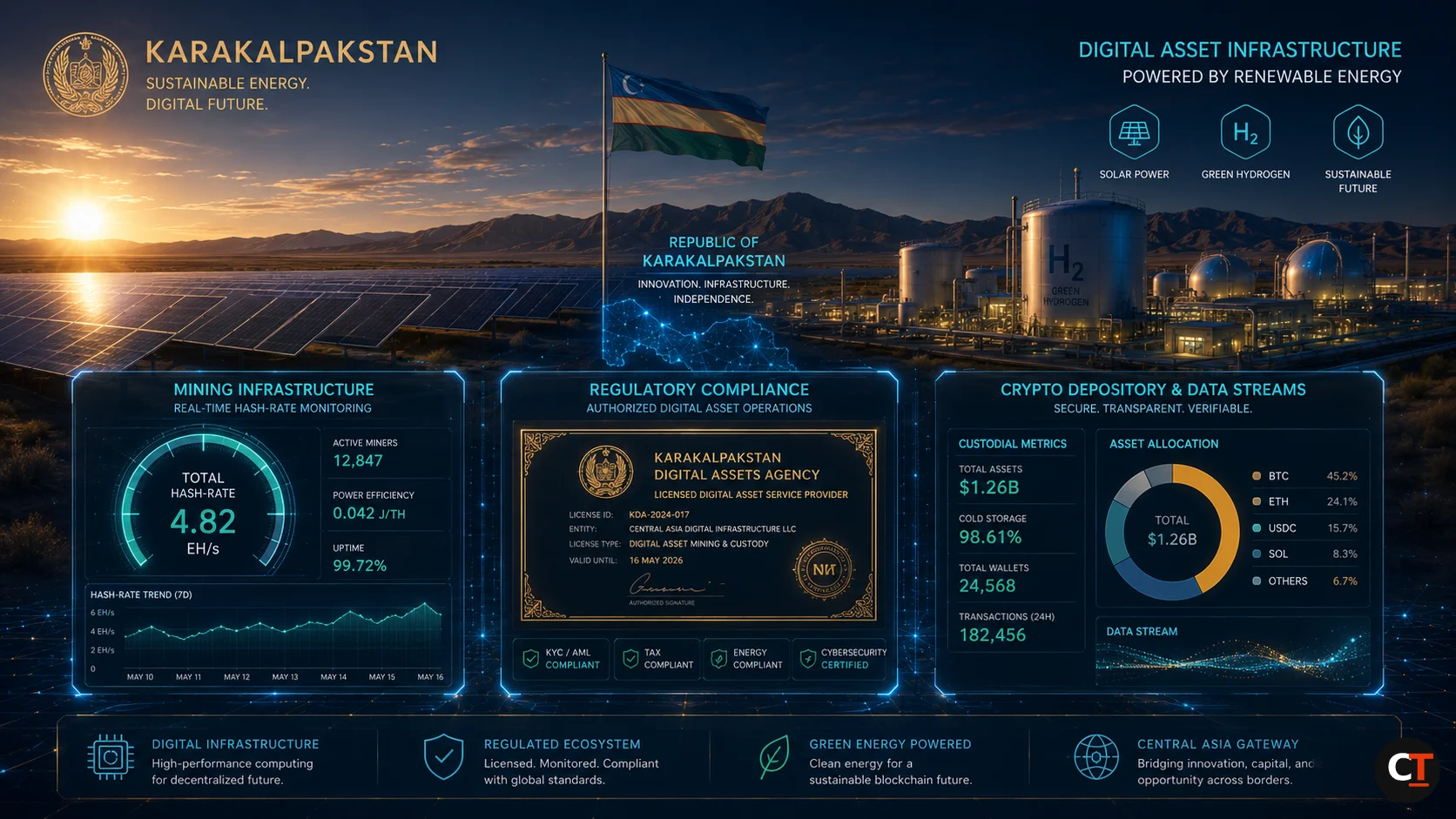
To turn surplus energy and regional development into industrial capital, President Shavkat Mirziyoyev enacted Presidential Resolution RP-143 on April 17, 2026, establishing the Besqala Mining Valley across the entire Republic of Karakalpakstan.
Companies registered in Karakalpakstan that secure Besqala resident status and a NAPP mining permit enjoy a complete corporate exemption from all taxes and state fees on mining income until January 1, 2035. In exchange, operators pay a 1% monthly fee on mining revenue to the zone directorate.
Crucially, Besqala expands the permitted power mix. Unlike the rest of Uzbekistan (which is confined to solar), Besqala residents can draw power from:
- The unified national electricity grid (with dedicated automated ASKUE metering).
- All commercial renewable energy sources (wind, hydro, solar).
- Green hydrogen power generation facilities.
This transformed Karakalpakstan into Central Asia’s premier jurisdiction for industrial-scale institutional proof-of-work infrastructure.
The NAPP Regulatory Sandbox: Real Pilot Projects
Launched on January 1, 2023, the NAPP Regulatory Sandbox is not a marketing concept. It is a legally codified experimentation regime that allows domestic enterprises to trial novel blockchain architecture under temporary statutory exemptions.
Approved sandbox participants are exempt from all corporate taxes, mandatory contributions to state reserve funds, and customs duties on imported technical equipment. Three prominent pilots illustrate how the sandbox functions:
1. UZINFOCOM NFT Domain Registry:
The administrator of the national top-level domain (.UZ) trialed a blockchain-based certificate system. Domain ownership rights are minted as non-fungible tokens, allowing decentralized verification and transfer while remaining synchronized with the national communications ministry database.
2. Kapitalbank Crypto Card Integration:
One of Uzbekistan’s largest commercial banks piloted a payment card linked directly to client balances held on licensed domestic exchanges. When a user swipes at a point-of-sale terminal, the platform automatically liquidates crypto into Uzbek Som via instant interbank clearing.
3. Octobank CRYPTO CARD-UzNEX Pilot:
A dedicated settlement rail testing real-time conversion between fiat banking balances and custodial exchange liquidity, providing blueprint architecture for institutional digital asset gateways across Central Asia.
How to Apply for Besqala Mining Status: Step-by-Step
For international mining conglomerates evaluating Karakalpakstan, the approval workflow requires a two-tier administrative process:
- Karakalpakstan Entity Incorporation: The applicant must form a locally registered legal entity (such as an LLC / MChJ) within the Republic of Karakalpakstan. Offshore entities cannot hold resident status directly.
- Directorate Application: Submit an electronic dossier to the Besqala Mining Valley Directorate detailing property cadastral deeds, technical energy contracts, power capacity certifications, and executive background checks confirming zero unexpunged financial crime convictions.
- Directorate Review & Certificate: The Directorate reviews the file within 30 days without administrative charge. Upon approval, it issues a formal Zone Resident Certificate.
- NAPP Mining Permit: Upon receiving the Directorate’s approval, NAPP issues the formal Mining Permit without requiring duplicate documentation, followed by mandatory online miner ledger registration.
Tax Incentives: A 3-Track Framework
Uzbekistan offers three distinct tax incentive tracks designed to channel capital into regulated entities:
| Incentive Track | Statutory Basis | Tax Treatment & Scope |
|---|---|---|
| Crypto Turnover Exemption | Presidential Resolution RP-3832 | Operations involving the turnover of cryptoassets (buying, selling, exchanging, holding) are completely exempt from taxation for both residents and non-residents. |
| NAPP Regulatory Sandbox | Special Legal Regime (Jan 2023) | Approved blockchain pilot projects (such as UZINFOCOM domain NFT certificates and bank crypto-card pilots) are exempt from all corporate taxes, trust fund levies, and customs duties. |
| Besqala Mining Zone | Presidential Resolution RP-143 | 100% tax holiday on mining operations through January 1, 2035, subject to a 1% monthly gross revenue fee to the zone directorate. |
It is important to understand the boundary of these exemptions. While the trading and turnover of cryptoassets carry zero capital gains tax, ordinary business overhead (such as non-crypto consulting fees, corporate real estate, and employee payroll taxes) remains subject to standard fiscal codes.
How Uzbekistan Compares to Global Regimes
Uzbekistan’s approach contrasts sharply with other major jurisdictions:
- Unlike the United Kingdom’s broad integration into existing financial laws under the UK FCA crypto regime, Uzbekistan created a bespoke standalone authority in NAPP.
- Unlike Latin America’s market-driven adoption in Argentina under CNV rules, Uzbekistan enforces strict state intermediation and local server containment.
- Unlike the European Union’s cross-border passporting under EU MiCA regulation, Uzbekistan prohibits cross-border servicing without a registered local legal entity.
- Similar to India’s regulatory stance under SEBI and RBI guidelines, Uzbekistan maintains that cryptocurrencies cannot serve as legal tender, focusing instead on state-supervised securities and tokenized infrastructure.
For institutions evaluating asset security and custody risks across emerging markets, read our comprehensive guide on the real risks of tokenized assets.
Uzbekistan is not trying to be a freewheeling offshore haven. It is building a permissioned, highly supervised digital economy.
For retail traders, the system channels all activity through KYC-compliant domestic gateways. For industrial miners, the Besqala Mining Valley offers a decade of tax certainty tied to green energy infrastructure.
By replacing ambiguity with clear statutory tiers, Uzbekistan has established one of the most stable and predictable digital asset operating environments in Eurasia.