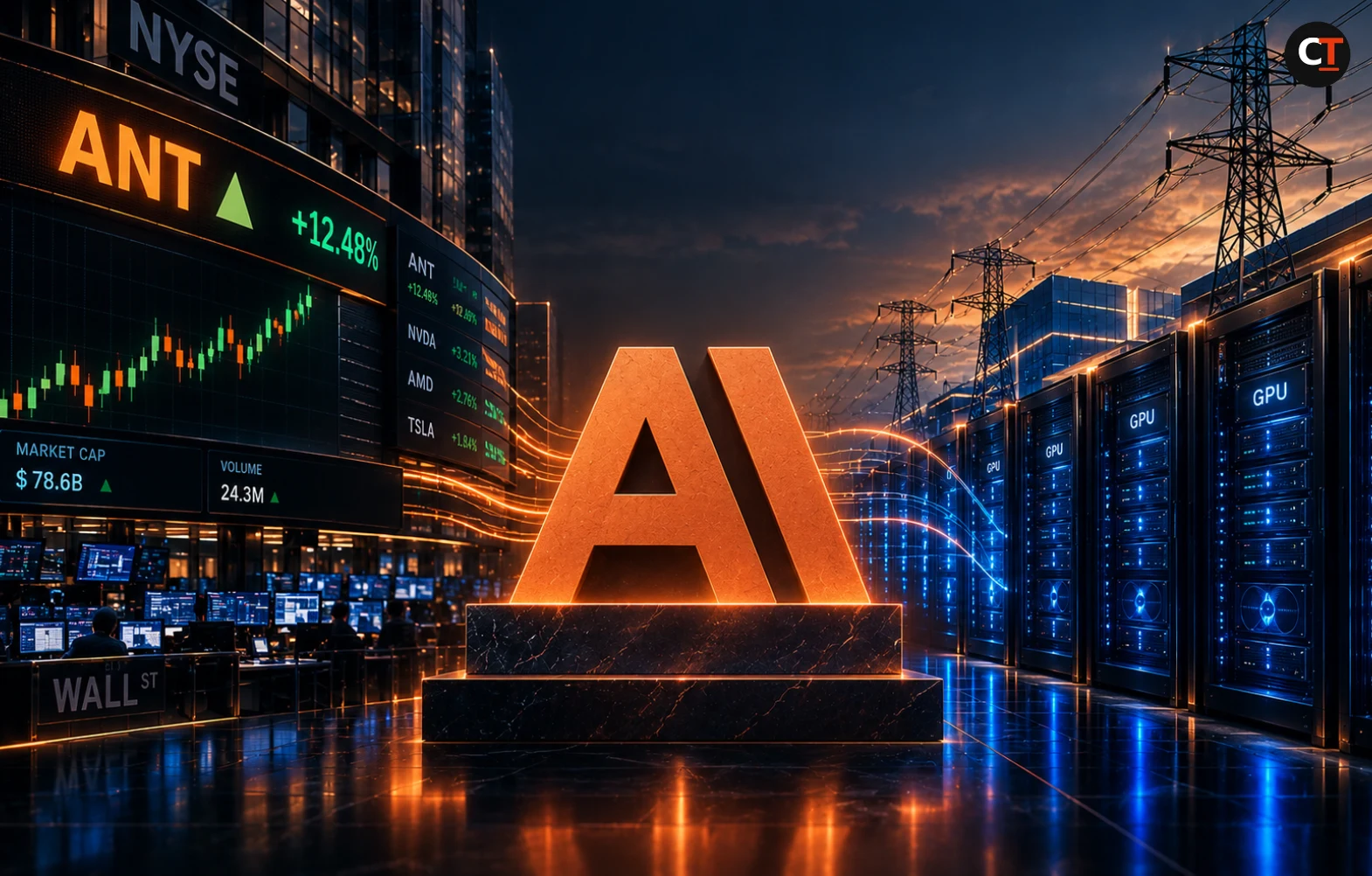
Why Wall Street’s biggest Anthropic IPO AI offering looks less like high-margin software equity and more like a public utility bill for runaway GPU clusters.
Key Facts at a Glance
- Anthropic filed its Form S-1 with the SEC on October 26, 2026, targeting a Nasdaq listing under ticker ANT at a reported $1.5 trillion valuation.
- The S-1 discloses $542 billion to $567 billion in total compute and infrastructure commitments through 2036.
- Revenue surged to $16.3 billion in H1 2026 from $4.6 billion for all of 2025 — genuine commercial traction, not vaporware.
- The revenue-to-compute ratio hit $2.07 per $1.00 of compute in Q2 2026, a positive spread but nowhere near traditional software margins of 75–80%.
- The SpaceX AI deal alone commits Anthropic to up to $120.5 billion through 2029, roughly $3.1 billion per month at full capacity.
Inside a wood-paneled conference room on the forty-first floor of a Midtown Manhattan investment bank, the roadshow pitch looks like every other enterprise software IPO of the past two decades. Clean typography charts, hockey-stick adoption curves, and logos of Fortune 500 engineering departments paying for Claude Enterprise seats. The underwriters speak of total addressable markets, platform moats, and operating leverage.
Travel three hundred miles south to Ashburn, Virginia, and the atmosphere changes completely. There are no PowerPoint decks in Loudoun County. There are only five-hundred-kilovolt transmission lines, humming step-down transformers, industrial chillers draining municipal water reservoirs, and padlocked concrete bunkers pulling fifty megawatts apiece from an aging regional grid.
On October 26, 2026, Anthropic, PBC publicly filed its Form S-1 registration statement with the SEC to list Class A common stock on the Nasdaq Global Select Market under the ticker ANT. The headline valuation target sits around $1.5 trillion, trimmed from earlier whisper numbers of $2 trillion, with underwriters aiming to raise tens of billions before the Thanksgiving holiday freeze.
The public reception has followed a familiar, breathless script. Tech commentators celebrate the arrival of the first pure-play frontier model lab on public exchanges. Bullish investors claim this is the opening bell for a multi-trillion-dollar cognitive revolution.
An unvarnished read of the 120-page prospectus reveals a more complicated reality. Anthropic is not a software company in the tradition of Microsoft, Salesforce, or Adobe. It is pioneering an entirely new corporate hybrid: a capital-intensive cognitive utility operator with a software front end. Behind Claude’s conversational brilliance sits $542 to $567 billion in multi-year, largely non-cancellable compute, power, and real-estate commitments. When brokerage accounts log in to bid for ANT, one fair question must be asked: are investors committing investment capital, or underwriting the world’s most expensive utility bill?
The Roadshow Versus the Substation
For three decades, the venture capital model for enterprise software rested on a single beautiful principle: near-zero marginal cost. You wrote the codebase once, burned venture cash to build the product, and then served customer number one million at virtually the same cost as customer number one. Gross margins printed at 75–85%. Operating leverage was automatic.
Anthropic does not possess those economics. It can never possess those economics under current transformer architectures. When a corporate client submits a complex prompt to Claude 3.5 Sonnet, Anthropic runs billions of matrix multiplications across liquid-cooled tensor cores. Every token generated consumes physical electricity, heats water in an evaporative cooling loop, and depreciates silicon hardware that reaches zero value inside thirty-six months.
The S-1 demonstrates this in stark numbers. Anthropic generated $16.3 billion in revenue in the first half of 2026, a surge from $1.1 billion in the same period a year earlier. That growth proves customer demand is real and accelerating. The problem is what sits beneath that revenue line: approximately $9 billion burned directly on compute and infrastructure in the same six-month window — more than half the top line, before a single engineer’s salary cleared payroll.
Add in Anthropic Direct, the company’s internal data-center arm, which has locked in $125.2 billion in five-year lease commitments, and the corporate classification becomes clear. Anthropic does not run a digital storefront. It operates a heavy industrial factory that converts raw electricity and Nvidia silicon into synthesized intelligence.
The S-1 Under the Hood: Auditing $567 Billion in Commitments
To understand where IPO proceeds will actually flow, one must examine the contractual commitment schedule disclosed in Fortune’s S-1 analysis and The Verge’s breakdown:
                          ANTHROPIC (ANT) — Compute Commitment Map
                               Total: $542B – $567B through 2036
                                              │
      ┌────────────────┬─────────────────────┴──────────────────┬────────────────┐
      ▼                ▼                                         ▼                ▼
 Amazon AWS       Google Cloud                             SpaceX AI         Microsoft
$110.0B Min      $114.5B Min                             $120.5B Max        $44.9B Min
 10-Year Term    Through 2033                            Through 2029       Through 2033
      │                │                                         │                │
      └────────────────┴──────────────────┬──────────────────────┘────────────────┘
                                          ▼
                         Anthropic Direct Data Center Leases
                                $125.2B (5-Year Rent)
| Counterparty | Commitment | Horizon | Primary Purpose |
|---|---|---|---|
| Amazon Web Services | At least $110.0 billion | 10-year contract minimum | Trainium/Inferentia accelerators, AWS Bedrock |
| Google Cloud | At least $114.5 billion | Through 2033 | Google TPU clusters and custom Broadcom silicon |
| SpaceX AI | Up to $120.5 billion | Through 2029 (~$3.1B/month) | Dedicated Nvidia GPU compute pods |
| Microsoft | At least $44.9 billion | November 2026–2033 | Secondary Azure cluster capacity |
| Anthropic Direct Leases | $125.2 billion | 5-year rent (excl. interest) | Direct-leased data center space and power |
| Total | $542B to $567B | Cumulative through 2036 | Baseline infrastructure to remain operational |
The SpaceX arrangement is the most revealing. Anthropic will wire approximately $3.1 billion every month to SpaceX for dedicated Nvidia GPU clusters once full contracted capacity is delivered. SpaceX itself completed a record-breaking IPO in June 2026, raising $85.7 billion at a $1.77 trillion valuation, and then immediately closed a further $40 billion in callable debt specifically to purchase next-generation GPUs arriving in 2027.
The circular mechanics are worth pausing on. SpaceX borrows $40 billion on the bond market to buy graphics cards from Nvidia. Anthropic commits $120.5 billion to rent those cards back from SpaceX. Anthropic files an IPO to raise public equity to fund those payments. Public investors supply the cash. Nvidia collects on both ends. This is not a typical venture software cycle. It is a closed-loop capital rotation between three megacap balance sheets — and the IPO is the invitation for public markets to step into the circle.
Revenue, Compute, and the $80 Billion Accounting Phantom
When the S-1 was filed, headlines fixated on a terrifying number: an $80.7 billion GAAP net loss for H1 2026. That figure is real but misleading in isolation.
Approximately $72 billion of that loss is a non-cash accounting artifact driven by fair-value adjustments on convertible notes and preferred financing instruments. Under GAAP rules, when a private company’s valuation rises, the value of convertible liabilities on the balance sheet rises with it and must be marked as an expense on the income statement. Anthropic did not write an $80 billion check from its bank account. The more valuable Anthropic became in private secondary rounds, the worse its paper GAAP loss looked. Once the IPO converts those instruments into permanent common equity, the non-cash charges disappear.
Strip away the accounting noise, and the operational numbers demand rigorous scrutiny:
| Metric | Full-Year 2025 | H1 2026 | Q2 2026 | Trajectory |
|---|---|---|---|---|
| Revenue | $4.60B | $16.30B | $11.60B | ~1,380% annualized growth |
| Compute & Infra Spend | $7.30B | ~$9.00B | $5.60B | ~52% of Q2 revenue consumed |
| Operating Spread (Revenue minus Compute) | -$2.70B | +$7.30B | +$6.00B | Positive spread, widening |
| Revenue / Compute Ratio | 0.63x | 1.81x | 2.07x | Expanding toward positive leverage |
| GAAP Net Loss | ~$42B | $80.7B | Not separately disclosed | $72B of H1 loss is non-cash derivatives |
The metric that matters for equity valuation is the 2.07x revenue-to-compute ratio in Q2 2026. In 2025, Anthropic lost money on every query, generating $0.63 for every $1.00 of compute. By Q2 2026, that had flipped to $2.07 per $1.00. That is proof of commercial traction and expanding monetization.
It is also proof that Anthropic’s gross economics resemble an oil refinery or an electrical utility, not an enterprise software platform. See our earlier analysis on AI-driven macro risk and capital allocation for context on how markets have priced similar capital-heavy tech bets.
Traditional SaaS (Microsoft, Salesforce): Gross margins of 78–84%. Once the code is written, serving another million users costs nearly nothing.
Frontier AI Operator (Anthropic Q2 2026): Compute and infrastructure COGS consume roughly 52% of revenue before R&D, sales, or depreciation. Every new wave of Claude usage requires new inference compute.
Why Price Before Thanksgiving? The SpaceX Precedent
Why is Anthropic pushing aggressively to price during the second week of November? Bankers are orchestrating roadshows for the week of November 9, targeting a Nasdaq debut before November 26. Under normal conditions, a $100 billion capital raise would prefer a calm spring book-building window.
Three pressures drive the rush. First, Anthropic genuinely needs the capital. Despite $16.3 billion in half-year revenue, the contractual ramp to AWS, Google, and SpaceX is accelerating. Second, the cost of capital is no longer zero — benchmark interest rates remain at multi-year highs, and venture balance sheets have reached their limits. Third, as Reuters reported, Wall Street is showing signs of megacap AI capex fatigue.
The warning sign is SpaceX. It listed on Nasdaq under SPCX on June 12, 2026, raised $85.7 billion at a $1.77 trillion valuation — and reportedly fell approximately 29% from its post-IPO peak of $225 to around $159 by late October, as investors calculated a trailing price-to-sales of 67.5x in an economy where money costs 5%.
IPO Price: $135 | Opening: $150 | Peak: $225 | October 2026: ~$159 (down 29.3%)
Trailing P/S: 67.5x vs Nasdaq-100 average of ~6.7x | Additional debt: $40B callable bonds for 2027 GPU purchases
As Reuters reported on valuation expectations, Anthropic’s private-market target already slipped from $2 trillion to $1.5 trillion amid investor concern about slowing sequential revenue growth and the cost of financing AI. Anthropic is entering that same public market environment with an even larger compute commitment and no hardware assets on its balance sheet. The pre-Thanksgiving rush is not confidence — it is an emergency exit into public liquidity before the window narrows further.
The Physical Ceiling: Grids, Water, and Transformer Backlogs
Technology investors often treat compute as an abstract cloud resource. The S-1 explicitly warns otherwise: Anthropic’s primary operational risk over the next five years is not algorithmic. It is physical.
The risk factor disclosures cover:
- Grid interconnection delays: Securing high-voltage transmission capacity now faces queue delays of four to seven years in Northern Virginia and Silicon Valley. Regional utilities have warned that new substations cannot be energized without major consumer rate hikes.
- Cooling water depletion: A fifty-megawatt data center can consume hundreds of thousands of gallons of municipal water daily. Rising temperatures are driving permitting moratoria across the American South and West.
- External cost acknowledgment: In a disclosure unusual even for a utility company, Anthropic publicly committed in February 2026 to cover consumer electricity-price increases caused by its data centers, including grid upgrades and new power infrastructure. When an AI company budgets to subsidize residential utility bills to avoid local zoning revolts, the boundary between tech firm and public utility has formally dissolved.
Goldman Sachs Research estimates that global data-center power demand will surge 165% by 2030, requiring over $720 billion in grid investment. Anthropic is not competing only against OpenAI for machine learning researchers. It is competing against aluminum smelters, EV charging networks, and semiconductor fabs for gigawatts of base-load power. That constraint cannot be resolved by writing a larger check to Nvidia.
As flagged in our guide on yield mechanics in capital-intensive crypto infrastructure, the pattern of promised returns constrained by physical and regulatory input costs is not new to digital finance — but Anthropic’s scale elevates it to a different order of magnitude.
The Bull Case: Why the Bears Could Be Wrong
The bulls are not irrational dreamers. Their thesis is coherent and grounded in real numbers:
- Unmatched revenue velocity: $16.3 billion in six months, growing at a rate with few historical precedents in enterprise history. Claude has achieved genuine enterprise stickiness in legal, finance, and software development workflows.
- Contracted scarcity as a moat: In a market where power and chips are bottlenecked, locking in $567 billion of capacity is an offensive weapon. Competitors who did not secure long-term infrastructure in 2024–2025 cannot enter the frontier model race today regardless of venture capital available.
- Path to utility-scale margins: If Anthropic widens its revenue-to-compute ratio from 2:1 to 4:1 through algorithmic efficiency, custom inference silicon, and pricing power, the $1.5 trillion entry point may look cheap in hindsight. The 21st-century cognitive utility monopoly is a defensible long-term thesis.
The Realistic Check: What Bears Get Right
- Structural margin compression: Anthropic will never achieve 80% gross margins. It is permanently dependent on third-party silicon suppliers and utility monopolies who extract a large share of value.
- The obsolescence treadmill: Unlike a railroad or telecom tower, the $567 billion of compute Anthropic is procuring depreciates to near-zero in three to four years, requiring fresh rounds of debt and equity issuance for each silicon generation.
- Multiple compression risk: If Wall Street rerates Anthropic from an enterprise SaaS compounder (45–60x sales) to an industrial compute provider (8–12x sales), the valuation collapse would be severe. Bloomberg’s analysis of climate and energy risk disclosures suggests the market has not yet fully priced this reclassification.
- Circularity of hyperscaler relationships: As one investor told Reuters, if Anthropic IPO demand is funded by cash freed from Microsoft, Alphabet, or Amazon balance sheets, it could become a headwind for those companies’ own earnings — creating a reinforcing loop of AI-sector financing dependency.
The Verdict: Check the Order Prompt Before You Hit Confirm
When underwriters open the order books for ticker ANT in mid-November, the financial press will frame it as the coronation of the artificial intelligence boom. Institutional wealth managers will appear on television praising the dawn of synthetic intelligence.
Retail investors logging into their brokerage terminals should look carefully at the order confirmation screen.
You are not buying stock in a traditional software company where programmers write code that prints free cash flow for twenty years. You are buying an equity stake in a voracious industrial machine that consumes capital and megawatts at a pace unmatched in modern business history. Claude may be a remarkable product. Anthropic may become one of the most consequential companies of the decade. But at $1.5 trillion, the valuation is not merely pricing software demand. It is pricing the ability to finance, build, power, and operate a global cognitive utility.
That is the real IPO question: do investors believe they are buying the future of intelligence — or are they underwriting the next decade’s compute bill?
For more on how capital rotates in AI-adjacent assets during macro uncertainty, or the enterprise risks embedded in aggressive Claude agentic deployment, see our related coverage on CryptechToday.
Frequently Asked Questions
What is Anthropic’s proposed IPO valuation and Nasdaq ticker?
Anthropic, PBC filed its Form S-1 to list Class A common stock on the Nasdaq Global Select Market under the ticker symbol ANT. The reported target valuation is approximately $1.5 trillion, seeking to raise $70–100 billion.
Why is the $80.7 billion GAAP loss misleading?
Approximately $72 billion of Anthropic’s H1 2026 GAAP net loss is non-cash. It results from fair-value mark-to-market adjustments on convertible notes and preferred financing instruments — accounting entries that reflect the rising private valuation of the company, not actual cash leaving the business. These convert to common equity at IPO.
What is Anthropic’s SpaceX deal and how much does it cost?
Anthropic has committed up to $120.5 billion through 2029 to SpaceX AI for dedicated Nvidia GPU compute, equating to approximately $3.1 billion per month once full capacity is delivered. SpaceX itself borrowed $40 billion in fresh callable debt to buy those GPUs.
What are Anthropic’s total infrastructure commitments?
The S-1 discloses $542 to $567 billion in cumulative compute, data center lease, and infrastructure commitments through 2036: at least $110B to AWS, $114.5B to Google Cloud, $44.9B to Microsoft, up to $120.5B to SpaceX AI, and $125.2B in Anthropic Direct lease obligations.
Why is Anthropic rushing to IPO before Thanksgiving?
Anthropic needs capital urgently to fund accelerating compute obligations. The IPO window is also uncertain: higher borrowing costs and investor concerns about slowing sequential revenue growth have already pushed the target valuation down from $2 trillion to $1.5 trillion. Missing the pre-Thanksgiving window could mean waiting until Q1 2027.
Disclaimer: CryptechToday is for educational and news purposes only. It is not financial or investment advice.