Wall Street giants and tech founders agree on one prediction: the way we record ownership of stocks, bonds, and real estate is shifting to the blockchain. Here is how it actually works, stripped of the marketing buzzwords.
Key Takeaways
- A new file format, not a new coin: Tokenization records ownership rights on a blockchain ledger without altering what the underlying asset actually is.
- Institutional capital is already moving: Over $15 billion in US government bonds and $300 billion in cash-equivalent stablecoins already operate on-chain.
- Wrapper versus reality: A digital token speeds up trade settlement, but it does not remove investment risk or magically create market liquidity out of thin air.
In 1976, when Larry Fink started his career on Wall Street, buying a bond was an exhausting physical exercise.
Traders negotiated orders over landline telephones. Clerks stamped paper certificates by hand. To complete the transaction, couriers jogged through lower Manhattan carrying briefcases of physical documents between clearinghouses. If a courier got stuck in traffic or lost an envelope, the settlement failed.
In late 2025, that same Larry Fink, now overseeing roughly $11 trillion as the chief executive of BlackRock, wrote an essay for The Economist alongside Chief Operating Officer Rob Goldstein. Their thesis was straightforward: ledgers have not been this exciting since the Italian merchant Fra Luca Pacioli documented double-entry bookkeeping in 1494.
Financial markets are entering their next major architectural transition. The industry calls this shift asset tokenization.
Yet if you ask five different market participants what tokenization means, you will get five conflicting answers. Crypto traders talk about liquidity pools. Tech founders talk about decentralization. Bankers talk about clearing efficiency.
Let us cut through the noise and look at what tokenization actually does, how the machinery works under the hood, and why practical investors should care.
The Simplest Definition: A Modern File Format for Wealth
To understand tokenization, start by separating the asset from the record of ownership.
When you own a share of an Indian company through Zerodha or Groww, you do not keep a physical stock paper in a drawer. Your ownership is stored as a digital entry inside a Central Depository Services Limited (CDSL) database.
When you store money in a savings bank account, the bank does not stack physical currency notes in a vault reserved under your name. They adjust numbers on an internal private database.
Tokenization is simply the next generation of that record-keeping system.
Asset tokenization is the process of converting the legal ownership or economic value of a real-world asset into a digital token managed on a shared blockchain network.
Think of it as a modern file format. In the early 1990s, sound existed on vinyl records and magnetic cassettes. When the MP3 format arrived, it did not alter Beethoven’s Fifth Symphony. It simply changed how the music was stored, shared, and played.
Tokenization does the same thing for capital. A government bond, an office building in Mumbai, or a private equity fund remains identical in substance. What changes is the rail it moves on.
What Tokenization Is Not
Before going further, we must clear up three widespread misconceptions that cause unnecessary confusion.
1. It is not a speculative cryptocurrency.
Native cryptocurrencies like Bitcoin or Solana derive their value from network adoption, programmatic scarcity, and decentralized utility. A tokenized asset derives its value entirely from the off-chain real-world collateral backing it. If you hold a tokenized US Treasury bill, its price moves with central bank interest rates, not crypto market hype.
2. It is not an unregulated loophole.
A security on a blockchain remains a security in the eyes of regulators. As international financial watchdogs frequently note: risk should be judged by what an asset is, not how it is packaged. A corporate debt instrument does not escape Securities and Exchange Board of India (SEBI) or US SEC oversight simply because its ledger runs on Ethereum.
3. It does not eliminate underlying risk.
If a real estate developer builds an office park in an unwanted location, putting that property on a blockchain will not make it profitable. Bad investments remain bad investments, regardless of the software wrapper.
The Core Anatomy: How an Asset Becomes a Token
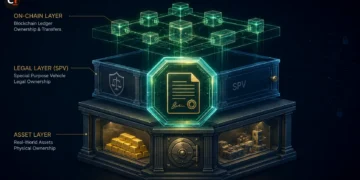
How does a physical or financial asset actually leap from the traditional world onto a shared digital ledger? The process follows four distinct phases.
| Phase | What Happens Behind the Scenes | Key Participants |
|---|---|---|
| 1. Asset Selection & Custody | The physical or financial asset (bonds, commercial real estate, art) is identified, legally structured, and locked in a regulated custody account or Special Purpose Vehicle (SPV). | Asset Managers, Custodian Banks, Legal Trustees |
| 2. Legal Architecture | Attorneys write legal agreements ensuring that holding the digital token gives the investor legitimate, enforceable rights to the underlying asset’s yield, distributions, or liquidation proceeds. | Corporate Law Firms, Compliance Officers |
| 3. Smart Contract Minting | Software code is deployed on a blockchain. This smart contract programmatically governs how tokens are minted, who is permitted to hold them, and how dividends or interest are disbursed. | Blockchain Developers, Security Auditors |
| 4. Distribution & Servicing | Approved investors purchase the tokens using digital cash (like stablecoins). The smart contract automatically passes through monthly yield payments directly to investor wallets. | Transfer Agents, KYC Providers, Digital Exchanges |
Why Traditional Finance Is Building This: 4 Practical Problems Solved
Wall Street institutions are conservative by nature. They do not invest billions in engineering just because a technology is fashionable. They do it when legacy systems cost too much money to operate.
Here are the four primary bottlenecks that tokenization addresses.
1. Settlement Latency (The Move to Instant T+0)
When you sell a stock on modern stock exchanges, you experience what looks like an instant transaction on your smartphone screen. Behind the curtain, however, your money and the seller’s shares take one business day (T+1) to genuinely clear and settle through central depositories and clearing corporations.
In cross-border real estate or private equity, settlements take weeks of paperwork, physical signatures, and escrow negotiations. During that waiting window, both buyer and seller face counterparty risk: the chance that one party fails to deliver before the trade completes.
Blockchain ledgers combine the trading step and the settlement step into a single simultaneous action known as atomic settlement. The token moves to the buyer at the exact millisecond the digital payment moves to the seller. If one leg fails, the entire transaction cancels automatically.
2. Programmable Corporate Actions
Managing bonds, private loans, or commercial leases requires an army of administrative intermediaries to calculate interest rates, check calendar dates, and wire coupon payments to hundreds of individual bank accounts.
On a blockchain, smart contracts automate administrative duties through code. If a tokenized treasury bond pays a 4.5% annual yield, the smart contract automatically calculates the exact daily accrual and deposits the payment directly into each token holder’s wallet without human intervention.
3. Fractional Access to Private Markets
Historically, high-performing asset classes like infrastructure projects, private credit funds, and grade-A commercial office buildings have required minimum checks of $1 million to $10 million. That dynamic locked retail investors out of the most lucrative wealth-generation engines.
Because digital tokens can be divided into tiny fractions at almost zero administrative cost, a $50 million commercial warehouse can be split into 500,000 units worth $100 each. While regulatory accreditation rules still apply in many jurisdictions, the technology removes the operational barrier to entry.
4. 24/7 Continuous Market Access
Traditional capital markets operate on regional banking schedules. They close at 3:30 PM, shutter on weekends, and freeze during national holidays. Yet economic events, geopolitical developments, and currency fluctuations occur around the clock.
Public blockchain infrastructure never sleeps. Assets can be transferred, collateralized for loans, or rebalanced on a Sunday night as effortlessly as on a Tuesday morning.
The Critical Distinction: Ownership vs. Price Exposure
As tokenized products proliferate, smart investors must understand an important structural distinction highlighted by BlackRock’s Chief Investment Officer of ETF and Index Investments, Samara Cohen: Tokenized Ownership versus Tokenized Price Representations (TPRs).
Not every token that carries an Apple or Tesla label is built the same way.
| Attribute | Tokenized Ownership | Tokenized Price Representation (TPR) |
|---|---|---|
| What You Actually Hold | Direct legal beneficial ownership interest in the asset itself or a bankruptcy-remote fund holding it. | A synthetic contract or derivative tracking the price movement of the reference asset. |
| Governance Rights | Standard shareholder rights, including proxy voting where applicable. | None. You hold no voting power in the corporate entity. |
| Dividend & Yield Pass-through | Legally guaranteed direct pass-through of distributions to your wallet. | Subject entirely to the third-party issuer’s synthetic payout terms. |
| Counterparty Risk | Low. If the platform shuts down, the underlying asset remains in a ring-fenced legal structure. | High. If the synthetic token issuer collapses, your capital can be wiped out completely. |
| Price Tracking | Tightly pegged to the traditional asset value through direct arbitrage and redemption. | Can deviate sharply during volatile periods or when traditional markets are closed. |
Where the Market Stands Today: The Early Winners
Tokenization is not an abstract future concept. It has already found clear product-market fit in two specific segments:
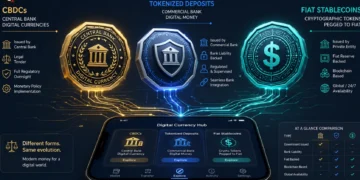
1. Stablecoins ($300B+ Market Capitalization)
Stablecoins represent the tokenization of the simplest asset in existence: fiat currency. Tokens like USDT and USDC let market participants move dollar-equivalent balances across global borders in seconds for pennies. Stablecoin transaction volume regularly rivals major card payment networks.
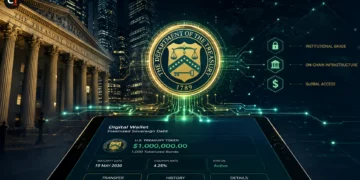
2. Tokenized Government Treasuries ($15B+ On-Chain)
Institutional investors and corporate treasuries holding digital cash needed a safe way to earn yields without off-ramping back into regional commercial banks.
This led to the rapid rise of institutional on-chain funds. BlackRock’s USD Institutional Digital Liquidity Fund (known as BUIDL) on Ethereum and Franklin Templeton’s OnChain US Government Money Fund (FOBXX) on Stellar and Polygon allow institutions to hold US sovereign debt directly inside digital asset wallets.
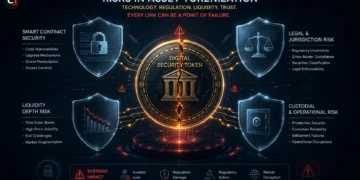
The 4 Real Obstacles Ahead
If the benefits are so obvious, why is every stock and bond not already trading on a blockchain? Because significant structural obstacles remain to be solved.
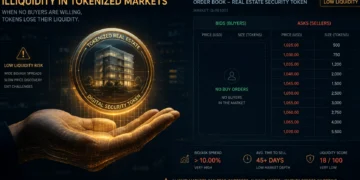
1. The Liquidity Paradox:
Tokenizing an illiquid asset does not automatically create buyers. If nobody wants to purchase an apartment building, representing it as 10,000 digital tokens simply creates 10,000 illiquid tokens. Secondary market depth requires active market makers and large investor pools.
2. Regulatory Fragmentation:
Blockchains are inherently borderless, but financial regulations stop abruptly at national frontiers. An asset structure compliant under European MiCA regulations may conflict with US SEC registration requirements or Indian Foreign Exchange Management Act (FEMA) guidelines.
3. Smart Contract and Key Security:
Traditional banking allows for password resets, reversed transactions, and dispute resolutions. Open blockchains are immutable. If an operational key is compromised or a smart contract contains an unspotted coding error, recovery of funds can be extraordinarily difficult without centralized administrative backdoors.
4. Institutional Switching Costs:
Global custodian banks and brokerage houses have invested decades and hundreds of billions of dollars optimizing their current electronic legacy systems. They will migrate to blockchain rails only when the cost savings and liquidity gains prove undeniable.
The Road to 2030: The Single Wallet Future
During a strategy debate among BlackRock’s senior leaders, Chief Operating Officer Rob Goldstein asked a room of executives a telling question: How much capital do you think will sit in digital wallets by 2030 compared to the roughly $4 trillion estimated today?
Every executive agreed the number would rise. Most expected it to double to at least $8 trillion.
JPMorgan’s Onyx division already processes over $1 trillion in short-term repo settlements every year on blockchain rails. That is not a pilot. It is live institutional infrastructure. When the world’s largest bank quietly moves a trillion dollars through distributed ledger technology without issuing a press release, you know the direction of travel.
The long-term endpoint is not a battle where crypto destroys traditional finance. The endpoint is convergence.
Over the coming decade, the artificial wall separating traditional investment accounts from digital wallets will gradually disappear. You will not have one app for mutual funds, a second app for foreign stocks, and a third app for digital currencies.
Instead, you will manage a diversified portfolio from a single digital interface on your smartphone. You will receive dividends from a tokenized treasury, borrow against your fractional real estate, and settle a global payment instantly. You may not even realize a blockchain is operating quietly in the background.
The couriers running paper stock certificates through Manhattan streets in 1976 gave way to computerized spreadsheets. Now, those spreadsheets are giving way to cryptographic code. The transition will take time, but the direction of financial history is clear.
This article is part of a complete educational series on real-world asset tokenization:
- How Financial Markets Evolved: From Paper to ETFs to Tokens
- What Does a Token Actually Own? SPVs and Legal Wrappers Explained
- Stablecoins vs. Tokenized Deposits vs. Digital Rupee
- Tokenized US Treasuries: On-Chain Yield Guide
- The Tokenization Liquidity Myth: Can You Sell RWA Tokens?
- Tokenization in India 2026: SEBI, RBI and the New Law
- The Real Risks of Tokenized Assets Nobody Talks About