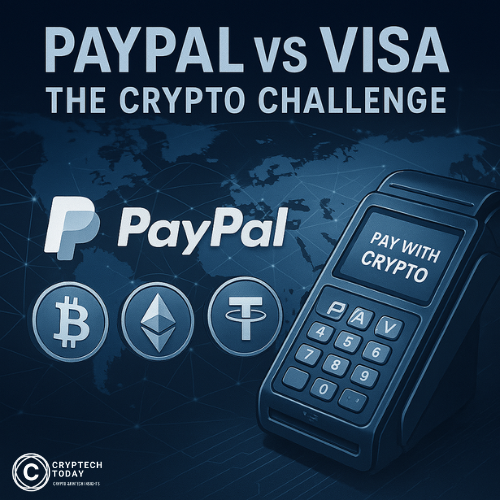
In a bold move that could reshape the future of global payments, PayPal has launched “Pay with Crypto”, a service that allows US merchants to accept over 100 cryptocurrencies, including Bitcoin, Ethereum, and USDT, from customers around the world. But beyond the headlines, what really makes this launch important is its potential to break the traditional payment monopoly held by Visa and Mastercard, who for decades have dominated the world’s digital transactions, with high fees and slow settlements.
Let’s unpack what PayPal just did, why it matters, and how it may mark the beginning of a new digital payments era that puts users and merchants first.
The old system: Expensive and slow
Before diving into what PayPal is offering, it’s important to understand the problem. Today, most international payments go through legacy systems like Visa and Mastercard. These systems charge transaction fees between 1.5% and 3.5%, and can take days to settle, especially across borders. Businesses lose revenue on every transaction, and customers often pay hidden fees in the name of “foreign exchange rates” or “processing charges.”
Moreover, global commerce has become increasingly digital, but the infrastructure supporting it is outdated. Legacy card networks were not built for real-time, cross-border digital economies. That’s where crypto and now, PayPal, steps in.
What is PayPal’s “Pay with Crypto”?
In July 2025, PayPal announced that U.S. merchants can now accept payments in over 100 cryptocurrencies, using existing PayPal infrastructure. Customers can pay using their preferred crypto wallets—including Coinbase, Binance, MetaMask, Kraken, Phantom, and others—and the system automatically converts the crypto into PayPal’s USD-backed stablecoin (PYUSD) or local fiat currency. This means transactions are settled instantly, eliminating the waiting periods typically associated with traditional bank or card payments.
The pricing structure is especially attractive. PayPal is offering an introductory 0.99% transaction fee, significantly lower than the usual 1.5–3.5% charged by Visa and Mastercard. Even after the introductory period ends and rates rise to 1.5%, the cost will still be competitive, especially for high-volume merchants. Additionally, merchants who choose to hold their balances in PYUSD are eligible to earn up to 4% annual yield, further enhancing the financial upside.
Unlike other platforms that require complex integrations, merchants only need to toggle on the “Pay with Crypto” option no wallet setup, no coding, no technical overhaul. This ease of use is likely to drive rapid adoption.
PayPal’s “Pay with Crypto” challenges Visa and Mastercard
Now here’s where things get interesting. For decades, Visa and Mastercard controlled the rails of online payments. They took a cut of every transaction, dictated terms, and offered little innovation beyond plastic cards. PayPal’s move threatens this system in several ways.
First, the drastically reduced transaction fee of 0.99% puts pressure on the traditional pricing models of card networks. Second, settlements are processed in seconds, while card payments often take 2–7 days to complete, especially when moving across borders. Third, the system removes many of the compliance and onboarding barriers that come with bank-centric networks, making it easier for emerging market merchants to participate in global trade.
And finally, with its stablecoin offering, PayPal allows users to earn passive income (up to 4% APY) on balances held in PYUSD, something Visa and Mastercard don’t offer at all. These benefits combined present a compelling alternative that could erode the legacy monopoly over time.
Ecosystem and Partnerships
PayPal isn’t doing this alone. Its strategic collaboration with Fiserv, a global fintech leader, helps integrate stablecoin and crypto services into more conventional financial systems. Furthermore, the launch of PayPal World brings together wallet networks from around the globe, including India’s UPI, China’s WeChat Pay, and Venmo in the U.S., into a unified platform that could reach nearly 2 billion users. This integration of regional wallets with crypto acceptance could redefine cross-border e-commerce by removing the need for intermediaries and reducing reliance on bank infrastructure.
Merchant Benefits Snapshot
| Benefit | Details |
|---|---|
| Transaction Fees | 0.99% promotional rate (rising to 1.5% after one year) vs. 1.5–3.5% card fees[S] |
| Supported Cryptocurrencies | 100+ (BTC, ETH, USDC, USDT, BNB, XRP, SOL, etc.)[S][S] |
| Settlement Speed | Near-instant crypto-to-fiat/stablecoin conversion |
| Yield on Stablecoin Balances | Up to 4% APY on PYUSD holdings |
| Global User Access | Connects to 650 million crypto users across 90% of the market cap[S][S] |
| Wallet Interoperability | Supports Coinbase, MetaMask, Binance, Kraken, OKX, Phantom, Exodus, and more[S] |
PayPal reimagines global commerce with “Pay with Crypto”
The impact on international commerce could be transformative. Cross-border payments have long suffered from excessive fees, currency conversion losses, and multi-day delays. PayPal’s new system tackles these challenges head-on. Payments are converted in real time from crypto to either PYUSD or local fiat currency, which shields merchants from the volatility of digital assets. This near-instant settlement allows businesses to receive their funds much faster and more reliably than before.
By enabling crypto payments at scale, PayPal opens the door to a customer base of over 650 million global crypto users, covering about 90% of the total crypto market cap. This expands the market reach for merchants and introduces a new segment of tech-savvy buyers who prefer decentralised payment options.
PayPal’s new launch also signals a broader shift in how cryptocurrency is being used — not just as a speculative asset, but as a real-world financial tool. Until now, most crypto use cases have centred around investment, trading, or decentralised finance (DeFi). Now, it’s being baked into the payment flow of mainstream commerce.
With a recognisable brand, a compliant framework, and massive existing user trust, PayPal is uniquely positioned to help bridge the gap between the crypto world and everyday consumers and businesses. It’s no longer just about Holding, it’s about spending.
Also Read
Chinese Kuaishou executive goes adrift of country’s crypto ban, handed sanctions