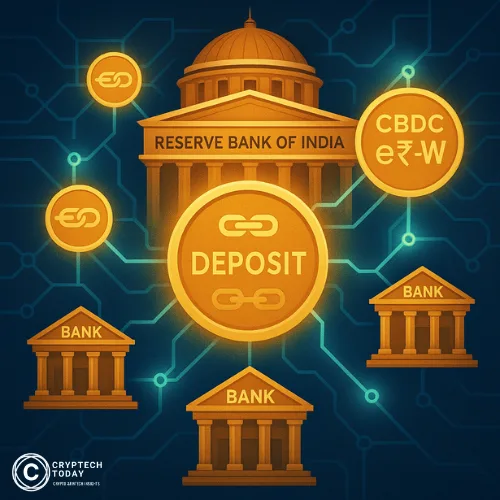
On October 7, 2025, the Reserve Bank of India (RBI) launched its long-awaited deposit tokenisation pilot, marking a major step in India’s digital financial evolution. The RBI deposit tokenisation pilot 2025 converts traditional bank deposits into blockchain-based tokens backed 1:1 by fiat currency, enabling faster settlement, programmability, and transparency all under the central bank’s regulatory umbrella.
This initiative builds on India’s wholesale Central Bank Digital Currency (CBDC) platform, first launched in 2022, and represents the central bank’s latest effort to modernise interbank money flows while maintaining legal safeguards and financial stability.
How Deposit Tokenisation Works
Deposit tokenisation transforms a conventional deposit into a digital token that exists on a secure distributed ledger, preserving the same legal claim as the original fiat balance. Each tokenised deposit is fully backed by central-bank money and benefits from atomic settlement, meaning both sides of a transaction complete simultaneously, or not at all.
Key features include:
- 1:1 backing with fiat currency
- Regulatory compliance with existing banking standards
- Programmability through smart contracts for automation
- 24/7 settlement on blockchain rails
The RBI deposit tokenisation pilot 2025 initially focuses on Certificates of Deposit (CDs), tradable, short-term debt instruments used by banks to test issuance, distribution, and settlement in real market conditions.
Why RBI Chose Wholesale CBDC as the Foundation
The RBI’s pilot uses the wholesale e₹ (e₹-W) system as its base layer, anchoring tokenised deposits to central bank money rather than private stablecoins or commercial liquidity pools. This ensures:
- Settlement finality backed by the central bank
- A controlled environment for testing digital instruments
- A secure foundation for future tokenised assets
According to RBI Chief General Manager Suvendu Pati, “We have picked up every use case on certification of deposits for tokenisation of assets. It’s a short-term instrument issued by banks.” The RBI’s careful approach mirrors its retail CBDC rollout, which started small before expanding to 6 million users.
Operational Advantages and Use Cases
Tokenised deposits promise transformative benefits for both banks and financial markets.
- Faster Settlements and Cost Reduction – Transactions that once took days can now close instantly, reducing settlement risk and operational costs by up to 40–60%. Smart contracts can automate repetitive tasks such as interest payments or fund transfers, further improving efficiency.
- Improved Liquidity and Collateral Use – Tokenised deposits can serve as collateral, enable fractional trading, and improve cross-border settlements, integrating seamlessly with programmable treasury systems. This could significantly boost liquidity management across India’s banking ecosystem.
- Programmable Money and Smart Compliance – Through smart contracts, banks can design conditional payments, enforce compliance automatically, and enable atomic transactions, reducing reconciliation errors while maintaining regulatory transparency.
Regulatory and Risk Considerations
While innovation is clear, the RBI deposit tokenisation pilot 2025 introduces new regulatory and operational challenges.
RBI officials emphasise that legal enforceability must remain clear. Key issues include:
- Preventing asset duplication across systems
- Preserving deposit insurance coverage
- Establishing clear ownership and redemption rights
- Maintaining AML and KYC compliance
There are also systemic concerns: instant liquidity could accelerate withdrawals during financial stress, while cybersecurity vulnerabilities in smart contracts could create new points of failure. Interoperability with existing payment systems remains a critical challenge.
India’s Place in the Global Tokenisation Race
India’s experiment aligns with international efforts such as:
- Singapore’s Project Guardian, focused on tokenised deposits and FX
- Hong Kong’s Project Ensemble, merging tokenised deposits with wholesale CBDC
- South Korea’s CBDC tokenisation trials for large-scale retail use
- Switzerland’s tokenised interbank payment models
Through the Bank for International Settlements (BIS) Project Agora, India joins seven other central banks exploring how tokenisation can enhance monetary systems. This international collaboration positions India as an emerging leader in regulated digital finance.
Potential Impact on Indian Banks
For banks, tokenised deposits could help reverse declining Current and Savings Account (CASA) ratios by making deposits more functional and programmable. Integration with capital markets from SIPs to IPO settlements could attract retail and institutional liquidity back into the banking system.
As tokenised instruments evolve, banks will need to adopt multi-signature custody, HSM-based wallet infrastructure, and real-time monitoring to maintain trust and operational continuity.
The Road Ahead
The pilot will progress in four phases:
- Phase 1: CD tokenisation testing with select banks
- Phase 2: Expansion to other deposit instruments
- Phase 3: Integration with digital payment ecosystems and cross-border pilots
- Phase 4: Full-scale deployment pending legal and risk framework completion
If successful, this could redefine how deposits function in India’s banking architecture, bridging traditional finance and programmable money under one framework. As RBI officials noted, tokenisation must balance innovation with integrity, ensuring speed, security, and supervision coexist.
The RBI deposit tokenisation pilot 2025 is not just a technological trial; it’s a blueprint for the future of digital banking. By merging blockchain efficiency with regulatory trust, India is signalling how emerging economies can lead the next era of financial modernisation.