Cryptech Today
  • News
    • Market Watch
    • Policy & Regulation
    • Geopolitics & Economy
    • Security & Risks
  • Blockchain & Web3
  • Finance & Fintech
    • Cryptocurrency
    • Fintech & Digital Finance
  • Voices
    • Events & Interviews
    • People & Companies
No Result
View All Result
tokenomist ai
Cryptech Today
  • News
    • Market Watch
    • Policy & Regulation
    • Geopolitics & Economy
    • Security & Risks
  • Blockchain & Web3
  • Finance & Fintech
    • Cryptocurrency
    • Fintech & Digital Finance
  • Voices
    • Events & Interviews
    • People & Companies
No Result
View All Result
Cryptech Today
No Result
View All Result
Home Security & Risks

The SBI Crypto Heist: North Korea’s Strategic Shift from Exchanges to Mining Infrastructure

The SBI Crypto exploits a $21M strike on a major mining pool, showing Lazarus-style operators are moving from CEX thefts to attacking the backbone of crypto networks.

Pranav Joshi by Pranav Joshi
October 2, 2025
in Security & Risks
0
The SBI Crypto Heist: North Korea’s Strategic Shift from Exchanges to Mining Infrastructure
76
SHARES
1.3k
VIEWS
Share on FacebookShare on Twitter

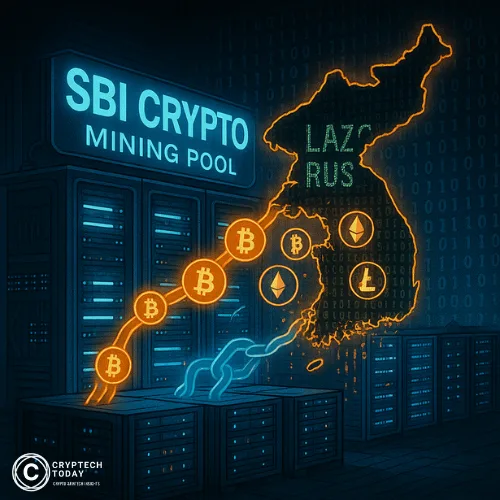
In September 2025, attackers drained roughly $21 million from SBI Crypto, the mining-pool arm of Japan’s SBI Group. At first glance, it looks like another headline theft. But the incident is different: investigators say the assault targeted mining infrastructure itself, not a custodial exchange account, marking a worrying strategic shift in state-sponsored cyber campaigns allegedly linked to North Korea.

Table of Contents

Toggle
    • You might also like
    • Distillation Wars: When AI Models Compete by Copying Each Other
    • USD1 Depeg: Political Volatility Tests Stablecoin Stability
    • The Coin Laundry Files: Inside the Exchanges That Enabled a Global Laundering Machine
  • Anatomy of the SBI Crypto Exploit
  • Why Mining Infrastructure Is an Attractive Target
  • The Lazarus Link: Tactics Evolve, Targets Shift
  • Geopolitical Stakes: Finance, Sanctions, and Asymmetric Power
  • Lessons for Operators, Institutions and Users
  • Final Takeaway

You might also like

Distillation Wars: When AI Models Compete by Copying Each Other

USD1 Depeg: Political Volatility Tests Stablecoin Stability

The Coin Laundry Files: Inside the Exchanges That Enabled a Global Laundering Machine

This attack matters because mining pools sit at the intersection of technical centralisation and large-value flows. By compromising the infrastructure that coordinates thousands of individual miners, attackers can both monetise immediate rewards and gain new leverage over network operations, a double win for sophisticated threat actors.

Anatomy of the SBI Crypto Exploit

Blockchain sleuths, including ZachXBT, first flagged coordinated outflows from wallets tied to SBI Crypto: Bitcoin, Ethereum, Litecoin, Dogecoin and Bitcoin Cash left pool-controlled addresses in a short window and soon flowed through instant exchanges and sanctioned mixers like Tornado Cash. Security firm Cyvers noted behavioural patterns similar to prior Lazarus Group operations: rapid use of instant swaps, cross-chain bridging and sanctioned-mixer deployment to obscure trails.

Technically, mining pools expose several attack surfaces: web dashboards, stratum servers, API endpoints, and the payment automation that periodically distributes block rewards. If an adversary gains admin-level credentials or inserts malicious code into payment tooling, they can redirect payouts in real time, which appears to be the method used in the SBI Crypto exploit.

Why Mining Infrastructure Is an Attractive Target

Mining pools aggregate hashpower and, crucially, rewards. Unlike single miners, a pool operator holds the keys to payout logic and coordination. That concentration turns the pool into a high-value single point of failure, exactly the kind of target a patient, well-resourced actor prefers.

Operational requirements compound risk: pools must accept thousands of miner connections with minimal friction, keep low-latency communications, and support diverse, sometimes outdated miner clients. Those trade-offs often mean weaker authentication, exposed admin panels, and legacy dependencies, fertile ground for supply-chain compromises or credential-theft campaigns. Once inside, attackers can siphon rewards, manipulate block templates, or attempt disruptive acts like block withholding or transaction censorship on a scale that matters to network health.

The Lazarus Link: Tactics Evolve, Targets Shift

The fingerprints on this heist resemble the playbook honed by the Lazarus Group: meticulous reconnaissance, supply-chain and interface compromises, fast laundering via instant swaps and mixers, and careful reuse of proven laundering pathways; Bybit analysis and context. The February 2025 Bybit breach, where Lazarus operators allegedly compromised Safe{Wallet} signers and siphoned $1.5 billion, taught a harsh lesson: when attackers understand enterprise workflows, they can weaponise convenience and multi-sig processes. SBI’s incident suggests the same operational learning curve is now being applied to mining infrastructure.

Intelligence and forensics indicate DPRK-linked actors have a modularised capability: some teams focus on exchange and custodial workflows while others specialise in infrastructure compromise, developer/toolchain supply-chain attacks, and opportunistic targeting of mining platforms. That division of labour accelerates both the scale and sophistication of attacks.

Geopolitical Stakes: Finance, Sanctions, and Asymmetric Power

Why would a state prioritise mining pools? The answer is twofold: revenue and leverage. Stolen funds can be laundered into hard currency to finance sanctioned programs; access to mining infrastructure also gives strategic options for disruption and signalling. In an era where Pyongyang’s cyber units are effectively revenue branches, diversifying targets from exchanges to mining pools broadens their avenues for sanction-evading income and tactical leverage.

International responses, sanctions, joint law enforcement action, and enhanced exchange compliance are reactive by necessity. But mining-focused attacks blur the line between financial crime and critical-infrastructure sabotage, which raises new policy questions about how to regulate or secure inherently global and decentralised resources.

Lessons for Operators, Institutions and Users

Mining pool operators must urgently harden operational tooling: enforce zero-trust admin access, implement hardware-backed keys and HSMs for payout signing, add multi-party computation for critical functions, and isolate payment subsystems from public dashboards. Regular penetration testing of stratum and API layers, plus vendor-supply-chain vetting, should be mandatory rather than optional.

For exchanges, custodians, and institutional players, the SBI Crypto exploit is a reminder: threats will continue evolving beyond classic custodial theft. Risk assessments must include infrastructure and third-party dependencies, and incident response playbooks should cover cross-domain compromises. Retail miners should prefer pools with transparent security measures and avoid pools that prioritise low fees over robust operational hygiene.

Final Takeaway

The SBI Crypto heist signals a dangerous maturity in state-sponsored crypto operations. When nation-level actors move from attacking centralised exchanges to the plumbing of the network itself, the threat becomes systemic. Mining pools were built for efficiency and payout fairness; attackers now exploit that efficiency. Defenders must respond the same way with layered security, international cooperation, and a recognition that the battlefield has expanded. The Lazarus-style shift to mining infrastructure is not just a new chapter in cybercrime; it’s a strategic evolution in digital geopolitics that the industry and governments cannot afford to ignore.

Tags: BitcoinCritical Infrastructure SecurityCross-Chain LaunderingCrypto CrimeCrypto ForensicsCrypto HackCrypto Infrastructure AttackCryptocurrencycybersecurityDPRK Cyber OperationsEthereumLazarus GroupMining InfrastructureMining PoolsMoney LaunderingNorth KoreaSanctions EvasionSBI CryptoState-Sponsored Hackingtornado cash
Share30Tweet19
Pranav Joshi

Pranav Joshi

A blockchain book author and crypto expert, dedicated to making cryptocurrency simple for everyone — byte by byte.

Recommended For You

Distillation Wars: When AI Models Compete by Copying Each Other

by Pranav Joshi
February 25, 2026
0
Distillation Wars: When AI Models Compete by Copying Each Other

For years, large language models were trained on the open web. News articles, blogs, code repositories, academic papers, and creative writing were absorbed into vast training datasets. AI...

Read moreDetails

USD1 Depeg: Political Volatility Tests Stablecoin Stability

by Pranav Joshi
February 24, 2026
0
USD1 Depeg: Political Volatility Tests Stablecoin Stability

On February 23, 2026, USD1 — the dollar-pegged stablecoin issued by World Liberty Financial briefly slipped below its $1 benchmark, trading between $0.993 and $0.994 before recovering toward...

Read moreDetails

The Coin Laundry Files: Inside the Exchanges That Enabled a Global Laundering Machine

by Pranav Joshi
November 19, 2025
0
The Coin Laundry Files: Inside the Exchanges That Enabled a Global Laundering Machine

When the Coin Laundry investigation first surfaced through the International Consortium of Investigative Journalists, the public saw headlines about a Cambodian conglomerate called Huione Group. But what the...

Read moreDetails

The Coin Laundry: Inside the Global Crypto Laundering Machine Operating in Plain Sight

by Pranav Joshi
November 18, 2025
1
The Coin Laundry: Inside the Global Crypto Laundering Machine Operating in Plain Sight

For months, murmurs in the crypto community hinted at strange on-chain behaviour: unfamiliar wallets moving millions, sudden bursts of stablecoin transfers, and accounts on major exchanges receiving funds...

Read moreDetails

Tracing 127,271 BTC: On-Chain Forensics and Global Policy Lessons from the Prince Group Case

by Pranav Joshi
October 16, 2025
0
Tracing 127,271 BTC: On-Chain Forensics and Global Policy Lessons from the Prince Group Case

In October 2025, the U.S. Department of Justice (DOJ) filed a civil and criminal forfeiture action targeting 127,271 BTC worth nearly $15 billion from wallets allegedly controlled by...

Read moreDetails
Next Post
India Cracks Down on 25 Offshore Crypto Exchanges

India Cracks Down on 25 Offshore Crypto Exchanges

Related News

Arizona state court building with legal documents and a gavel, symbolizing paused prosecution.

Arizona Pauses Kalshi Prosecution Following Federal Judge Ruling

April 13, 2026
Traders monitor financial charts on multiple screens with S&P 500 logos in a digital trading hub.

New Alternative Trading Platform Enables Round-the-Clock S&P 500 Betting

March 19, 2026
An online trading platform graphic with warning signs indicating regulatory action.

Portugal Bans Polymarket Amid Growing Regulatory Pressure

January 20, 2026

Browse by Category

  • BlockBasics
  • Blockchain
  • Blockchain & Web3
  • Central Bank Digital Currency (CBDC)
  • Crypto
  • Crypto Now
  • Cryptocurrency
  • Ethereum
  • Finance
  • Fintech & Digital Finance
  • Geopolitics & Economy
  • GreenLedger
  • Inside CrypTechToday
  • Legal & Business Pages
  • Market Watch
  • People & Companies
  • Policy & Regulation
  • Politics
  • Security & Risks
  • Technology
  • World
  • About Us
  • Tools
  • Privacy Policy
  • Terms of Service
  • Disclosure
  • Cookie Policy
  • Disclaimer
  • Contact Us
Mail Us @ contactus@cryptech.com

© 2025 CrypTechToday All rights reserved.

No Result
View All Result
  • News
    • Market Watch
    • Policy & Regulation
    • Geopolitics & Economy
    • Security & Risks
  • Blockchain & Web3
  • Finance & Fintech
    • Cryptocurrency
    • Fintech & Digital Finance
  • Voices
    • Events & Interviews
    • People & Companies

© 2025 CrypTechToday All rights reserved.

Are you sure want to unlock this post?
Unlock left : 0
Are you sure want to cancel subscription?