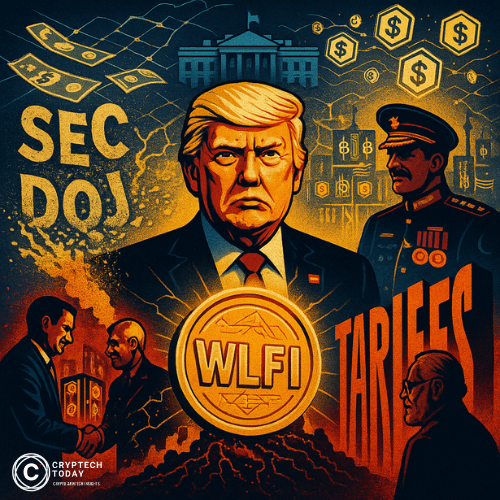
Trump Crypto Empire and Regulatory Capture is becoming one of the most defining forces in global finance. Donald Trump has tied nearly 73% of his wealth to cryptocurrency ventures like World Liberty Financial, USD1 stablecoin, and American Bitcoin Corp. At the same time, his administration has dismantled key enforcement units, appointed pro-crypto regulators, and leveraged “crypto diplomacy” to shape relations with nations like Pakistan and India. This marks the rise of a new era where Trump Crypto Empire and Regulatory Capture blend politics, profit, and policy into a single agenda.
The WLFI token debuted with wild enthusiasm, briefly peaking at 40 cents before settling near 18 cents within days. Despite this volatility, the Trump family’s 22.5 billion WLFI tokens, nearly a quarter of the total supply, are currently worth $4–5 billion. Even at depressed prices, this represents the single largest source of Trump’s estimated $15.9 billion net worth.
The WLFI Advantage
The structure of World Liberty Financial makes this wealth especially powerful. The Trump family controls WLF through DT Marks LLC, holding a 60% ownership stake and claiming 75% of all net revenue from token sales. This arrangement ensures the family profits handsomely regardless of market conditions.
Already, WLF’s launch has generated nearly $500 million in real revenue for the Trumps, on top of the billions in paper wealth represented by their token holdings (Reuters). The design is simple yet effective: create scarcity, drive hype through presidential visibility, and extract maximum revenue through structured token sales.
The USD1 Stablecoin Machine
The second foundation of Trump’s cryptocurrency fortune is the USD1 stablecoin, which was issued by WLF in March 2025. Pegged 1:1 to the U.S. dollar, USD1 has already achieved a $2.1 billion market capitalisation. Like other stablecoin issuers, WLF collects the cash reserves backing these tokens and invests them in ultra-safe U.S. Treasury bills, keeping the interest income.
Even with a modest 4% return, that means roughly $90 million annually in nearly risk-free profit. And with the Trump family’s majority ownership, most of that revenue flows directly into their pockets. The arrangement is especially lucrative because it scales: as more businesses and even governments adopt USD1, the revenue stream grows with no need for new infrastructure.
What makes USD1 even more significant is its international endorsement. In May 2025, Abu Dhabi’s MGX, a sovereign investment firm, purchased $2 billion worth of USD1 tokens for transactions on Binance. That deal not only gave USD1 global credibility but also created a pipeline of foreign government funds flowing through a Trump-owned venture, a direct conflict of interest by traditional ethical standards.
American Bitcoin: Mining Gold from Code
Beyond WLF, Trump’s sons have carved out their own empire with American Bitcoin Corp, a mining and treasury company that debuted on NASDAQ on September 3, 2025. Backed heavily by Eric Trump and Donald Trump Jr., the company’s stock surged nearly 90% in early trading before stabilising at a market cap exceeding $7 billion.
The company has already accumulated more than 2,400 Bitcoin, worth over $160 million, as part of its balance sheet. Eric Trump’s personal stake, valued at $548 million, instantly made him one of the wealthiest young business figures in the U.S. The timing could not be more advantageous. Just as the White House dismantles regulatory barriers for crypto mining, the Trump sons’ company is positioned to dominate.
The Memecoin Factor
If the WLFI token and USD1 stablecoin represent structured wealth, the $TRUMP memecoin shows how Trump monetises personal branding in digital assets. Launched around his second inauguration, $TRUMP once hit a $17 billion valuation before correcting to about $9 billion. Even at reduced levels, it has delivered an estimated $315 million in earnings for the family.
Trump’s wife and former First Lady, Melania Trump, has also entered the game, with her $MELANIA token valued at $144 million, alongside NFT collections that earned her approximately $216,700. Collectively, these ventures illustrate the Trump family’s strategy of turning every member into a revenue-generating brand asset.
Crypto Dominance of Net Worth
Today, 73% of Trump’s personal fortune is tied to cryptocurrency holdings. This marks a radical departure from the real estate mogul image that defined him for decades. Properties once central to the Trump brand, from Manhattan skyscrapers to Florida resorts, now pale in comparison to digital tokens and blockchain-based enterprises.
The implications are staggering. A sitting U.S. president has become one of the largest private beneficiaries of the digital asset boom, not as an investor riding the wave, but as an architect designing the very conditions under which his fortune multiplies.
If building the digital fortune was the first step, the second was ensuring the rules of the game worked entirely in Trump’s favor. During his second term, Trump has reshaped the U.S. regulatory system in ways that directly enrich his crypto ventures while crippling the agencies meant to provide oversight. This is not just deregulation; it is a textbook case of regulatory capture, where public institutions designed to protect citizens instead serve the industries they regulate.
This shift is best understood through the lens of Trump Crypto Empire and Regulatory Capture, where regulatory bodies are reshaped to favor Trump-linked ventures and broader crypto adoption.
Dismantling the Watchdogs
In April 2025, Trump’s Justice Department abruptly disbanded the National Cryptocurrency Enforcement Team (NCET), a specialised unit created under Biden to target money laundering, fraud, and illicit finance in the crypto sector. Deputy Attorney General Todd Blanche declared that the DOJ would “no longer target virtual currency exchanges, mixing services, and wallets” except in cases involving terrorism or narcotics.
This decision effectively removed the federal government’s main enforcement mechanism against crypto-related crime. The NCET has led high-profile cases such as the Tornado Cash sanctions and the conviction of Avraham Eisenberg for a $110 million market manipulation scheme. Its elimination was a clear signal: Trump’s crypto world would face no serious scrutiny from federal prosecutors.
At the same time, the Securities and Exchange Commission (SEC) dismantled its Crypto Assets and Cyber Units. By May 2025, the SEC had dropped its $4.3 billion lawsuit against Binance, one of the most aggressive enforcement actions ever filed against a crypto exchange. The timing was remarkable. Just weeks earlier, Binance had signed a $2 billion partnership deal with World Liberty Financial, Trump’s family-controlled venture.
Appointing Crypto’s Own Regulators
Trump didn’t just dismantle existing enforcement; he installed crypto industry insiders to lead the agencies themselves. His appointment of Paul Atkins as SEC Chairman was the clearest example. Atkins, who previously ran a consultancy serving crypto firms, declared almost immediately that “most crypto assets are not securities” and launched “Project Crypto” to modernise securities law around blockchain.
Alongside him, Commissioner Hester Peirce, nicknamed “Crypto Mom” for her long-time industry advocacy, was put in charge of the SEC’s Crypto Task Force. Staffed almost entirely by pro-industry personnel, the task force has prioritised easing registration, creating new exemptions for token sales, and expanding experimental “regulatory sandboxes” where crypto firms operate without traditional compliance burdens.
Over at the Commodity Futures Trading Commission (CFTC), Acting Chair Caroline Pham announced a “Crypto Sprint” to “deliver wins for President Trump” and usher in a “Golden Age of Crypto”. The CFTC even allowed foreign exchanges to register as Foreign Boards of Trade, letting them handle U.S. customers without fully complying with domestic law, a massive gift to offshore firms like Binance. The CFTC’s “Crypto Sprint” further reinforces the theory of Trump Crypto Empire and Regulatory Capture, enabling offshore firms and deregulated markets to thrive.
The GENIUS Act: Law Written for the Trumps
In July 2025, Trump signed the GENIUS Act, the first major piece of government crypto legislation. The act’s most significant feature was classifying stablecoins as commodities, not securities, placing them under far lighter regulation.
For World Liberty Financial’s USD1 stablecoin, this was a jackpot. The law ensured minimal disclosure requirements, no continuous oversight, and broad permission to operate as a crypto bank with federal charters. By design, this positioned USD1 to dominate the stablecoin market while generating billions in nearly risk-free profit.
The timing again raised alarms. Trump had already made over $57 million in income from World Liberty Financial before signing legislation that directly benefited the venture. Critics like Senator Elizabeth Warren called the law “corruption in plain sight,” warning that the president was writing rules for his own family business.
From Oversight to Advantage
Instead of merely removing regulatory barriers, Trump’s administration has gone a step further by actively creating advantages for Trump-linked companies. World Liberty Financial has been allowed to raise $288.5 million under Regulation D and S exemptions, limiting scrutiny from the SEC while directing the majority of its offering overseas. It also avoided having its WLFI tokens classified as securities, despite offering both governance rights and revenue-sharing features, conditions that normally trigger securities law.
Even the International Monetary Fund (IMF) shifted its tone after Trump-linked delegations pressed Pakistan’s case for Bitcoin mining. Initially critical of Pakistan’s 2,000MW crypto energy allocation, the IMF softened to “technical dialogue” within months, a striking example of U.S. political pressure being applied in ways that align with Trump’s business interests.
The Blurred Line Between State and Business
This regulatory realignment creates a chilling precedent: a U.S. president dismantling oversight while installing industry loyalists to regulate themselves, all while profiting personally from the outcome. The Emoluments Clause of the Constitution was designed to prevent presidents from profiting from foreign or domestic business while in office. Yet the Trump administration’s approach to crypto shows how easily those protections can be bypassed in the digital age. When legislation, enforcement, and international policy are written in ways that benefit a president’s personal holdings, the line between governance and business dissolves.
As watchdog group Accountable noted, crypto assets now make up nearly three-quarters of Trump’s wealth. Every regulatory choice from dismantling NCET to passing the GENIUS Act becomes not just a matter of public policy, but a matter of family profit.
If Trump reshaped U.S. regulation to benefit his family’s crypto empire at home, his foreign policy has been equally transactional, rewarding nations that embrace his ventures while punishing those that don’t. This technique, known as “crypto diplomacy,” has elevated World Liberty Financial and associated projects to the forefront of America’s global strategy, with far-reaching ramifications in South Asia, the Middle East, and elsewhere.
Pakistan: From Partner to Power Broker
The most obvious example of crypto diplomacy is Trump’s unexpected shift to Pakistan. For decades, U.S. foreign policy treated India as Washington’s key South Asian partner. But in 2025, Trump placed his bets on Islamabad.
In May 2025, Pakistan launched a bold initiative to allocate 2,000 megawatts of electricity for Bitcoin mining and AI data centres, one of the largest such commitments anywhere. This surplus power, once considered a liability, suddenly became a pathway to generate $8–12 billion annually in digital assets.
World Liberty Financial quickly struck a deal with Pakistan’s Crypto Council, granting the Trump family access to this mining capacity and to the country’s expanding stablecoin market. The delegation that sealed the partnership included Zachary Witkoff, son of Trump’s envoy to the Middle East, a symbol of how business and diplomacy were increasingly indistinguishable.
The relationship was sealed not only with money but with flattery. In June 2025, Pakistan nominated Trump for the Nobel Peace Prize, crediting him with easing tensions after the Pahalgam terror attack nearly pushed India and Pakistan toward conflict. While Indian Prime Minister Narendra Modi denied that Trump played any mediating role, Pakistan’s Army Chief Asim Munir publicly called him a “genuine peacemaker.”
The timing was convenient: just days later, Trump ordered strikes on Iranian nuclear sites, but Pakistan maintained its support for his Nobel bid anyway. The message was clear: Trump’s mix of business partnerships and personal vanity had bought Islamabad’s loyalty.
India: From Ally to Adversary
If Pakistan was rewarded, India was punished. Trump imposed 25% tariffs on Indian goods in August 2025, escalating to 50% by month’s end, hitting nearly 70% of India’s exports to the U.S..
Officially, the White House chastised India for continuing to import Russian oil. However, observers believe the true catalyst was Modi’s refusal to support Trump’s peacemaking claims or his Nobel bid. In one purported call, Trump even offered that India nominate him, which Modi bluntly refused. Relations immediately deteriorated, with Modi ignoring Trump’s calls and Trump cancelling his scheduled visit to India for the Quad conference.
Former National Security Advisor Jake Sullivan described the decision as a “huge strategic harm,” claiming that Trump had “thrown away ties with India over his family’s business deals in Pakistan.” Nikki Haley reiterated the worry, claiming that diminishing ties with India will only help China.
For India, the economic blow was immediate: tariffs squeezed exporters, while the political fallout drove New Delhi closer to Moscow and Beijing.
The SCO’s Counter-Move
The Shanghai Cooperation Organisation (SCO), led by China and Russia, seized the opportunity. At its September 2025 summit in Tianjin, Chinese President Xi Jinping outlined a vision for a new global order, one less reliant on the United States.
Russia’s Vladimir Putin proposed joint bonds, shared payment systems, and a new development bank to shield member economies from dollar-based fluctuations. India, bruised by U.S. tariffs, joined these conversations enthusiastically, with Modi meeting separately with both Xi and Putin. The result was a tentative thaw in India-China relations, united by frustration with Trump’s transactional policies.
SCO members also explored alternative digital payment systems that could bypass Trump’s USD1 stablecoin. While not yet as advanced as World Liberty Financial’s ecosystem, these initiatives show how U.S. crypto diplomacy may be accelerating the rise of rival financial architectures.
Diplomacy Replaced by Transactions
The Pakistan-India split shows how Trump has effectively commercialised U.S. foreign policy. Instead of pursuing long-term strategic objectives countering China, supporting allies, and maintaining balance, decisions now revolve around which nations align with Trump’s business interests.
Pakistan supported World Liberty Financial and obtained benefits such as tariff relief, energy transactions, and Nobel recognition. Despite resisting crypto entanglements, India faced severe tariffs and diplomatic backlash.
This kind of transactionalism undermines decades of bipartisan diplomacy and creates uncertainty among allies. As Sullivan put it, “Other nations are watching and thinking: that could be us tomorrow.”
Global Consequences
The ripple effects go far beyond South Asia. By dismantling enforcement at home and monetising diplomacy abroad, Trump has:
- Encouraged rival systems: China and Russia push harder for SCO-based trade and finance.
- Weakened U.S. alliances: India, a key partner in countering China, now drifts away.
- Created security risks: Lax oversight opens doors for adversaries like Iran to use crypto for sanctions evasion.
The most striking part is the systematic nature. Trump’s crypto empire isn’t just a business; it’s a governing model where policy, regulation, and diplomacy serve family profit first. Whether this strategy ultimately strengthens or destabilises the U.S. economy remains uncertain, but one thing is clear: Trump Crypto Empire and Regulatory Capture have become the defining story of America’s crypto era.