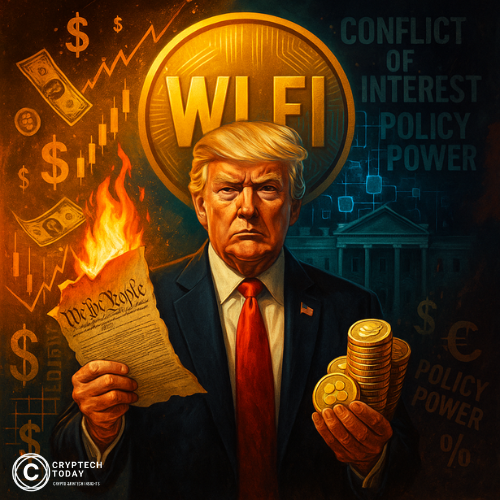
Donald Trump’s cryptocurrency empire has ballooned into a $5 billion fortune, powered largely by his family’s stake in World Liberty Financial (WLF). What makes this story extraordinary is not just the number, but the fact that this wealth was built. At the same time, Trump sits in the Oval Office — raising serious questions about how far presidential power is being used to secure private gain.
At the centre of Trump’s crypto success is World Liberty Financial, a DeFi platform co-founded by Eric and Donald Jr. during Trump’s 2024 campaign. The family controls around 22.5 billion WLFI tokens, nearly a quarter of the total supply. When the token debuted on September 1, 2025, it spiked to forty cents before settling near twenty-three cents. Trump’s personal holdings, which were over 15.75 billion tokens, nevertheless made him nearly $5 billion in crypto net worth, even at this decreased price (ABC News). Beyond paper wealth, the Trump family entities own sixty percent of World Liberty Financial and are entitled to seventy-five percent of revenue from token sales. Reports suggest this structure has already generated half a billion dollars in cash, separate from the not-yet-liquid token value.
The family’s most profitable creation may not be WLFI itself but USD1, a stablecoin pegged to the U.S. dollar. Launched in March 2025, USD1 quickly grew to a $2.1 billion market cap by May. Stablecoins are particularly lucrative because issuers hold the dollars backing the tokens and typically invest them in Treasury bills, keeping the interest income. Even a modest four percent return on USD1’s reserves could generate ninety million dollars annually. With the Trump family as majority owners, this revenue becomes a personal annuity that grows as adoption spreads. Abu Dhabi’s MGX fund has already invested two billion dollars into Binance using USD1, giving the Trump-backed stablecoin both legitimacy and massive transaction volume.
Behind the headlines, Trump’s crypto fortune is shielded by Delaware’s corporate tax laws, often described as America’s domestic version of an offshore haven. Delaware does not tax profits from business activities conducted outside the state, meaning that most of World Liberty Financial’s global revenue escapes state taxation. The state also exempts revenue from intangible assets like digital tokens and intellectual property, further reducing the tax bill. On top of that, Delaware corporations face minimal reporting requirements, allowing Trump’s financial structures to remain largely hidden from public scrutiny.
What makes this fortune even more controversial is the way Trump’s policy decisions as president appear to support his private ventures directly. In July 2025, he signed the GENIUS Act, America’s first major federal crypto law, which defines stablecoins as commodities rather than securities. This looser classification benefits World Liberty Financial’s USD1 stablecoin by avoiding stricter oversight. The timing raised eyebrows since Trump had already earned over $57 million from WLF before the law passed. His administration also rolled back Biden-era oversight by scrapping Executive Order 14067 and scaling back enforcement. Several investigations involving Trump-linked investors were paused or dropped altogether.
Critics say this is not just entrepreneurial success but “corruption in plain sight.” Senator Elizabeth Warren warned that allowing foreign governments to invest billions into Trump-backed crypto products creates an unprecedented conflict of interest. Government watchdog Accountable reported that crypto now makes up seventy-three percent of Trump’s net worth. At the same time, Citizens for Responsibility and Ethics in Washington documented more than 3,400 conflicts of interest during Trump’s first presidency. Analysts argue his second-term crypto empire dwarfs those concerns in both scale and impact.
The central question is whether a sitting president should be able to shape laws and policies that enrich his family’s businesses by billions of dollars. The World Liberty Financial saga is not only about crypto innovation but about the fusion of personal profit and public policy. Delaware shelters the profits, stablecoins create ongoing revenue, and new laws tilt the playing field in favor of Trump’s own company. Whether this is financial genius or unprecedented corruption may depend on political perspective, but the facts are undeniable. Trump’s $5 billion crypto fortune shows how presidential power and personal wealth have never been so tightly intertwined. If this trajectory continues, it could mark the most financially lucrative presidency in American history.