Bitcoin has once again lived up to its “Uptober” reputation, shattering records to reach an all-time high of $125,689. The move marks a roughly 15% surge in October, capping one of the strongest monthly starts in Bitcoin’s history. While past rallies were often driven by speculative frenzy, this one tells a different story, one built on institutional adoption, tightening supply, and shifting macroeconomic tides that could push prices even higher, though not without potential turbulence ahead.
Much of the momentum has been powered by a flood of institutional capital. In the first week of October alone, U.S. spot Bitcoin ETFs saw $3.24 billion in inflows, according to Yahoo Finance, marking their second-largest week since debuting in January 2024. BlackRock’s IBIT fund accounted for more than half that total, pulling in $1.78 billion and bringing its assets under management to a staggering $96 billion. For many traditional investors, ETFs have become the most direct and regulated gateway to Bitcoin exposure, and their rapid growth is now reshaping market dynamics.
It’s not just fund managers making moves. Corporate treasuries have quietly joined the accumulation wave, with over 60 public companies now holding a combined 848,000 BTC, representing nearly 4% of total supply, as reported by Fintech Weekly. While MicroStrategy remains the largest single holder, a growing number of tech and financial firms are following its lead, treating Bitcoin as a strategic reserve asset. For the first time, corporate accumulation has begun to outpace ETF buying, signalling that long-term conviction, not just speculative trading, is driving this leg of the rally.
At the same time, Bitcoin’s available supply is drying up at an unprecedented pace. Data from CoinCentral shows the amount of Bitcoin held on centralised exchanges has fallen to between 2.45 and 2.83 million BTC, the lowest level since 2019. That’s roughly one million coins fewer than during the 2021 bull run. This supply squeeze means each new wave of demand has a far greater price impact. ETF inflows are effectively removing Bitcoin from circulation faster than miners can produce it, with some estimates suggesting over 100,000 BTC could be absorbed by funds this quarter, double the expected mining output. On-chain data supports this narrative, showing that large holders, or “whales,” have shifted from selling to accumulating, moving their holdings into cold storage. It’s a clear sign of renewed long-term confidence.
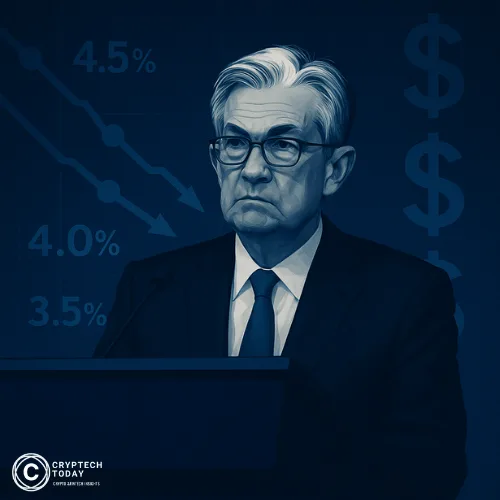
The macro backdrop has only added fuel to the fire. Markets are now almost certain the Federal Reserve will cut rates by 25 basis points at its upcoming October 28–29 meeting, with the CME FedWatch Tool showing a 96% probability of easing. The expectation of lower rates has traditionally boosted risk assets, but Bitcoin’s reaction this time has been more aligned with gold than with equities. The correlation between the two has climbed to 0.82, its highest level in five years. That’s not just a statistical quirk; it reflects Bitcoin’s evolving role as a macro hedge against policy uncertainty and fiat volatility.
Adding to that uncertainty is the ongoing U.S. government shutdown, which began on October 1. The political deadlock has created economic ripples, delaying federal payments and freezing regulatory decisions. Ironically, that dysfunction has made decentralised assets more appealing. Analysts told CNBC that Bitcoin has increasingly been trading like a “debasement hedge,” drawing capital from investors wary of U.S. fiscal instability. Gold, too, hit new highs during the same period, underscoring the broader rotation into assets perceived as outside government reach.
Technicals: Bulls in Control, But Caution Advised
From a technical standpoint, Bitcoin remains firmly bullish.
Price action is consolidating above $120,000, with resistance forming around the $125,400–$126,500 zone. A decisive breakout above this band could open the path toward $130,000–$135,000, where multiple Fibonacci levels and channel tops align.
Key support zones to monitor:
- $120,000: Near-term support
- $115,000–$117,000: Former ATH zone, potential retest level
- $108,000–$110,000: Strong base from September lows
Momentum indicators support continuation. The RSI remains in bullish territory without flashing extreme overbought readings, and the Average Directional Index (ADX) near 30 signals strengthening trend conviction.
Still, no rally comes without risk. The biggest near-term threat is ETF flow reversal. If inflows slow or reverse, the same dynamic that pushed prices higher could amplify downside volatility. Technical overheating remains another concern, as momentum traders pile in and push RSI toward overbought territory. The macro picture also remains fragile; a surprise hawkish shift by the Fed or swift resolution to the government shutdown could blunt Bitcoin’s safe-haven narrative and cool speculative appetite. And with the SEC still partially frozen by the shutdown, regulatory uncertainty hangs over the next round of crypto approvals, leaving the policy path murky.
Yet, despite those risks, Bitcoin’s breakout feels meaningfully different from prior hype cycles. The 2021 rally was driven by retail speculation and meme-fueled exuberance. This time, it’s structurally shaped by capital flows, fiscal uncertainty, and supply mechanics that look more like a commodity revaluation than a tech bubble. As institutional money treats Bitcoin as a macro asset, its correlation with traditional markets may fall further, reinforcing its place as a portfolio diversifier rather than a speculative gamble.
The next few weeks will test whether the “Uptober” momentum can sustain through macro turbulence and profit-taking. For traders, the key levels are clear: maintain focus on $120,000 as critical support and $130,000 as the next psychological test. Whether Bitcoin extends higher or cools off, this rally has already signalled a structural turning point: Bitcoin is behaving less like a fringe digital asset and more like a maturing financial instrument — one increasingly tied to global liquidity cycles and institutional conviction.