Between October 17 and October 24, 2026, the foundational trust assumptions of web infrastructure buckled simultaneously: an emergency CA root distrust, a 12-year regex RCE in GitLab, an NGINX heap overflow, and decrypted environment variables on Railway. Here is the forensic anatomy of the collapse and the survival runbook for cloud engineering teams.
- Cryptographic Trust Failed at the Root: Mozilla and Google issued emergency distrust orders against eMudhra intermediate CAs after weak P-384 private keys with values below 256 were generated on hardware security modules. Browsers blocked them in hours, but non-browser backends (curl, Python, Go, Node.js) continued trusting forged certificates.
- Ingress and Repositories Exposed Simultaneously: NGINX patched a critical heap overflow in rewrite and alias parsing (CVE-2026-15176), while GitLab dropped an emergency patch for an unauthenticated CVSS 10.0 remote code execution flaw in Ruby’s Onigmo regex engine (CVE-2026-110264) affecting releases all the way back to 2014.
- Runtime Secrets Leaked at Rest: Cloud platform Railway confirmed an intrusion that accessed and decrypted stored customer environment variables, exposing live database connections, OpenAI/OpenRouter inference tokens, and AWS infrastructure credentials worldwide.
At the edge layer, TLS handshakes to banking partner APIs began throwing invalid certificate authority errors as major operating systems rolled out emergency revocation lists. At the reverse proxy tier, internal vulnerability scanners flagged an unpatched heap overflow in the production NGINX ingress routing table. In the continuous integration pipeline, GitLab announced an emergency patch for a maximum-severity CVSS 10.0 remote code execution vulnerability that had quietly resided in the codebase for twelve years. And over in cloud operations, hosting provider Railway posted an incident notice warning that stored production environment variables had been accessed and decrypted by unauthorized intruders.
Cybersecurity models operate on the assumption of defense in depth: if the perimeter fails, the proxy filters; if the proxy fails, repository permissions protect; if repository permissions fail, secret management insulates. Between October 17 and October 24, 2026, that assumption collapsed. Every single layer of the modern cloud engineering stack experienced an independent, catastrophic breach of trust within a 72-hour window.
Understanding this cascade is essential for modern engineering teams. When four independent trust anchors fail concurrently, standard incident response runbooks fail with them. Here is the forensic anatomy of what broke, why it broke, and the exact order of operations required to triage the damage.
The Incident Matrix: 72 Hours of Compounding Breaches
To grasp the speed and scope of the crisis, examine the four core incidents side by side. Each affected a completely different layer of the technical architecture, from mathematical root trust down to the runtime secrets powering modern autonomous applications.
Forensic Breakdown of the Late October 2026 Cascade
| Target Layer | Vulnerability / Event | Severity Rating | Root Failure Mechanism | Remediation Requirement |
|---|---|---|---|---|
| PKI Trust Anchor (eMudhra CA) |
Mozilla Bug 2083449 Chrome Root Distrust |
Critical Trust Failure | P-384 private keys with values under 256 generated during HSM ceremony; Sectigo cross-signed | Update ca-certificates, Python certifi, Node.js; recompile Go binaries |
| Ingress Proxy (NGINX Gatekeeper) |
CVE-2026-15176 (F5 K000162416) |
CVSS 8.1 / 9.2 (High / Critical) |
Heap buffer overflow when combining alias, rewrite, and $request_filename |
Upgrade to 1.30.6 (stable) or 1.31.7+ (mainline); eliminate alias rewrites |
| CI/CD Core (GitLab Server) |
CVE-2026-110264 (CERT-EU 2026-019) |
CVSS 10.0 (Maximum Critical) |
Integer overflow in bundled Onigmo Ruby regex engine; unauthenticated RCE | Immediate patch to 19.5.1 / 19.4.3 / 19.3.6 / 18.11.13; restart workers |
| PaaS Secrets (Railway Platform) |
October 21 Breach Disclosure | Critical Secret Exposure | Stored customer environment variables accessed and decrypted at platform level | Rotate all API tokens, cloud keys, database passwords; redeploy builds |
Layer 0: The Cryptographic Trust Collapse at eMudhra
The foundation of all secure web communication is the Public Key Infrastructure (PKI). Browsers and operating systems trust Root Certificate Authorities, which in turn sign Intermediate Certificate Authorities (ICAs). If an intermediate private key is compromised, an attacker can issue mathematically valid certificates for any domain on the internet, enabling invisible man-in-the-middle decryption.
On October 17, 2026, security researchers confirmed an astonishing cryptographic failure originating from eMudhra, a prominent global Certificate Authority based in India. During a key generation ceremony conducted on April 30, 2025, using Utimaco Hardware Security Modules (HSMs), an engineer ran an automated script to test key wrapping and unwrapping routines. The test script generated a secondary set of weak elliptic curve keys using the P-384 curve.
Due to nearly identical label strings in the HSM key repository, staff inadvertently selected the weak keys for production Certificate Signing Requests (CSRs). Six TLS intermediates (EM DV/OV/EV TLS CA G3B and G3C) and two code-signing intermediates were generated with these trivial keys. Compounding the disaster, commercial CA Sectigo cross-signed all eight under its legacy “AAA Certificate Services” root, expanding the blast radius across sixteen certificate authority objects worldwide.
The institutional response from browser vendors was instantaneous. Google Chrome pushed an emergency CRLSet block within two hours of confirmation. Mozilla completed an emergency OneCRL revocation at 22:59 UTC on October 17, followed by releases of Firefox 158.0.1 and ESR updates that excised the emSign ECC Root CA entirely (recorded canonically under Mozilla Bug 2083449). NSS 3.131.1 permanently revoked the root, forcing approximately 30,000 active customer certificates to migrate before October 27.
The Blind Spot: Why Non-Browser Clients Remained Exposed
While browsers protected desktop users almost immediately, backend cloud architectures suffered a massive vulnerability window. Web browsers maintain real-time revocation engines like Chrome CRLSets and Firefox OneCRL. Backend runtimes, microservices, and command-line developer tools do not.
Unless patched manually, non-browser environments rely on static certificate bundles distributed by operating systems. In the days following October 17:
- Standard
curlbinaries on macOS read stale trust stores from/etc/ssl/cert.pemand never execute Online Certificate Status Protocol (OCSP) checks. - Python applications using the standard
requestslibrary read cached trust certificates fromcertifi, which did not drop the eMudhra roots until version2026.10.19. - Compiled Go binaries remained vulnerable until developers recompiled their entire applications against Go versions
1.27.3or1.26.10under security trackingCVE-2026-111943. - Node.js microservices accepted forged intermediate signatures until releases
22.23.4,24.22.1, and26.12.1patched the bundled NSS database.
Any attacker executing a local network intercept or DNS spoofing attack against an unpatched microservice during this window could intercept internal API traffic, decrypt encrypted JSON payloads, and harvest authentication tokens without triggering a single TLS handshake warning.
Layer 1: The Ingress Gatekeeper Breach in NGINX
As engineering teams scrambled to update operating system CA bundles, a second vulnerability dropped at the reverse proxy layer. On October 14, NGINX published security updates for versions 1.30.6 (stable) and 1.31.7 (mainline), addressing five distinct vulnerabilities. Among them was CVE-2026-15176, a critical heap buffer overflow in the core rewrite engine.
NGINX functions as the primary front door for web applications, terminating TLS, enforcing rate limits, and routing incoming paths to backend microservices. The flaw surfaces in configurations that combine the alias directive with internal rewrite rules that evaluate the $request_filename variable.
# VULNERABLE NGINX CONFIGURATION SNIPPET
location /assets/ {
    alias /var/www/static/;
    rewrite ^/assets/(.*)$ /files/$1 break;
    # Referencing $request_filename or setting custom log formats
    set $target_file $request_filename;
    proxy_pass http://backend_upstream;
}
When an attacker supplies a specially crafted URI designed to trigger boundary miscalculations between the aliased directory path and the rewritten target, the internal string evaluation routine writes beyond the allocated heap buffer. Upstream open-source maintainers at nginx.org initially categorized the bug as medium severity, but commercial distributor F5 issued enterprise advisory F5 K000162416, scoring the flaw at 8.1 under CVSS v3.1 and 9.2 under CVSS v4.0.
The impact in Kubernetes environments is severe. The vulnerability extends across NGINX Plus R33 through R36, Gateway Fabric 2.1.0 through 2.7.2, and the NGINX Ingress Controller versions 5.6.0 through 5.6.3. Furthermore, Ingress Controller deployments faced a secondary critical authorization bypass (CVE-2026-104939, CVSS 8.7), where flaws in the externalAuth policy handler allowed unauthenticated requests to bypass OAuth identity providers entirely. If an organization relied on its ingress controller to shield internal services, that shield was effectively down.
Layer 2: GitLab’s 12-Year Unauthenticated CVSS 10.0 RCE
If the reverse proxy is the gatekeeper, the source code management platform is the kingdom’s vault. On October 22, GitLab dropped an emergency security release that sent shockwaves through enterprise IT departments: a remote code execution vulnerability assigned the maximum possible score of CVSS 10.0 (CERT-EU Advisory 2026-019).
Tracked as CVE-2026-110264, the vulnerability allows an unauthenticated, remote attacker to execute arbitrary code on self-managed GitLab servers. Most alarming is its historical depth: the bug impacts every GitLab Community Edition and Enterprise Edition release dating back to version 7.0, originally deployed in 2014.
The Technical Root Cause: Onigmo Integer Overflow
The vulnerability does not lie in GitLab’s proprietary Ruby on Rails application code. It resides in Onigmo, the default regular expression library bundled directly inside Ruby. GitLab packages its own custom Ruby runtime inside its official Omnibus and cloud-native container (CNG) distributions.
When GitLab processes incoming HTTP requests containing user-controlled search queries, repository filter expressions, or markdown references, it passes them to Onigmo for regex compilation. When parsing complex nested repetition operators (such as malformed repeat counts), an integer overflow occurs in Onigmo’s repeat ID allocation logic. The overflow corrupts internal heap pointers, allowing an unauthenticated attacker to take control of instruction pointers and achieve native shell execution under the git user account.
Table 2: GitLab Vulnerability Matrix and Upgrade Targets
| Affected Release Branch | Vulnerable Versions | Required Secure Target | Upgrade Notes & Downtime Risk |
|---|---|---|---|
| GitLab 19.5 | 19.5.0 | 19.5.1 | Zero-downtime rolling upgrade available |
| GitLab 19.4 | 19.4.0 – 19.4.2 | 19.4.3 | Includes database migrations; requires brief downtime |
| GitLab 19.3 | 19.3.0 – 19.3.5 | 19.3.6 | Includes database migrations; requires brief downtime |
| GitLab 19.2 | 19.2.0 – 19.2.8 | 19.2.9 | Routine patch; restart application workers |
| GitLab 19.1 | 19.1.0 – 19.1.8 | 19.1.9 | Routine patch; restart application workers |
| GitLab 19.0 | 19.0.0 – 19.0.9 | 19.0.10 | Legacy branch patch |
| GitLab 7.0 – 18.11 | All historical releases | 18.11.13 | Mandatory security backport for long-term support |
This advisory marks the fourth regex-engine RCE uncovered by security researcher joaxcar within four weeks, following CVE-2026-97229 (CVSS 10.0, patched October 12), CVE-2026-93577, and CVE-2026-89078. Self-managed instances patched on October 12 were immediately vulnerable again on October 22 because the new vulnerability bypassed earlier regex sanitization filters.
Compounding the problem, GitLab administrators have no configuration workaround or temporary feature flag to mitigate the flaw. The only remedy is compiling the patched Ruby Onigmo binaries via official Omnibus updates (such as merge requests !9922 and !9923).
Much like the command-line data exposures detailed in our investigation of PixelLeak and autonomous coding agents, developer tools operating with high privilege boundaries remain prime targets for automated exploit pipelines.
Layer 3: Decrypted Secrets at Railway
While platform teams scrambled to patch ingress proxies and source code repositories, the bottom layer of the deployment stack cracked open. Modern development teams have largely abandoned manual server provisioning in favor of Platform-as-a-Service (PaaS) providers like Railway, Render, and Fly.io. Developers store production database connection strings, payment processor secrets, and LLM inference API keys directly inside these platforms’ web dashboards as encrypted environment variables.
On Wednesday, October 21, 2026, at 07:24 UTC, Railway detected anomalous activity inside the core infrastructure responsible for storing customer environment variables. By 09:28 UTC, Railway initiated an emergency platform-wide lockdown, taking down its dashboard, API, and command-line interfaces while pausing builds across all global regions.
Railway stated that the attack appeared to be part of a coordinated campaign targeting platform companies to harvest high-value AI inference credentials. While Railway immediately invalidated platform-level API tokens, rotated GitHub OAuth credentials, and reset storage bucket access keys, the blast radius for end-user developers is catastrophic:
- AI Inference Budget Drain: Attackers actively target OpenRouter, OpenAI, and Anthropic API keys stored in environment variables to run high-throughput LLM workloads on victim accounts. Leaked OpenRouter keys drain prepaid balances in hours.
- Cloud Infrastructure Takeover: Hardcoded AWS
AWS_ACCESS_KEY_IDand GCP service account JSON payloads stored as environment variables permit attackers to provision unauthorized compute clusters for cryptojacking or deep reconnaissance. - Database Exfiltration: PostgreSQL and MySQL connection URIs (such as
postgres://user:pass@host:5432/db) allow direct, unauthenticated data exfiltration if databases possess publicly accessible endpoints without strict IP whitelisting.
The Chain-Reaction Threat Model: How an Attacker Chains the Cascade
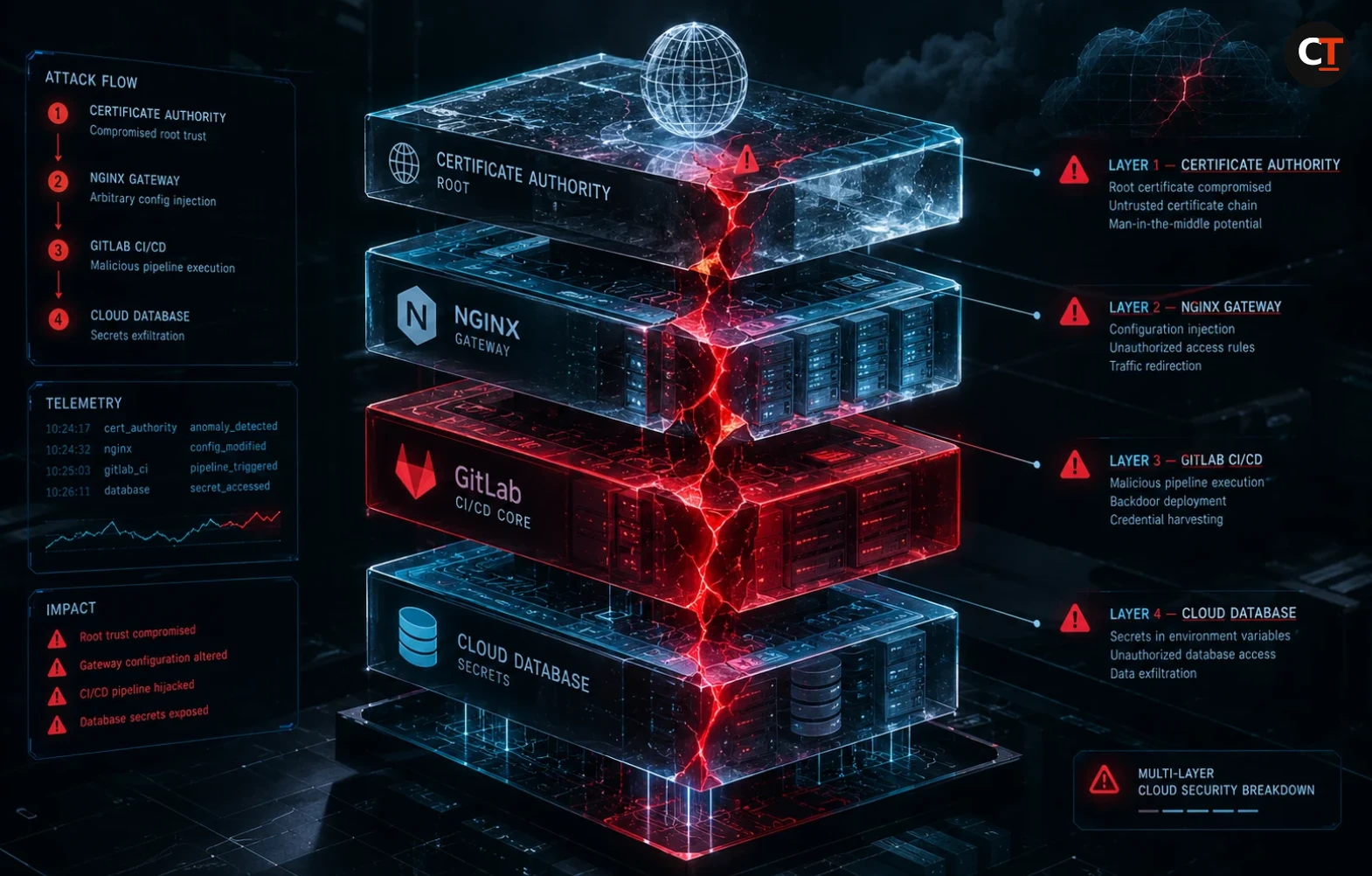
Individually, each of these four incidents represents a significant security event. Together, they create an automated kill chain that can dismantle an organization from the outside in without requiring sophisticated zero-day techniques.
The 4-Stage Compound Kill Chain
- Step 1: Trust Store Hijacking (eMudhra CA): The attacker establishes a position on a shared network or compromises an upstream DNS route. Because the victim organization’s backend worker scripts and CLI tools have not updated their static CA bundles, the attacker presents a forged TLS certificate signed by an eMudhra intermediate, intercepting internal traffic.
- Step 2: Perimeter Piercing (NGINX CVE-2026-15176): The attacker routes an HTTP request with a malformed rewrite payload through the NGINX reverse proxy, crashing worker processes or achieving memory corruption to bypass ingress authentication filters.
- Step 3: Source Code Seizure (GitLab CVE-2026-110264): Reaching the self-managed GitLab instance on the internal network, the attacker sends a single HTTP request containing a crafted regex payload. The Onigmo integer overflow triggers, granting remote shell access to the source code repository and CI/CD pipelines.
- Step 4: Credential Harvest and Persistence (Railway Leak): Leveraging decrypted API keys harvested from platform breaches, the attacker authenticates directly to cloud databases, cloud object storage, and production infrastructure, establishing persistent backdoors that survive server rebuilds.
This attack progression mirrors the sophisticated operational methods observed in historical breaches, such as the gateway compromises outlined in our Check Point zero-day investigation and the high-value infrastructure extractions documented in the Bitget $352M hack dossier.
The DevSecOps Survival Runbook: Five Mandatory Remediations
Faced with a compound failure across multiple infrastructure tiers, engineering teams cannot afford to react haphazardly. Triage must follow a strict, risk-weighted sequence based on active exploitability and blast radius.
Table 3: Emergency Action Order for Cloud Engineering Teams
| Priority | Domain | Required Tactical Execution | Verification Command |
|---|---|---|---|
| Tier 1 | GitLab CI/CD | Upgrade omnibus packages immediately to 19.5.1, 19.4.3, or 18.11.13. Force a restart of all background Puma and Sidekiq workers. | gitlab-rake gitlab:env:info |
| Tier 2 | Secret Rotation | Treat every secret stored on Railway as burned. Revoke tokens at providers (OpenAI, AWS, Stripe) before updating the dashboard. | Audit AWS CloudTrail and OpenRouter billing consoles |
| Tier 3 | Trust Store Patches | Update operating system ca-certificates, upgrade Python certifi to 2026.10.19+, update Node.js, and recompile Go binaries. |
python3 -c "import certifi; print(certifi.__version__)" |
| Tier 4 | NGINX Gateway | Upgrade to NGINX 1.30.6+ or 1.31.7+. Audit configuration files to remove alias directives paired with rewrite. |
nginx -v && nginx -T | grep -E "alias|rewrite" |
| Tier 5 | Origin Isolation | Close all public inbound web ports (80, 443, 22). Route management traffic through zero-trust tunnels and origin cloaking. | ufw status verbose |
Step 1: Emergency Patching of GitLab Instances
Because CVE-2026-110264 allows unauthenticated RCE with zero user interaction, self-managed GitLab servers represent the most urgent target. Upgrade your package repository and install the latest patch release immediately:
# For Debian/Ubuntu GitLab Omnibus Deployments
sudo apt-get update
sudo apt-get install gitlab-ee=19.5.1-ee.0
sudo gitlab-ctl reconfigure
sudo gitlab-ctl restart

# Verify that worker processes are running the patched Ruby runtime
sudo gitlab-rake gitlab:check SANITIZE=true
If your instance cannot be immediately upgraded, GitLab published two Sigma detection rules to identify active exploitation attempts: monitor server logs for bursts of Onigmo native worker crash events and anomalous Org mode render error burst exceptions.
Step 2: The Universal Secret Rotation Protocol
If your team utilized Railway or stored secrets on any cloud deployment platform during October 2026, follow a strict out-of-band rotation runbook:
- Revoke at the Source First: Never update environment variables inside the platform dashboard before invalidating the old keys at the provider level. Log directly into OpenAI, OpenRouter, AWS IAM, Stripe, and SendGrid consoles to disable active API keys.
- Audit Infrastructure Activity: Review AWS CloudTrail logs for unusual
ec2:RunInstancesoriam:CreateAccessKeycalls. Check GCP Cloud Audit Logs for anomalous service account token generation. - Rotate Database Passwords: Alter database user credentials, restart database instances, and ensure database ports (such as 5432 or 3306) are strictly bound to
127.0.0.1or isolated private virtual networks. - Redeploy After Rotation: Pushes made during the Railway incident were frozen; trigger clean redeployments of all services once new credentials have been safely provisioned.
Step 3: Purging Distrusted Roots from Non-Browser Runtimes
Ensure that backend microservices, scrapers, and data ingestion pipelines do not accept compromised certificates. Execute the following updates across container base images and production servers:
# 1. Update Linux OS Certificate Bundles
sudo apt-get update && sudo apt-get install --only-upgrade ca-certificates
sudo update-ca-certificates -f

# 2. Upgrade Python certifi library across virtual environments
pip install --upgrade certifi>=2026.10.19

# 3. Upgrade Node.js runtimes to pull NSS 3.131.1 updates
# Requires Node 22.23.4, 24.22.1, or 26.12.1+
nvm install 24.22.1 && nvm use 24.22.1

# 4. Rebuild Go microservices using the latest patch compiler
go version # Ensure Go 1.27.3 or 1.26.10+
go build -a -v -o /usr/local/bin/microservice ./cmd/server
Step 4: Hardening NGINX Configurations
Inspect all active NGINX configuration files to identify vulnerable directive patterns. If an immediate upgrade to version 1.30.6 or 1.31.7 is blocked by operational constraints, apply F5’s recommended interim mitigation: decouple aliased paths from internal rewrite logic and avoid evaluating $request_filename inside rewrite blocks.
# HARDENED NGINX CONFIGURATION PATTERN
location /assets/ {
    # Replace fragile alias and rewrite combinations with root mapping
    root /var/www/static;
    try_files $uri $uri/ /index.html;
    # Avoid referencing $request_filename in log formats or script evaluations
}
Step 5: Origin Cloaking and Zero-Trust Isolation
The single most effective architectural guard against mass-scanning bots and sudden zero-day disclosures is zero-trust origin cloaking. Attackers rely on internet-wide port scanners like Shodan and Censys to discover exposed GitLab, NGINX, and database ports across public IPv4 ranges.
Deploying an outbound-only reverse tunnel daemon (such as Cloudflare Tunnel via cloudflared) paired with strict Linux firewall rules eliminates public attack surfaces:
# UFW Firewall Lockdown for Origin Cloaking
sudo ufw default deny incoming
sudo ufw default allow outgoing
# Allow SSH strictly from a dedicated private WireGuard or corporate management IP
sudo ufw allow from 10.0.0.50 to any port 22 proto tcp
# Enable firewall; ALL public HTTP/HTTPS ports (80, 443, 8000, 5432) remain CLOSED
sudo ufw enable
With inbound ports locked, external attackers cannot directly probe origin reverse proxies or continuous integration portals. Every incoming request must route through edge Web Application Firewalls (WAF) where managed rules drop malicious payloads before they ever reach the local server stack.
For organizations deploying high-availability cloud servers or dedicated crypto infrastructure, selecting vetted hosting partners with robust hardware firewalls and dedicated IP provisioning (such as BigRock Linux VPS Hosting) provides an essential baseline of physical and network isolation.
Architectural Lessons: Building Resilience Beyond Trust Assumptions
The 72-hour security crisis of late October 2026 delivered an unambiguous verdict on modern software engineering practices: the industry’s reliance on implicit trust has become its single greatest vulnerability.
When an engineering team assumes that Certificate Authorities never bungle private key ceremonies, that reverse proxies never suffer heap overflows, that foundational regex engines written in 2014 are thoroughly vetted, and that cloud hosting providers will securely guard plain-text API secrets forever, that team is operating on hope rather than security architecture.
Resilient cloud operations require adopting structural defense principles:
- Assume the Root Is Compromised: Pin certificates where possible, enforce DNSSEC with SSHFP and TLSA records, and automate the distribution of updated CA bundles to backend runtimes with the same urgency applied to application code.
- Cloak the Origin: Never expose an administration dashboard, code repository, or database directly to the public internet. If Shodan can see your port, an automated botnet will exploit your next zero-day within sixty minutes of publication.
- Enforce Envelope Encryption for Secrets: Treat platform-hosted environment variables as high-risk caches. Utilize dedicated key management services (KMS) with client-side envelope encryption, short-lived ephemeral tokens, and strict IP-bound credentials.
The engineer in Frankfurt who spent Tuesday morning battling simultaneous alerts did not survive the cascade by hoping for vendor fixes. They survived because layered defenses, strict secret rotation protocols, and isolated network architectures allowed the team to absorb the failure of four separate trust pillars without suffering a catastrophic data loss. In a cloud ecosystem where zero-days arrive in clusters, that resilience is the only metric that matters.
Disclaimer: CryptechToday is for educational and news purposes only. It is not financial or investment advice.