Leaving web ports open to the public internet is an obsolete architectural model. Here is how modern cloud engineering teams combine outbound Cloudflare Tunnels, edge WAF scrubbing, and Turnstile challenges to defeat automated zero-days and serverless billing exhaustion.
- The Ingress Trap Is Real: Running NGINX, Node.js, or PHP on a public IP address with open ports 80, 443, or 22 leaves servers vulnerable to automated mass scanners within minutes of a zero-day disclosure.
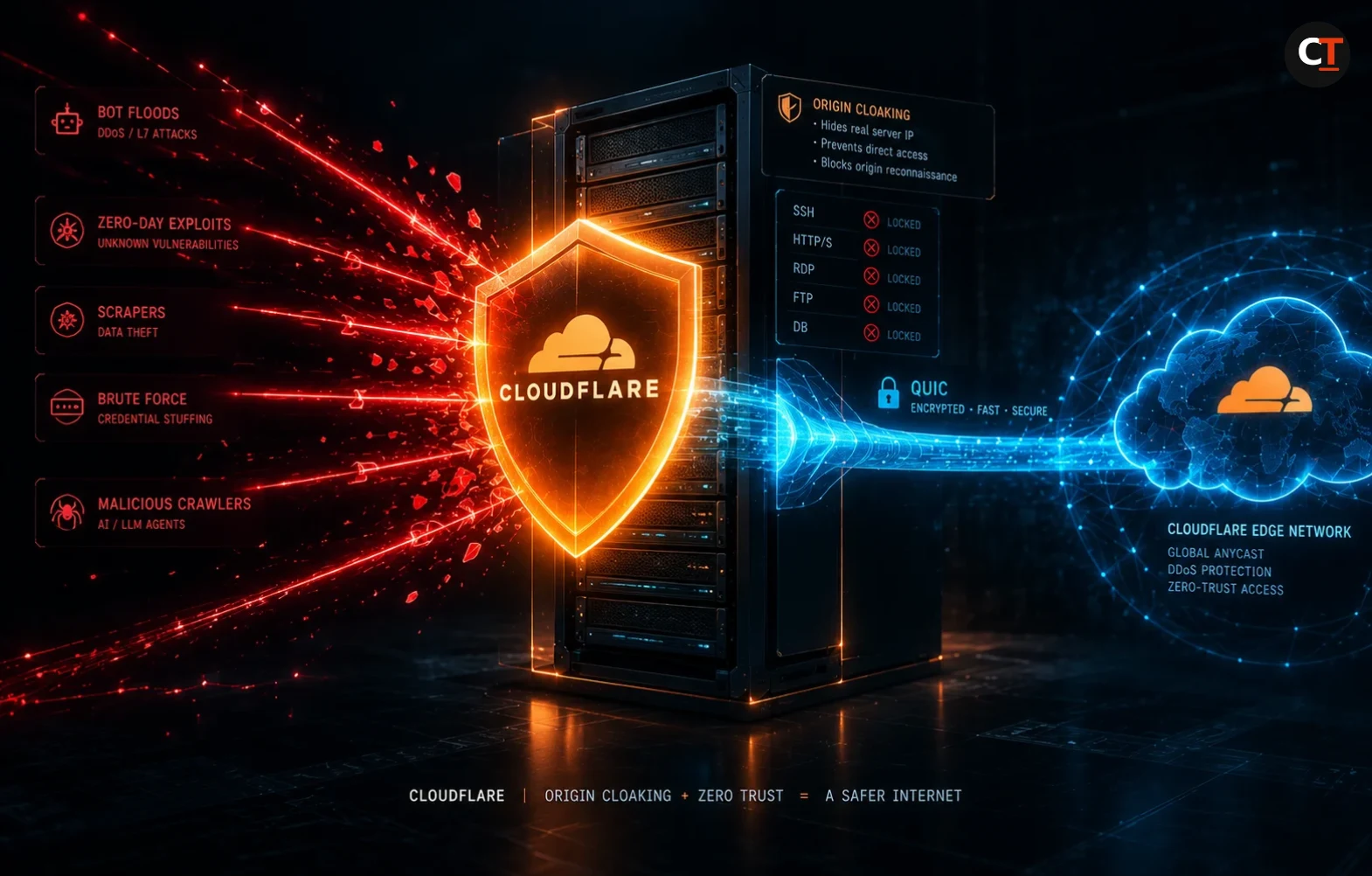
- Outbound-Only Origin Cloaking: Cloudflare Tunnel (cloudflared) dials out to Cloudflare edge PoPs on port 7844 over QUIC/HTTP2. Combined with a local UFW default-deny policy, all public web ports remain completely closed. Shodan and Censys see a dark IP.
- Stopping Denial-of-Wallet on Serverless: Automated AI scrapers rotating residential IPs can hit Next.js and Vercel frontends with millions of dynamic SSR requests, exhausting billing caps. Edge rate limiting, cache key normalization, and Turnstile halt scraping waves before serverless functions execute.
- Virtual Patching at the Edge: Cloudflare Managed Rulesets drop critical zero-days like PHP2Shell (Rule ID 4e315666e8e344cdb64119a3b5ccf32f) at the perimeter, sparing origin CPUs from parsing malformed payloads.
The technical impact was not server downtime. The application remained online. The real damage was financial: the unmetered wave of uncached requests rapidly exhausted the account’s serverless function quotas, threatening to trigger thousands of dollars in overage fees. This modern attack vector, known in site reliability engineering as a denial-of-wallet attack, turns the flexible scalability of serverless cloud hosting into a direct financial vulnerability.
At the same time, the broader internet was reeling from high-severity zero-day disclosures. As documented in our investigations of the 72-hour DevSecOps cascade and the PHP2Shell runtime crisis, automated botnets now begin scanning public IPv4 addresses for newly published vulnerabilities within fifteen minutes of an advisory appearing online.
The lesson for engineering teams is inescapable: relying on perimeter firewalls that leave ports 80 and 443 exposed to the public internet is fundamentally broken. Surviving the modern threat landscape requires a radical architectural shift: cloaking your origin server completely, routing traffic through outbound-only zero-trust tunnels, and letting the edge absorb both malicious zero-days and volumetric bot surges.
Here is the production-tested security blueprint that allows developers to lock down hybrid cloud architectures without paying enterprise security premiums.
The Architecture: Defense-in-Depth
A resilient cloud architecture decouples the public internet from backend execution. Instead of allowing external clients to establish direct TCP handshakes with your application server, every request is scrubbed across Cloudflare’s globally distributed Anycast network spanning more than 300 cities.
│
┌─────────────────┴─────────────────┐
▼ ▼
┌─────────────────────┐ ┌─────────────────────┐
│ Web Application │ │ Database / API │
│ (Serverless Edge) │ │ (Cloudflare Proxy) │
└──────────┬──────────┘ └──────────┬──────────┘
│ │
│ │
• Strict CSP & Clickjack Headers • L3/L4/L7 DDoS Scrubbing (Anycast)
• Route-Scoped Rate Limiting • Managed WAF (Anti-SQLi / Anti-XSS)
• Cloudflare Turnstile Validation • Super Bot Fight Mode (Edge Challenge)
│ │
│ │
▼ ▼
┌─────────────────────┐ ┌─────────────────────┐
│ Serverless Edge │ │ Cloudflare Edge PoP │
│ App Router & APIs │ │ (300+ Cities) │
└──────────┬──────────┘ └──────────┬──────────┘
│ │
│ Shared Internal Secret │ Encrypted QUIC/HTTP2 Tunnel
│ HTTPS (Direct Server-to-Server) │ (Outbound Only on Port 7844)
▼ ▼
╔════════════════════════════════════════════════════════════════════════════╗
║ PRODUCTION CLOUD VPS ║
║ ║
║ FIREWALL RULES (UFW): Port 22 (SSH Only). ALL WEB PORTS CLOSED! ║
║ NO public ports 80, 443, 8000, or 5432 exposed to the Internet. ║
║ ║
║ ┌────────────────────────────────────────────────────────────────────┐ ║
║ │ cloudflared (Background Tunnel Daemon) │ ║
║ │ • Dial-out tunnel to Cloudflare Edge │ ║
║ │ • Routes internal traffic directly to localhost: 127.0.0.1 │ ║
║ └─────────────────┬────────────────────────────────┬─────────────────┘ ║
║ │ │ ║
║ ▼ ▼ ║
║ ┌─────────────────────────┐ ┌─────────────────────────┐ ║
║ │ FastAPI / Node Engine │ │ PostgreSQL Database │ ║
║ │ (Localhost: 8000) │ │ (Internal Docker) │ ║
║ └─────────────────────────┘ └─────────────────────────┘ ║
╚════════════════════════════════════════════════════════════════════════════╝
1. Origin Cloaking via Cloudflare Tunnel (`cloudflared`)
The traditional method of hosting a web application requires opening port 80 (HTTP) and port 443 (HTTPS) in your Linux firewall (UFW or iptables) and binding a reverse proxy like NGINX to your server’s public IPv4 address. The moment you do this, automated reconnaissance bots indexed by search engines like Shodan and Censys catalogue your open ports, web server header banners, and TLS certificates.
When an attacker wants to compromise your platform, they bypass your CDN entirely by sending malicious payloads directly to your server’s public IP address. To prevent this, modern production architectures implement Zero-Trust Origin Cloaking using Cloudflare Tunnel.
How It Works Under the Hood
- You install the Cloudflare lightweight connector daemon
cloudflaredon your cloud VPS or server. - When the service launches, it does not open a listening socket. Instead, it initiates an outbound-only connection to the nearest Cloudflare edge PoPs over UDP or TCP port 7844 using encrypted QUIC and HTTP/2 protocols.
- You configure the Linux host firewall to drop all incoming web traffic. Ports 80, 443, 8000, and database ports like 5432 or 3306 are permanently locked.
- When a user navigates to your API domain, Cloudflare resolves the DNS request to its Anycast IP addresses, inspects the request at the edge, and streams the verified traffic back down through the existing outbound tunnel directly to
127.0.0.1on your server.
Production UFW Firewall Baseline
To implement this model, apply the following strict Uncomplicated Firewall (UFW) configuration on your Linux VPS:
# 1. Reset and establish default policies: block ALL incoming, permit outgoing
sudo ufw default deny incoming
sudo ufw default allow outgoing

# 2. Allow SSH strictly from your dedicated management IP or VPN interface
sudo ufw allow from 203.0.113.10 to any port 22 proto tcp

# 3. Enable the firewall
sudo ufw enable

# 4. Verify configuration: ALL public web ports (80, 443, 8000, 5432) remain CLOSED
sudo ufw status verbose
Because cloudflared communicates via outbound connections, UFW’s default policy (allow outgoing) permits the daemon to establish its QUIC tunnels on port 7844 automatically without opening a single inbound port.
2. Edge WAF Scrubbing: Stopping Zero-Days Before Localhost
A common misconception among developers is that origin cloaking stops application vulnerabilities. It does not. If an attacker submits a valid HTTP request through your domain, Cloudflare passes that HTTP request through the tunnel to your backend. If your backend is running an unpatched PHP worker vulnerable to PHP2Shell or a vulnerable NGINX rewrite directive, the payload will still execute.
This is where Cloudflare Web Application Firewall (WAF) and Managed Rulesets provide critical defense. Instead of relying on your backend server CPU to parse, inspect, and reject malicious payloads, Cloudflare inspects requests at the edge before they enter the tunnel.
Table 1: Cloudflare Edge Scrubbing Capabilities Across Threat Vectors
| Threat Vector | Targeted Component | Cloudflare Protection Mechanism | Production Defense Action |
|---|---|---|---|
| PHP2Shell (CVE-2026-109618) |
PHP runtime memory (Multipart parsing) |
Cloudflare Managed Ruleset Rule ID: 4e315666e8e344cdb64119a3b5ccf32f |
Inspects request-response transactions; drops multipart OOM exploit payloads at the edge with HTTP 403 |
| GitLab Regex RCE (CVE-2026-110264) |
Ruby Onigmo regex (CI/CD Core) |
Cloudflare Access (Zero Trust) + OWASP Managed Core |
Places administration and git consoles behind edge identity verification; unauthenticated bots cannot reach the login route |
| L3/L4 Network Floods | VPS Network Bandwidth | Unmetered Anycast Scrubbing | Absorbs multi-gigabit SYN floods across 300+ data centers without alerting the origin |
| Direct Origin Port Probing | Origin Apache/NGINX/DB | Cloudflare Tunnel (`cloudflared`) | Eliminates public inbound listening ports; scanners discover zero open ports |
| AI Scraper Bot Waves (Denial-of-Wallet) |
Serverless Compute Quotas (Next.js / Vercel) |
Super Bot Fight Mode + Edge Rate Limiting + Turnstile |
Executes non-interactive cryptographic challenges; drops headless automated crawlers before invoking functions |
During the October 2026 PHP2Shell crisis, Cloudflare deployed emergency updates to its Cloudflare Managed Ruleset (Ruleset ID efb7b8c949ac4650a09736fc376e9aee). The rules, including Rule ID 4e315666e8e344cdb64119a3b5ccf32f, analyze multipart upload requests and drop malicious session upload progress strings at the edge. By dropping the request at the perimeter, your backend PHP engine never triggers the vulnerable longjmp() out-of-memory routine.
3. Defeating Denial-of-Wallet: Protecting Serverless Frontends
For modern web applications that utilize serverless frontends (such as Next.js hosted on Vercel, Netlify, or AWS Lambda), volumetric threats have evolved. Attackers no longer focus solely on taking servers offline. Instead, rogue scrapers, automated competitor pricing monitors, and LLM training crawlers execute high-volume scrape jobs designed to bypass traditional caching.
The Anatomy of the Serverless Bot Wave
To force serverless platforms to execute expensive Server-Side Rendering (SSR) functions, automated crawlers employ two simple tricks:
- Cache-Busting Query Strings: The scraper appends random parameters (such as
?_ref=83920194) to every URL. If your CDN caching configuration does not ignore arbitrary query strings, every single hit is treated as a cache miss, triggering a fresh serverless function execution. - Residential Proxy Rotation: By rotating millions of clean residential IP addresses, automated crawlers stay well beneath standard per-IP rate limits (such as 100 requests per minute).
A bot wave of one million requests hitting an unshielded serverless frontend can exhaust monthly compute allowances in a single afternoon, leaving the developer with massive overage invoices or a suspended deployment.
The Cloudflare Edge Defense Strategy
To eliminate denial-of-wallet risks, developers must apply a layered mitigation strategy at the Cloudflare edge before requests reach the serverless provider:
The 4-Step Edge Serverless Protection Runbook
- Normalize Cache Keys: Configure Cloudflare Caching Rules to ignore arbitrary query strings on public marketing and content routes. Transform the cache key so that
/product?rand=123serves the identical cached edge HTML as/product. Serverless functions run exactly once, while millions of scraper hits are served from Cloudflare edge cache for free. - Enable Super Bot Fight Mode (SBFM): SBFM categorizes incoming requests into Definitely Automated, Likely Automated, and Verified Bots. For standard public applications, configure Likely Automated traffic to receive a Managed Challenge. Legitimate users pass invisibly in milliseconds, while headless Puppeteer or Playwright bots fail and get blocked.
- Implement Route-Scoped Rate Limiting: Do not rely on generic per-IP rate limits across the entire website. Create targeted WAF Rate Limiting rules scoped strictly to expensive API endpoints (such as
/api/searchor/api/generate). Enforce a limit of ten requests per ten seconds per IP, returning an immediate HTTP 429 response. - Deploy Cloudflare Turnstile on Interactive Forms: For login screens, registration pages, and contact forms, replace legacy CAPTCHAs with Cloudflare Turnstile.
The Critical Tunnel Gotcha: Super Bot Fight Mode Handshakes
cloudflared as automated bot traffic. This results in intermittent websocket: bad handshake errors and drops tunnel connections.
The Solution: In zones running Cloudflare Tunnel, set the SBFM action for Definitely Automated to Allow or Managed Challenge. Protect your sensitive public endpoints using targeted WAF Custom Rules, explicit URI rate limits, and Turnstile rather than a global automated block.
4. Cloudflare Turnstile: Invisible Anti-Bot Verification
Traditional CAPTCHA systems (such as reCAPTCHA v2) frustrate human users. Forcing visitors to decipher distorted street numbers or click crosswalks degrades conversion rates and increases bounce rates. Furthermore, traditional solutions frequently harvest user browsing telemetry for cross-site behavioral advertising.
Cloudflare Turnstile completely reinvents bot verification:
- Frictionless User Experience: Legitimate humans pass non-interactive cryptographic proof-of-work challenges in the browser background without clicking a single checkbox.
- Privacy-Preserving Architecture: Turnstile does not track users across websites, harvest cookies for advertising, or monetize user interaction data.
- Server-Side Cryptographic Validation: The frontend receives a unique, time-stamped verification token. Your backend microservice validates this token directly against the Cloudflare
/siteverifyendpoint using a secret private key before processing any database write or compute-heavy task.
# Backend Python FastAPI Validation Example for Cloudflare Turnstile
import httpx
from fastapi import FastAPI, HTTPException, Form

app = FastAPI()
CLOUDFLARE_SECRET_KEY = "0x4AAAAAA..." # Your Turnstile Secret Key

@app.post("/api/submit")
async def handle_submission(cf_turnstile_response: str = Form(...)):
    async with httpx.AsyncClient() as client:
        verify_data = {
            "secret": CLOUDFLARE_SECRET_KEY,
            "response": cf_turnstile_response
        }
        res = await client.post("https://challenges.cloudflare.com/turnstile/v0/siteverify", data=verify_data)
        outcome = res.json()

    if not outcome.get("success"):
        raise HTTPException(status_code=403, detail="Bot challenge verification failed")

    return {"status": "success", "message": "Verified human submission processed"}
5. Complementary Application-Level Best Practices
While Cloudflare provides unmatched perimeter and network-layer defenses, true production resilience requires complementary application-level guards on your server:
1. Enforce Strict Content Security Policy (CSP) Headers
Prevent cross-site scripting (XSS) and unauthorized third-party script injection by configuring robust security headers in your application reverse proxy or serverless config:
frame-ancestors 'none': Eliminates clickjacking attacks by forbidding external websites from embedding your application inside rogue iframes.X-Content-Type-Options: nosniff: Forces browsers to strictly adhere to declared MIME types, preventing executable code disguised as user images from running.Referrer-Policy: strict-origin-when-cross-origin: Protects sensitive authentication tokens in URL query strings from leaking to external referrers.
2. Internal Microservice Authentication Headers
When your serverless frontend communicates with your backend VPS through the tunnel, protect every internal endpoint with a high-entropy secret header (such as x-internal-secret). Even if an attacker discovers your internal tunnel routing hostname, unauthenticated HTTP requests are rejected at the application routing layer with an instant HTTP 401.
3. Safe In-Memory File Processing
Never pass user-uploaded files directly to untrusted native shell decompressors (such as tar, unzip, or ImageMagick). Parse documents and images using sandboxed in-memory extractors, isolating file processing from system shell execution.
For organizations deploying high-performance cloud backends, trading bots, or sovereign validator nodes, choosing hardened hosting providers that provide isolated dedicated resources and physical firewall boundaries (such as BigRock Dedicated & VPS Cloud Infrastructure) creates the ideal hardware foundation for a zero-trust software stack.
Architectural Summary: What Attack Is Blocked Where?
Table 2: Complete Defense Matrix
| Attack Vector | Vulnerable Layer | Defense Component | Defensive Mechanism |
|---|---|---|---|
| Direct IP Port Sweeps (Shodan / Censys) |
Origin VPS / Database | Cloudflare Tunnel (`cloudflared`) + UFW Default Deny |
Closes all inbound firewall ports; origin IP is invisible to port scanners. |
| Volumetric L3/L4 DDoS | Network Bandwidth | Global Anycast Network | Absorbed and dropped in real time across 300+ global edge data centers. |
| SQL Injection / XSS / LFI | Application Queries | Cloudflare WAF Managed Rules | Inspects payloads at the edge and drops exploit strings with HTTP 403. |
| PHP2Shell / Runtime Zero-Days | Backend Language Engine | WAF Virtual Patching (Rule ID: 4e315666e8e344cdb64119a3b5ccf32f) |
Drops malicious multipart OOM exploit patterns before reaching the host. |
| Credential Stuffing & Form Spam | Authentication & Leads | Cloudflare Turnstile | Invisible cryptographic proof-of-work challenge; drops headless scripts. |
| Denial-of-Wallet (Scraper Floods) | Serverless Compute (Next.js) | Super Bot Fight Mode + Cache Key Normalization |
Serves cached assets, strips cache-busting parameters, and challenges bots. |
| Clickjacking & Script Sniffing | Browser Client Session | Strict CSP Security Headers | Blocks iframe embedding and prevents MIME-type sniffing exploits. |
The Zero-Trust Imperative
The lessons of late October 2026 are clear. In a landscape where software supply chains suffer simultaneous trust failures, where Certificate Authorities issue weak keys, and where memory corruption flaws trigger before applications even load, relying on perimeter trust is no longer viable.
By shifting to an edge-cloaked architecture, you change the fundamental economics of cybersecurity. Mass-scanning botnets cannot attack an IP address they cannot discover. Automated zero-days are dropped at the edge by managed firewall rules before your server spends a single CPU cycle. And aggressive scraper waves are absorbed by global Anycast caches before they can deplete your serverless budget.
Security is not about building an impenetrable application. It is about eliminating unnecessary attack surfaces. By closing your inbound ports, deploying outbound tunnels, and letting the edge scrub the blast radius, you give your engineering team the one asset that matters most when the next zero-day drops: the time to patch on your own terms.
Disclaimer: CryptechToday is for educational and news purposes only. It is not financial or investment advice.