Tokenization upgrades market plumbing, but it also creates entirely new failure points. From smart contract logic bugs to servicing collapses, here is the honest risk breakdown every investor must know.
Key Takeaways
- Software wrapper risks: Changing an asset from paper to code introduces smart contract vulnerabilities, oracle dependencies, and private key security hazards.
- The immutability trap: Blockchains have no customer service desk. An irreversible transfer error requires complex legal intervention to correct.
- Post-minting servicing is where projects fail: If the off-chain company managing the physical property or loan defaults, the on-chain token becomes useless.
In March 2022, a hacker exploited an administrative weakness in the Ronin Network bridge, draining $625 million in digital assets in under an hour.
The underlying blockchain nodes functioned flawlessly. The cryptography did not break. The vulnerability lay in a 5-of-9 multi-signature validation setup that allowed an external adversary to compromise private keys.
Tokenized real-world assets (RWAs) operate on the very same digital infrastructure.
When Wall Street asset managers describe tokenization as a modern digital wrapper, they are correct. But every new wrapper brings new points of failure.
If you are evaluating tokenized government bonds, private credit funds, or fractional real estate, you must look past the promotional marketing.
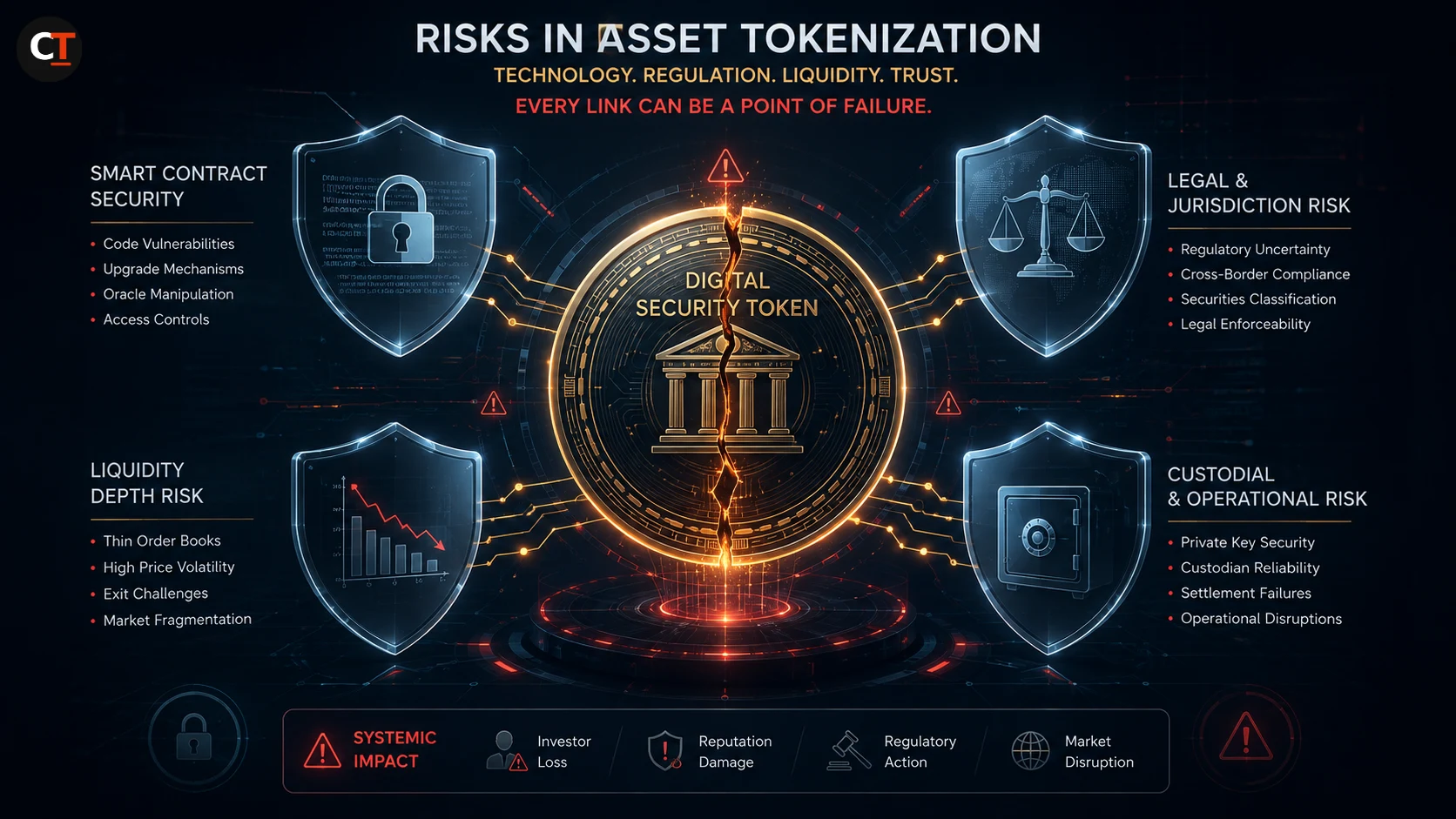
Here are the four distinct risk categories that define the tokenized landscape in 2026.
The 4 Risk Buckets of Tokenized Finance
| Risk Category | Primary Threat Vector | Who Bears the Loss? |
|---|---|---|
| 1. Technology & Smart Contracts | Software bugs, oracle feed manipulation, private key theft. | Token Holder |
| 2. Operational Servicing | Off-chain property neglect, tenant default, loan servicer bankruptcy. | Token Holder & SPV |
| 3. Market Structure & Liquidity | Empty secondary order books, severe bid/ask discounts, mandatory lock-ups. | Exiting Investor |
| 4. Legal & Regulatory Friction | Cross-border court jurisdictional gaps, VDA tax misclassifications. | Retail Investor |
1. Technology & Smart Contract Risks
In traditional banking, if a computer database makes an error, system administrators roll back the database to a prior backup.
Public blockchains do not work that way.
The Immutability Dilemma
Public blockchain networks are designed to be immutable: once a transaction settles, it cannot be canceled, edited, or reversed.
While immutability guarantees that no corrupt authority can erase your ownership record, it also means that if you send tokenized funds to an incorrect address or lose your credentials, no central bank or customer service helpline can reverse the transaction on the base ledger.
Regulated security token standards (like ERC-3643) address this by including an administrative “burn and re-mint” master key. But that introduces a separate paradox: if an issuer has the power to burn your token, the asset is no longer truly censorship-resistant.
Smart Contract Vulnerabilities
A tokenized fund runs on hundreds of lines of code governing dividend calculations, transfer whitelists, and redemption requests.
If developers leave an unspotted logic flaw, malicious actors can drain collateral pools or freeze token distributions. Even heavily audited code can suffer unforeseen interactions when integrated across multiple decentralized finance protocols.
Oracle Failure Risk
Smart contracts cannot read physical reality directly. They rely on oracles (specialized data feeds like Chainlink) to inform them of real-world events, such as a property appraisal update, a tenant rent payment, or a bond coupon maturity.
If an oracle transmits incorrect data or goes offline during high network congestion, the smart contract will execute automated actions based on false inputs.
2. The Operational Servicing Risk (The Silent Killer)
Most tokenization articles focus entirely on how tokens are minted. Almost none explain what happens during the five years after issuance.
A real-world asset is not a self-sustaining software program. It is an off-chain physical or financial operation that requires constant human management.
If you own a token for an office building, someone must clean the hallways, collect monthly rents from tenants, pay local property taxes, and hire contractors when a water pipe bursts.
If the property management company neglects the building or commits fraud, the property’s real value drops. The smart contract on Ethereum will continue to display your token balance perfectly, but the cash flow backing that token will dry up.
In private credit tokenization, the loan servicer must perform credit underwriting and pursue legal recovery if a corporate borrower defaults. If the servicing agency collapses, token holders are left holding digital claims with no practical mechanism to enforce loan collections in physical courtrooms.
3. Liquidity and Secondary Market Risks
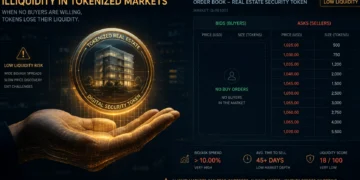
As detailed in our breakdown of the tokenization liquidity myth, converting an illiquid asset into a token does not magically generate buyers.
Investors who buy tokenized real estate or alternative debt frequently face:
- Fragmented Liquidity: Tokens issued on one platform cannot trade on another due to proprietary compliance standards.
- Severe Price Discounts: When retail investors need emergency liquidity, the lack of institutional market makers forces sellers to accept 20% to 35% discounts below appraised property value.
- Mandatory Lock-Up Freezes: Securities regulations (such as US Regulation D) mandate holding periods of 6 to 12 months before tokens can legally be transferred to secondary buyers.
4. Regulatory and Cross-Border Jurisdictional Gaps
Blockchains are global, synchronized networks with no national borders. Financial laws, however, stop strictly at territorial boundaries.
Consider an investor in Mumbai holding a tokenized debt instrument issued by a Delaware LLC representing corporate loans made to a manufacturer in Germany.
If the borrower defaults:
- Which legal court has jurisdiction?
- Can an Indian retail investor afford to hire cross-border commercial litigation counsel in Delaware or Frankfurt?
- Will Indian tax authorities classify the yield under standard foreign dividend rates or apply a punitive 30% Virtual Digital Asset tax under Section 115BBH?
Until international regulatory frameworks harmonize, cross-border tokenized investments carry substantial legal overhead during disputes.
The 6-Point Investor Safety Checklist
Before allocating capital to any tokenized asset product in 2026, run the opportunity through this six-point risk audit:
- Audited Code: Has the smart contract been audited by at least two top-tier independent security firms, and are audit reports publicly accessible?
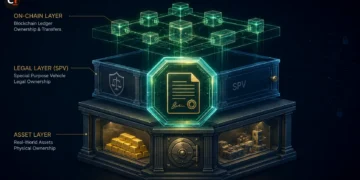
- Bankruptcy-Remote Legal Wrapper: Is the asset held in a segregated Special Purpose Vehicle (SPV) that cannot be seized if the platform fails?
- Independent Custody: Are physical assets or sovereign bonds vaulted with a recognized institutional custodian (e.g., BNY Mellon, State Street), not a startup hot wallet?
- Transparent Servicing Terms: Who is the designated off-chain property manager or loan servicer, and what is their historical track record?
- Clear Exit Architecture: Does the product feature a primary mint-and-redeem mechanism, or are you 100% dependent on finding a secondary buyer?
- Domestic Tax Impact: Have you evaluated domestic tax compliance (such as Indian VDA tax rates or LRS limits) before remitting funds?
Case Studies: When the Risks Materialized
Theoretical risk frameworks become real when you look at documented incidents from the past four years.
Oracle Failure: Mango Markets (October 2022)
Mango Markets, a decentralized lending and trading protocol on the Solana blockchain, was drained of $114 million in a single attack exploiting a fundamental oracle weakness. The attacker did not breach the smart contract code itself. Instead, they manipulated the price oracle feed for the MNGO governance token by artificially inflating its price using two accounts they controlled on a thin secondary market.
With the oracle reporting an inflated MNGO price as collateral, the attacker borrowed $114 million in legitimate assets from the Mango Markets protocol against their artificially overvalued position. By the time the oracle corrected, the protocol was insolvent. No code was broken. The oracle was broken.
For RWA tokenization, this is the clearest possible warning: if a tokenized real estate platform uses a single real estate appraisal oracle without independent verification, a manipulated valuation could trigger forced loan recalls or false yield distributions affecting every token holder in the pool.
Smart Contract Exploit: Euler Finance (March 2023)
Euler Finance, a permissionless lending protocol on Ethereum with over $850 million in total value locked, was attacked through a donation function exploit that allowed an attacker to bypass flash loan protections and drain the protocol.
The loss: $197 million in a single transaction. The Euler protocol had been audited by multiple top-tier security firms in prior years, yet the specific vulnerability went undetected. The attacker eventually returned most of the funds after a negotiation, but the incident demonstrated that even audited code from sophisticated teams can fail under complex edge-case conditions.
The lesson for tokenized real-world assets: technical audits reduce risk. They do not eliminate it. Any protocol holding billions in sovereign debt or real estate tokens carries this residual software vulnerability as a permanent background risk.
Before investing in any tokenized product, assess both the legal structure (read our guide to SPVs and what tokens actually own) and the liquidity exit paths (the liquidity myth guide). In India specifically, the regulatory context (India’s 2026 tokenization guide) determines which products have legal recourse and which do not.
Tokenization is not an investment strategy. It is an infrastructure format.
Just as a PDF document can contain a masterpiece or a fraudulent contract, a blockchain token can represent an ultra-safe US sovereign bond or an over-leveraged, illiquid property deal.
When you evaluate a tokenized opportunity, do not be blinded by the elegance of the digital interface. Inspect the smart contract, verify the legal wrapper, assess the servicing agency, and understand the liquidity terms.
The future of capital markets is undeniably moving on-chain. But smart wealth preservation will always depend on asking the hard questions before you click “Confirm.”
The future of capital markets is undeniably moving on-chain. But smart wealth preservation will always depend on asking the hard questions before you click “Confirm.”
This article is part of a complete educational series on real-world asset tokenization:
- What Is Asset Tokenization? The Real Explanation (2026)
- How Financial Markets Evolved: From Paper to ETFs to Tokens
- What Does a Token Actually Own? SPVs and Legal Wrappers
- Stablecoins vs. Tokenized Deposits vs. Digital Rupee
- Tokenized US Treasuries: On-Chain Yield Guide
- The Tokenization Liquidity Myth: Can You Sell RWA Tokens?
- Tokenization in India 2026: SEBI, RBI and the New Law