They all look like numbers on a phone screen. Yet one is private corporate credit, one is commercial bank money, and one is sovereign government debt. Here is how to tell them apart before you store your money.
Key Takeaways
- Three distinct issuers: Stablecoins come from private tech firms, tokenized deposits come from commercial banks, and CBDCs come directly from sovereign central banks.
- UPI is a pipe, not a currency: UPI routes commercial bank deposits between accounts. A Central Bank Digital Currency (CBDC) is the currency itself.
- Credit risk varies dramatically: CBDCs have zero default risk; stablecoins depend entirely on the quality and liquidity of private reserve vaults.
If you look at your smartphone screen while transferring funds, all digital money appears identical.
A balance updates from ₹50,000 to ₹40,000. A green checkmark appears. The recipient receives a notification.
Yet behind that simple pixel update lies an intense global battle over the future of money.
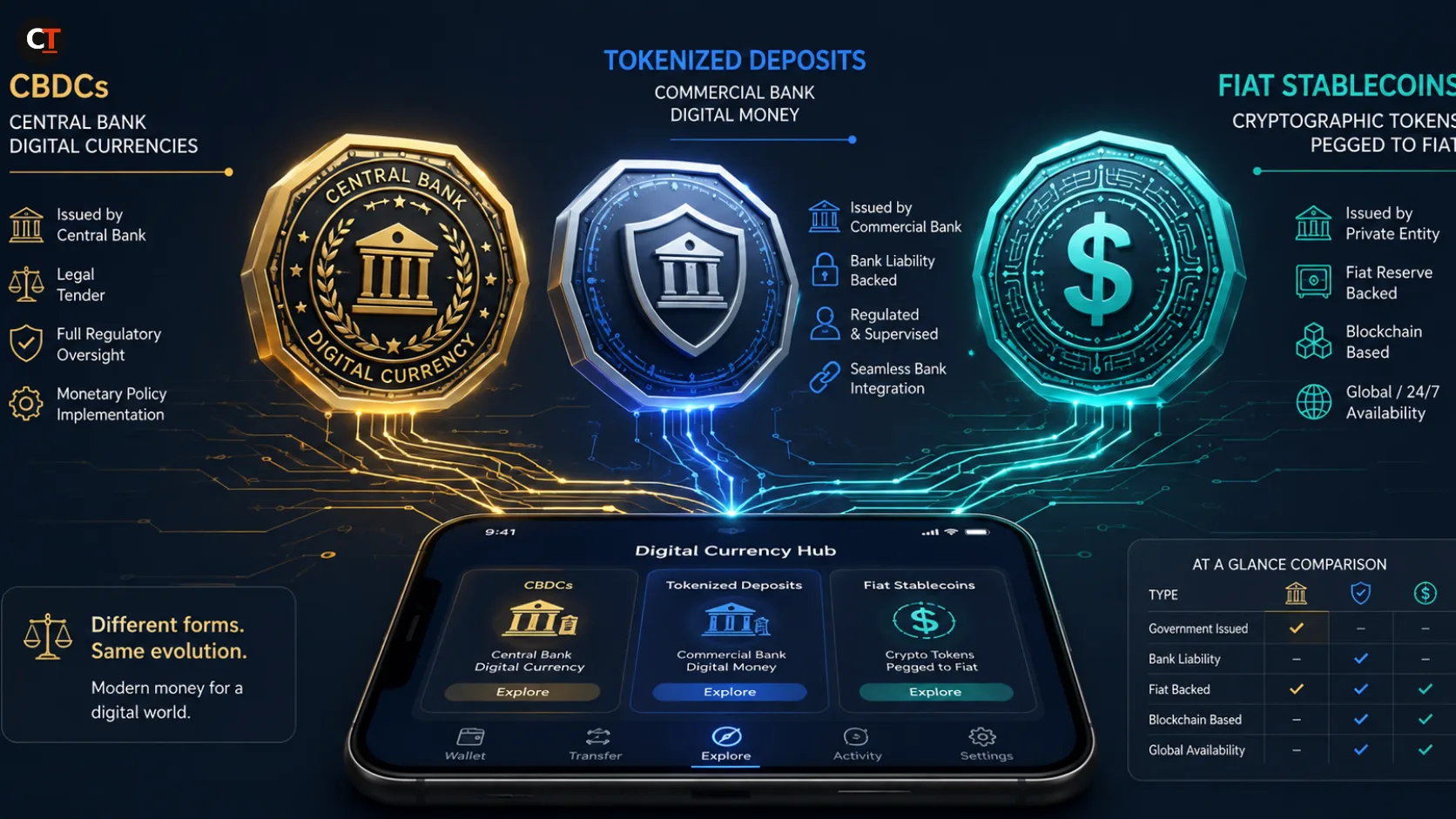
In 2026, capital moves through three fundamentally different digital rails:
- Private Stablecoins (such as USDT and USDC)
- Tokenized Bank Deposits (such as JPMorgan JPM Coin)
- Central Bank Digital Currencies / CBDCs (such as India’s Digital Rupee e₹)
Because all three are frequently described as “digital cash on a blockchain,” everyday investors assume they are interchangeable.
They are not.
The differences between who issues them, who guarantees them, and what happens if something breaks determine whether your capital is completely safe or exposed to sudden losses.
The Starting Anchor: How Money Actually Works Today
To understand digital cash, we must first look at the traditional banking system.
When you deposit ₹1,00,000 into HDFC Bank or State Bank of India, you no longer own legal tender currency notes. You own a digital IOU from that specific commercial bank. You are an unsecured creditor of the bank.
When you send money to a friend via UPI, no physical currency changes hands. The National Payments Corporation of India (NPCI) simply sends a standardized digital message telling Bank A to reduce your balance and Bank B to increase your friend’s balance.
UPI is a messaging network that coordinates balances across closed commercial bank databases. It is not a new form of currency. The three formats below are actual new representations of money itself.
1. Stablecoins: Private Digital Cash for Open Networks
Stablecoins are digital tokens issued by private corporate entities on public blockchains (like Ethereum, Solana, or Polygon) designed to maintain a 1:1 peg with a fiat currency (primarily the US Dollar).
How They Work
When you give $100 to an issuer like Circle (the company behind USDC), Circle deposits your $100 into short-term US Treasury bills and cash reserves held at a partner bank. They then mint 100 USDC tokens directly into your digital wallet.
Key Characteristics
- Issuer: Private corporations (Tether, Circle, Paxos).
- Where They Live: Public, permissionless blockchains. Anyone with an internet connection can download a wallet and receive them without an official bank account.
- Primary Use Case: Trading settlement on crypto exchanges, decentralized finance (DeFi) collateral, and low-cost cross-border business remittances.
- Market Scale: Over $300 billion in total market capitalization as of 2026.
The Real Risk
Stablecoins carry private credit and reserve risk. If the private company mismanages its reserves, suffers a bank run, or loses access to regulated banking partners, the token can break its $1 peg (de-peg). You have no government deposit insurance guarantee.
2. Tokenized Deposits: Commercial Bank Accounts on Shared Ledgers
If you ask commercial banks why they are building on blockchain, they will tell you they have no interest in holding volatile crypto tokens. What they want is to modernize their own deposit liabilities.
A tokenized deposit is simply a regular commercial bank account deposit recorded on a synchronized blockchain ledger instead of legacy core-banking mainframes.
How They Work
JPMorgan’s Onyx division pioneered this through JPM Coin. When a corporate client deposits $50 million at JPMorgan, the bank creates 50 million tokenized deposit credits on its private blockchain network.
The corporate client can transfer those tokenized deposits to another JPMorgan corporate client at 2:00 AM on a Sunday, settling a multi-million-dollar supply chain payment in two seconds.
Key Characteristics
- Issuer: Regulated commercial banks (JPMorgan, Citi, Standard Chartered).
- Where They Live: Primarily private, permissioned blockchains or compliant institutional networks.
- Legal Status: Direct claim against the issuing commercial bank, covered by standard banking regulations and national deposit insurance limits.
- Primary Use Case: Institutional treasury management, wholesale interbank settlements, and automated corporate payrolls.
The Real Risk
Tokenized deposits are permissioned and closed. You cannot freely trade JPM Coin on a decentralized exchange or send it to an unverified private wallet. They exist inside the walled garden of regulated commercial banking.
3. Central Bank Digital Currencies (CBDCs): Sovereign Cash in Code
A Central Bank Digital Currency (CBDC) is digital sovereign cash issued directly by a nation’s central bank.
In India, this is the Digital Rupee (e₹) issued by the Reserve Bank of India (RBI). In Europe, it is the Digital Euro.
How They Work
Physical currency notes in your wallet are direct liabilities of the central bank. If commercial banks go bankrupt tomorrow, your physical currency notes remain legal tender.
A retail CBDC is the exact digital equivalent of those physical notes. When you hold e₹ in an official RBI-approved digital wallet, you do not hold a claim on HDFC Bank or ICICI Bank. You hold a direct claim on the Reserve Bank of India itself.
Key Characteristics
- Issuer: Sovereign Central Banks (RBI, ECB, People’s Bank of China).
- Legal Status: Official legal tender. Cannot default unless the nation-state itself collapses.
- Settlement: Final sovereign settlement. No intermediate clearinghouse or interbank reconciliation required.
- Primary Use Case: Government benefit transfers, programmable welfare subsidies, offline digital payments, and reducing physical cash printing costs.
The Real Trade-Off
While CBDCs eliminate credit risk, they introduce significant privacy and programmability concerns. Because central banks control the ledger, transactions can theoretically be monitored, restricted, or programmed with expiration dates by government authorities.
The Master Comparison: Side-by-Side Breakdown
| Attribute | Private Stablecoins (USDT/USDC) | Tokenized Deposits (JPM Coin) | CBDCs (India Digital Rupee e₹) |
|---|---|---|---|
| Issuing Entity | Private FinTech Companies | Regulated Commercial Banks | Sovereign Central Bank (RBI, Fed) |
| Legal Status | Corporate Debt / Token Contract | Commercial Bank Deposit | Direct Sovereign Legal Tender |
| Credit Risk | Medium to High (Issuer & reserve risk) | Low (Bank credit risk + DICGC/FDIC) | Zero (Sovereign guarantee) |
| Network Access | Public, open, permissionless | Private, permissioned, KYC-gated | Government-regulated wallet apps |
| Programmability | Full smart contract composability (DeFi) | Bank-controlled automation rules | State-mandated purpose programming |
| Interest / Yield | 0% native (earned via external DeFi) | Standard savings/commercial rates | 0% (designed not to compete with banks) |
Why This Matters for the Future of Asset Tokenization
When financial institutions tokenize real-world assets (like government bonds, corporate loans, or real estate), they need a reliable form of digital cash to enable instantaneous atomic settlement.
Today, that bridge is overwhelmingly dominated by stablecoins because they operate seamlessly across open blockchain protocols.
Over the next five years, however, commercial bank tokenized deposits and wholesale CBDCs will increasingly handle multi-billion-dollar institutional transactions where regulatory compliance and zero settlement risk are paramount.
The Stablecoin Reserve Scandal That Changed Everything
Understanding why the “digital cash” question matters so much requires one historical data point.
In 2021, US regulators forced Tether (the issuer of USDT) to pay an $18.5 million fine after discovering its reserves were not 100% held in cash. Tether had deployed reserve capital into commercial paper, Chinese corporate bonds, and secured loans. During the peak of the 2022 crypto market rout, approximately $10 billion was redeemed from USDT in a single 72-hour window, stressing the reserve portfolio significantly.
Tether survived. But the event exposed the core systemic risk: a stablecoin is only as stable as the private company running it. This is structurally different from the digital rupee, where redemption risk does not exist because the Reserve Bank of India is the issuer.
India’s wholesale e₹ pilot (launched in October 2022) processed interbank government securities settlement among nine participating banks, including SBI, HDFC Bank, and ICICI Bank, without needing physical cash settlement. By 2025, the RBI had expanded the retail e₹ pilot to 13 cities with over 1.5 million registered users testing offline digital rupee payments via NFC-enabled devices.
This offline capability matters. Unlike a UPI transaction that requires an active internet connection and bank server availability, the Digital Rupee’s offline mode stores value on a chip, enabling payments in rural areas, metro tunnels, or during network outages. It is the same way physical cash works, just digital.
For more on how India’s regulatory framework is handling tokenization broadly, read our guide on SEBI and RBI’s approach to tokenization in 2026.
The Bottom Line
Money is evolving from disconnected database entries into interoperable digital tokens.
If you want open global access, frictionless cross-border payments, and decentralized finance compatibility: stablecoins lead the market.
If you are an institution moving large corporate balances within regulated legal safety: tokenized deposits are your destination.
If you want the undisputed safety of sovereign legal tender without commercial bank bankruptcy risk: central bank digital currencies provide the ultimate foundation.
Knowing who stands behind your digital balance is no longer an academic exercise. In the tokenized era, it is the first rule of wealth preservation.
Knowing who stands behind your digital balance is no longer an academic exercise. In the tokenized era, it is the first rule of wealth preservation.
This article is part of a complete educational series on real-world asset tokenization:
- What Is Asset Tokenization? The Real Explanation (2026)
- How Financial Markets Evolved: From Paper to ETFs to Tokens
- What Does a Token Actually Own? SPVs and Legal Wrappers
- Tokenized US Treasuries: On-Chain Yield Guide
- The Tokenization Liquidity Myth: Can You Sell RWA Tokens?
- Tokenization in India 2026: SEBI, RBI and the New Law
- The Real Risks of Tokenized Assets Nobody Talks About