Tokenization pitches always promise instant liquidity for illiquid assets. In practice, putting an apartment building on a blockchain does not create buyers out of thin air. Here is the uncomfortable truth about secondary markets.
Key Takeaways
- Settlement speed is not liquidity: A blockchain can settle a trade in two seconds, but only after you find a willing buyer.
- Mint-and-redeem versus secondary markets: Tokenized T-bills are liquid because the issuer buys them back. Tokenized real estate relies on finding a peer, creating severe illiquidity.
- Regulatory friction remains: KYC whitelists, accredited investor restrictions, and 12-month lock-up rules prevent open trading of security tokens.
If you have read any marketing pitch deck from a tokenization platform over the past four years, you have seen this exact promise:
“We are unlocking $100 trillion in illiquid real estate and private equity by putting it on the blockchain, creating instant 24/7 global liquidity.”
It sounds revolutionary. You buy a $200 token representing a fraction of an apartment complex in London or a luxury villa in Bali. If you ever need your cash back, you simply tap “Sell” in your app and walk away with digital dollars in seconds.
Then reality hits.
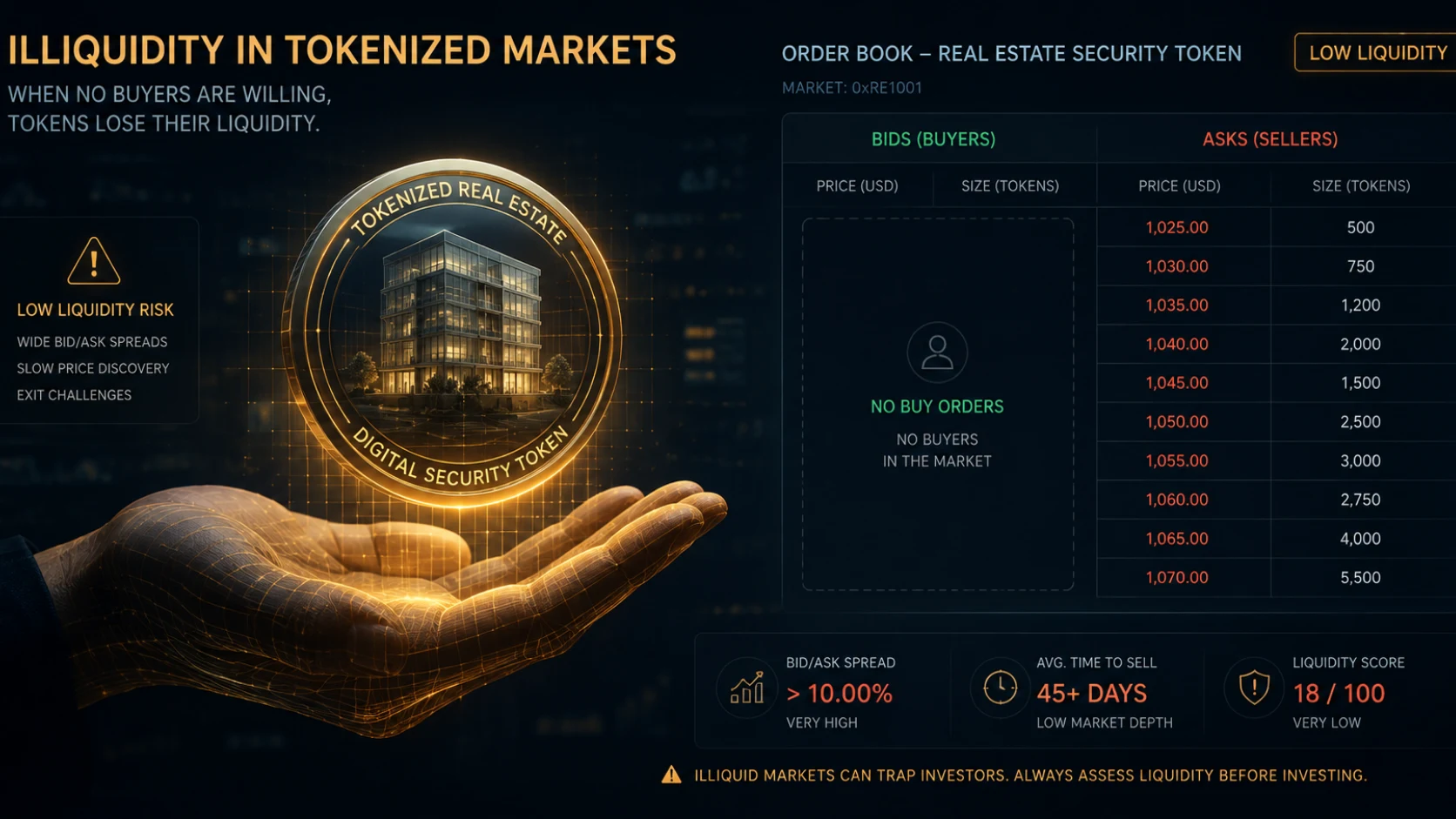
When you actually click “Sell” on a secondary market two years later, you discover your sell order sitting unfilled for six weeks. 400 other investors are trying to exit, and exactly two buyers are bidding 30% below net asset value.
Welcome to the tokenization liquidity myth.
Let us examine why this happens, why technology cannot solve an economic problem on its own, and how to avoid getting your capital trapped.
The Fundamental Confusion: Settlement Speed vs. Market Liquidity
The entire tokenization marketing machine relies on confusing two distinct concepts:
- Settlement Velocity: The technical time required to transfer an asset and clear payment once both parties agree on a price.
- Market Liquidity: The ease with which an asset can be converted into cash without causing a drastic collapse in its price.
Blockchain technology is extraordinary at settlement velocity. It turns a 3-day clearing nightmare into a 2-second atomic transaction. But blockchain has zero power over market liquidity. Software cannot force another human being to buy your asset.
If you own a physical painting by an unknown local artist hanging in your living room, it is illiquid because nobody wants to buy it. If you tokenize that painting into 1,000 digital tokens on Ethereum, you do not have a liquid asset. You simply have 1,000 illiquid tokens.
The Two Liquidity Models: Why T-Bills Work and Real Estate Struggles
To understand which tokenized products are genuinely liquid and which are traps, you must examine the mechanism used to cash out.
| Feature | Model A: Primary Mint-and-Redeem | Model B: Peer-to-Peer Secondary Market |
|---|---|---|
| How You Exit | You return the token to the issuing fund; the fund liquidates underlying reserves and sends you cash. | You list your token on an order book and wait for another investor to buy it from you. |
| Counterparty | The Fund Issuer (e.g., BlackRock, Ondo, Franklin Templeton). | A random secondary market participant. |
| Price Determination | Exact Net Asset Value (NAV) of underlying cash and government debt. | Negotiated bid/ask spread (frequently at steep discounts during panics). |
| Primary Examples | Tokenized US Treasuries (BUIDL, USDY), Stablecoins (USDC, USDT). | Tokenized Real Estate, Fine Art, Private Venture Capital. |
| Liquidity Quality | High (Backed by sovereign cash markets). | Very Low to Poor (Fragmented order books). |
Notice the difference.
When you invest in BlackRock’s BUIDL or Ondo USDY, you do not need to find another retail investor to buy your token. The fund manager holds short-term US sovereign debt that matures every few weeks. When you exit, the fund simply redeems your shares against its massive cash reserves.
With real estate or private equity, the fund cannot sell 1/500th of an office building on a Tuesday morning to pay you back. You are trapped waiting for someone on the internet to buy your specific token.
The 4 Hidden Walls Blocking Secondary Market Liquidity
Why have secondary markets for security tokens failed to generate massive trading volume so far? Four structural barriers prevent active trading:
1. KYC and Whitelist Fences
In cryptocurrency markets, anyone with an internet connection can buy Bitcoin or trade on Uniswap.
In regulated tokenized assets, smart contracts use permissioned compliance standards (such as ERC-3643 or ERC-1400). You cannot transfer the token to a friend unless their specific wallet address has already completed identity verification (KYC), anti-money laundering (AML) checks, and jurisdictional accreditation on that specific platform.
This shrinks the potential buyer pool from hundreds of millions of global crypto users to a few thousand pre-registered platform users.
2. Regulatory Lock-Up Mandates
Securities laws in major jurisdictions impose mandatory holding periods on private placements.
Under US SEC Regulation D rules, private security tokens cannot be resold to the general public for 12 months after initial issuance. Even if you want to sell your real estate token after three months, the smart contract code will programmatically freeze and reject your transfer transaction.
3. The Absence of Institutional Market Makers
Public stock exchanges work smoothly because dedicated market-making firms (like Citadel Securities or Jane Street) continuously quote both buy and sell prices for every stock, risking their own capital to ensure you can sell your shares at any second.
In bespoke tokenized real estate projects, no professional market makers are providing continuous two-sided liquidity. The order book is a ghost town.
4. Extreme Liquidity Fragmentation
Today, tokenized assets are split across dozens of disconnected blockchains (Ethereum, Polygon, Avalanche, Stellar, Solana) and separate Alternative Trading Systems (ATS). A buyer on one platform cannot see or purchase tokens listed on another.
When Will Real Secondary Liquidity Actually Arrive?
Secondary liquidity for alternative assets will not happen overnight. It requires three specific milestones to mature:
- Standardized Compliance Interoperability: Cross-chain standards that allow KYC-verified credentials to travel seamlessly between different exchanges and networks.
- Institutional Depository Participation: Traditional clearinghouses (like DTCC or Euroclear) connecting their multi-trillion-dollar institutional client bases directly to on-chain security tokens.
- Automated Market Maker (AMM) Liquidity Pools with Regulated Guardrails: Decentralized liquidity pools where issuers or institutional investors provide dedicated capital reserves to absorb sudden retail sell orders.
The 5-Point Investor Liquidity Checklist
Before committing capital to any real-world asset token, run through this five-point diagnostic:
1. Is there a primary redemption mechanism?
Can you redeem directly with the fund for cash at net asset value, or are you 100% dependent on finding a secondary buyer?
2. What is the mandatory lock-up period?
Check whether securities regulations require your tokens to be frozen for 6 to 12 months.
3. Where is the secondary market hosted?
Is the token listed on a regulated, active exchange (like an SEC-registered Alternative Trading System), or just an internal bulletin board on the startup’s website?
4. What is the actual average daily trading volume?
Ignore the total value of the real estate project. Look at how many dollars actually traded hands in the past 30 days.
5. What is the historical bid/ask discount?
Are sellers forced to accept a 15% to 30% discount below appraised property value just to exit?
Tokenization is a powerful tool for modernizing record-keeping, automating dividend distributions, and cutting administrative paperwork.
Yet it is not financial alchemy.
Putting an illiquid asset on a distributed ledger makes it easier to transfer once a buyer is found. It does not create the buyer.
If you invest in tokenized sovereign debt and cash equivalents, you will enjoy genuine 24/7 liquidity. But if you invest in tokenized real estate, private credit, or art, treat it exactly as you would an offline private investment: money you can afford to lock away for years.
The Real Numbers: What Secondary Markets Look Like in Practice
RealT, one of the earliest platforms to tokenize US residential rental properties (operating since 2019), provides the most transparent data available on secondary market reality.
As of mid-2026, RealT operates an internal secondary marketplace called RealT Market. Properties with strong rental yield histories and well-located assets in cities like Detroit and Cleveland typically show active secondary markets with 10 to 30 buyers competing at or near assessed value.
But lower-performing properties in harder-to-rent markets show a very different picture. Sellers on those tokens routinely discount 12% to 25% below the platform’s own property appraisal to attract any buyer. Average time on market before a fill: 6 to 14 weeks.
Lofty.ai, which focuses on lower-priced US residential properties tokenized as Al Tokens on the Algorand blockchain, reports total secondary market trading volume of approximately $2.1 million per month across its entire portfolio as of Q1 2026. Spread across hundreds of listed properties, that is roughly $8,000 to $12,000 of trading volume per property per month. For a retail investor holding $5,000 in one property token, the wait to exit can stretch to weeks or months.
The contrast with tokenized T-bills is sharp. BlackRock’s BUIDL processed over $1.5 billion in daily mint-and-redeem volume in January 2026. Ondo Finance’s USDY reported zero failed redemption requests in 18 months of operation. That is what genuine liquidity looks like.
The structural lesson connects directly to what you actually own in each token type. T-bills are in institutional custodian accounts that can convert to cash in hours. A residential property in Detroit takes 30 to 90 days to sell even under ideal market conditions. The blockchain cannot compress that physical reality.
Frequently Asked Questions
This article is part of a complete educational series on real-world asset tokenization:
- What Is Asset Tokenization? The Real Explanation (2026)
- How Financial Markets Evolved: From Paper to ETFs to Tokens
- What Does a Token Actually Own? SPVs and Legal Wrappers
- Stablecoins vs. Tokenized Deposits vs. Digital Rupee
- Tokenized US Treasuries: On-Chain Yield Guide
- Tokenization in India 2026: SEBI, RBI and the New Law
- The Real Risks of Tokenized Assets Nobody Talks About