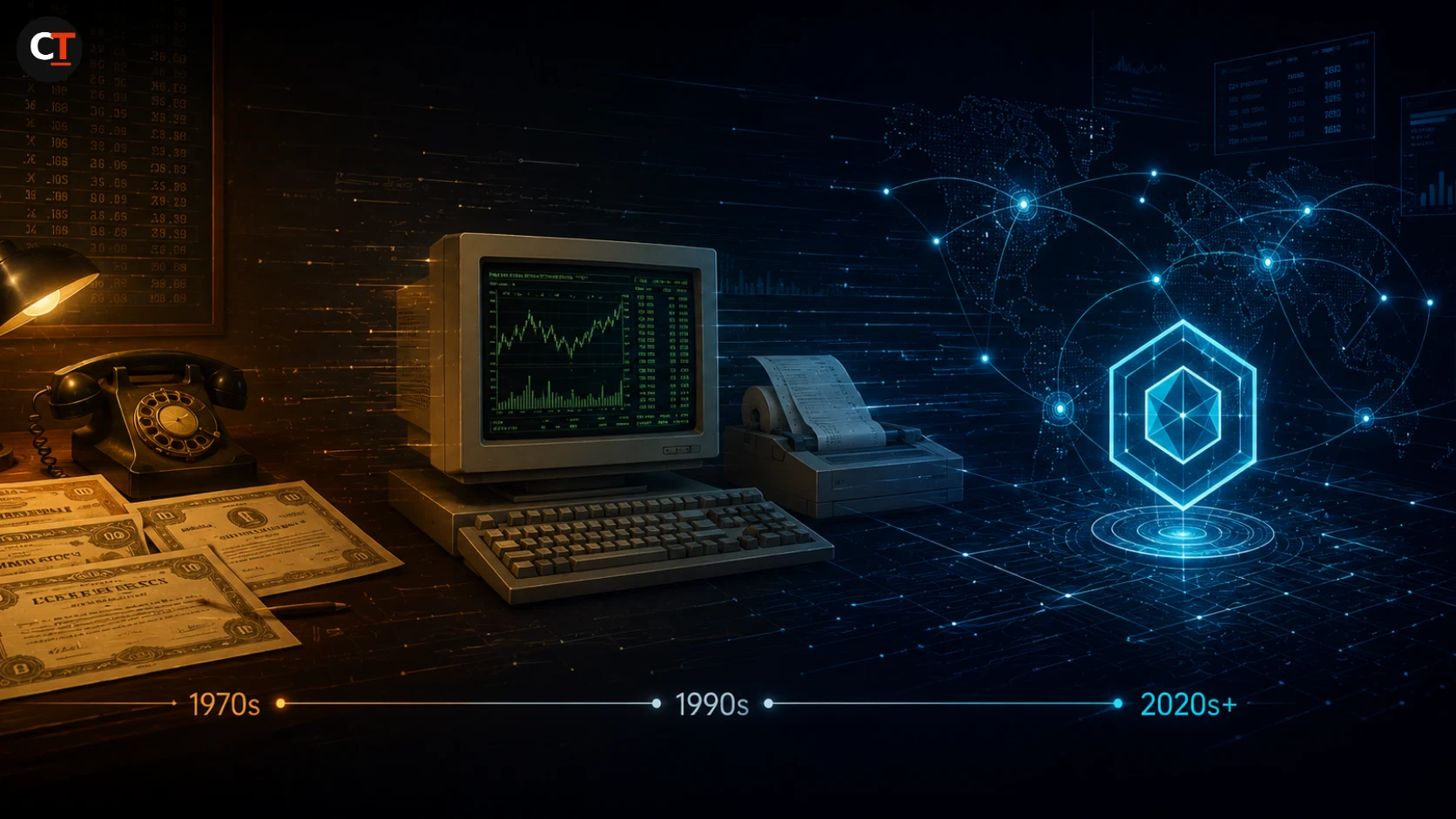
Most investors treat tokenization as an overnight crypto experiment. In reality, it is the fifth logical chapter in a 50-year campaign to eliminate friction from global capital.
Key Takeaways
- Finance is an information business: Every major market leap over five decades solved a data transmission and record-keeping bottleneck.
- The ETF was a technology: Just as mutual funds and ETFs modernized market access in past decades, the digital token is simply the next vehicle wrapper.
- The internet in 1996 analogy: Tokenized real-world assets are early, but growing at over 300% across sovereign debt, credit, and cash equivalents.
If you ask an investor what has changed most about finance over the past 50 years, they will usually point to the assets themselves.
They will talk about tech equities, venture capital, high-yield corporate credit, or crypto.
Yet the most radical changes in financial history were never about what people bought. They were about the plumbing: how ownership was recorded, how money moved, and how long a buyer had to wait before a trade was finalized.
When you place an order on your smartphone today, you are the beneficiary of four previous infrastructure revolutions.
To understand why asset tokenization is dominating boardroom discussions at firms managing trillions in capital, you have to understand the 50-year arc that led here.
When Money Moved at the Speed of Mail
In the mid-1970s, global finance was a physical logistics business.
When a fund manager in New York wanted to purchase government bonds from a dealer, the deal was struck over the telephone. Clerks wrote trade details on paper tickets.
Settlement did not happen when the phone call ended. It happened days later, when messengers carrying leather bags walked physical paper certificates through city streets to bank vaults.
The system had obvious limits. Physical paper can be lost, stolen, or forged. If trading volume surged unexpectedly, clearinghouses suffered certificate backlogs that forced exchanges to close early on Wednesdays simply to let clerks catch up on filing paperwork.
The entire machine was slow, expensive, and fragile.
Act II (1977 to 1985): SWIFT and the Electronic Ledger
The first major acceleration arrived in 1977 with the launch of the Society for Worldwide Interbank Financial Telecommunication, known everywhere today as SWIFT.
Before SWIFT, international bank transfers relied on Telex messages: slow, unstandardized, and vulnerable to human misinterpretation. SWIFT introduced standardized digital messaging codes.
Suddenly, an instruction to send funds between London and New York did not take days of postal coordination. It arrived in minutes.
During the same window, stock markets began building centralized depositories. Instead of moving physical paper certificates for every trade, banks deposited their shares in a central trust (such as the DTCC in the United States, or later CDSL and NSDL in India).
Ownership became a set of book-entry adjustments on centralized computer databases. That single change cut settlement times from weeks to five business days (T+5), then three days (T+3).
Act III (1990s): The Mutual Fund and ETF as Access Technologies
We often forget that financial products are themselves forms of technology.
In an interview on BlackRock’s The Bid podcast, Chief Operating Officer Rob Goldstein pointed out a fundamental truth: the mutual fund was a technology, and the exchange-traded fund (ETF) was a technology.
In capital markets, a technology is any structural innovation that reduces friction, aggregates liquidity, and makes market access faster, cheaper, and safer for investors.
Consider what the mutual fund achieved. Before mutual funds gained mass adoption, an individual wanting a diversified basket of 50 companies had to research, buy, and manage 50 separate stock certificates. The mutual fund bundled those assets into a single pooled vehicle.
Then came the ETF in 1993.
The ETF took the mutual fund’s pooled diversification and added intraday exchange trading. Investors no longer had to wait for end-of-day NAV calculations. They could buy and sell entire stock indexes or bond baskets in a single second on an exchange screen.
Bond ETFs did the same for fixed income, connecting opaque over-the-counter dealer markets with public stock exchanges. Emerging market ETFs bundled equities across 20 countries into one tradable ticker.
Each step lowered the cost of entry and brought millions of new participants into the capital markets.
The 50-Year Arc: From Couriers to Code
| Era | Dominant Format | Settlement Speed | Core Limitation |
|---|---|---|---|
| 1970s | Physical paper certificates & telephone tickets | T+5 to T+14 (courier delivery) | Physical loss, human error, geographic constraints |
| 1980s | SWIFT messaging & centralized depositories | T+5 / T+3 | Fragmented bank databases, high wire fees |
| 1990s–2000s | Mutual funds & electronic brokerage screens | T+3 / T+2 | End-of-day pricing, regional market hour limits |
| 2010s–2020s | ETFs & mobile trading applications | T+1 | Disconnected back-end clearing, manual private markets |
| 2026+ | Tokenized digital assets on shared ledgers | T+0 (Instantaneous) | Early liquidity depth, cross-border regulatory harmonization |
The Problem That Still Exists in 2026
Looking at that timeline, you might wonder: if trades already execute in milliseconds on mobile apps, why do we need another revolution?
Because your screen is deceiving you.
When you click “Buy” on an investment platform, the front-end application updates instantly. But behind the scenes, a maze of intermediaries (executing brokers, clearing corporations, custodians, transfer agents, and central depositories) must spend 24 hours reconciling their separate, disconnected databases to settle the trade.
In private markets, the situation is far worse.
Private equity, commercial real estate, corporate loans, and infrastructure debt still operate much as public markets did in the 1980s. They run on PDF documents, scanned signatures, manual bank wires, and bespoke spreadsheets.
Because these processes are manual, managing a private investment fund with 50,000 small retail investors is an operational nightmare. Funds protect themselves by demanding $1 million minimum investments, locking everyday savers out of high-yield private assets.
Enter the Token: What the New Wrapper Solves
Just as the ETF took the mutual fund and made it tradable on an exchange, the token takes financial assets and places them on a synchronized, programmable ledger.
This introduces three structural upgrades:
1. Single Shared Source of Truth:
Instead of five institutions reconciling five different database versions of who owns what, every participant references a single cryptographic record on the blockchain. Reconciliation friction vanishes.
2. Atomic Settlement:
Payment and asset transfer happen simultaneously in one self-executing code block. If the digital dollar payment fails, the token does not transfer. Counterparty risk drops to near zero.
3. Built-In Compliance:
Transfer restrictions, investor accreditation checks, and dividend distributions are written directly into the token’s smart contract code. The asset enforces its own regulatory rules automatically.
Act III-B (2000s to 2015): India’s Own Digitization Leap
While Wall Street built electronic dark pools and algorithmic order books after 2000, India was running a parallel and arguably more dramatic digitization story.
The National Stock Exchange (NSE) went fully electronic in 1994, just one year after its founding. By 2000, it had displaced the Bombay Stock Exchange (BSE) as the dominant venue for equity trading volume. Settlement moved from T+5 (five business days) to T+3 in 2002, and then to T+2 by 2003.
The Central Depository Services Ltd (CDSL) and National Securities Depository Ltd (NSDL) converted tens of millions of physical share certificates into dematerialized electronic records stored in centralized digital vaults. By 2010, virtually all Indian equity trading operated through Demat accounts.
The result was dramatic. Transaction costs for an average retail investor fell by over 80% between 1994 and 2010. The number of retail brokerage accounts in India grew from under 2 million in 1995 to over 30 million by 2015.
This Indian story matters in the tokenization context because it proves the thesis: every time market infrastructure digitized and lowered friction, a new wave of participants flooded in. Tokenization is the same pattern applied to a new layer of capital.
Act IV (2007 to 2020): Algorithmic Trading and the Limits of Speed
The Financial Information eXchange protocol (FIX), introduced in 1992 for standardized electronic trading messages, accelerated through the 2000s. High-frequency trading firms built co-location data centers within meters of exchange matching engines, cutting round-trip trade execution from milliseconds to microseconds.
By 2010, over 70% of US equity trading volume originated from algorithmic strategies. The front-end of capital markets was now moving at machine speed. Transactions confirmed in 50 microseconds.
Yet even as execution grew faster, post-trade settlement kept its multi-day schedule. A trade that executed in 50 microseconds still took 2 full business days to legally change hands between custodians. This growing contradiction between execution speed and settlement latency created the core problem that tokenization is now solving.
The “Internet in 1996” Analogy
In their op-ed for The Economist, Larry Fink and Rob Goldstein offered a perspective on where tokenization sits today:
Tokenization in 2026 is roughly where the commercial internet was in 1996. That was the year Amazon had generated just $16 million in book sales, and three of today’s Magnificent Seven tech giants had not even been founded.
Tokenized traditional assets currently represent a tiny fraction of global capital markets. Yet the early data demonstrates momentum:
- Tokens representing real-world financial assets have expanded by roughly 300% over the past 20 months.
- Over $15 billion in sovereign government debt is now active on public and private blockchains.
- Over $300 billion in stablecoins acts as the digital cash settlement layer for global trade.
- Nearly three-quarters of digital asset holders live in developing economies (Asia, Latin America, Africa), where traditional banking access has historically been slow or inaccessible.
Why Traditional Finance Is Collaborating, Not Fighting
Five to seven years ago, the dominant crypto narrative was adversarial. Early enthusiasts proclaimed that decentralized networks would destroy Wall Street banks and render traditional financial institutions obsolete.
That rhetoric has shifted entirely.
Today, the prevailing strategy is a bridging model. Traditional institutions bring massive capital reserves, trusted regulatory compliance, and distribution scale. Blockchain networks bring speed, programmability, and 24/7 global accessibility.
Neither side is replacing the other. They are learning to interoperate.
When an investor buys BlackRock’s BUIDL tokenized fund on Ethereum or Franklin Templeton’s FOBXX fund on Stellar, they are not abandoning traditional finance for crypto speculation. They are using traditional asset managers through modern digital pipes.
What This Means for Everyday Investors
You do not need to become a cryptography expert to benefit from this transition.
When you tap your phone to pay for groceries using UPI or Apple Pay, you do not think about the underlying network protocols, routing switches, or clearinghouse messaging specs. You only care that the transaction is fast, cheap, and reliable.
Tokenization will follow the same path.
Over the coming decade, as capital markets complete this transition from paper to spreadsheets to tokens, your investment accounts will become simpler, faster, and more global.
The plumbing of wealth is catching up with the speed of the modern world. That is not crypto speculation. That is just the obvious arc of financial history.
This article is part of a complete educational series on real-world asset tokenization:
- What Is Asset Tokenization? The Real Explanation (2026)
- What Does a Token Actually Own? SPVs and Legal Wrappers
- Stablecoins vs. Tokenized Deposits vs. Digital Rupee
- Tokenized US Treasuries: On-Chain Yield Guide
- The Tokenization Liquidity Myth
- Tokenization in India 2026: SEBI, RBI and the New Law
- The Real Risks of Tokenized Assets Nobody Talks About